








 Watch Full Show


What will it take to bring an end to the fossil fuel era? We speak to Kumi Naidoo, the president of the Fossil Fuel Treaty Initiative, which aims to reach a binding agreement for a global transition away from fossil fuels. Currently backed by over 25 countries from the Global South, the intergovernmental process began earlier this year in Santa Marta, Colombia. Meanwhile, at the United Nations, “for 30 years of negotiations, we don’t have any mention of fossil fuels [in the outcome document]. That’s like Alcoholics Anonymous holding 30 years of conferences and not mentioning alcohol,” says Naidoo. We discuss the Fossil Fuel Treaty Initiative’s goals, how the oil and gas industry drives global conflict, and the Trump administration’s glaring absence from international action on climate change.
Related Story
 Web ExclusiveNov 17, 2026Electrification Must Be Powered by Renewables to Reduce Fossil Fuel Use: Oil Change International
Transcript
AMY GOODMAN: We’re broadcasting from Antalya, Turkey, at the global U.N. climate summit, known as COP31. There are just four days remaining for nearly 200 countries to come to some agreement on the next steps to tackle climate change.
On Monday, negotiators published a wide-ranging 18-page draft document that’s been characterized as a shopping list of language and issues to be debated ahead of a Friday deadline for a final agreement. This is the global policy lead for Oil Change International.
ROMAIN IOUALALEN: So, I think this is a text that was designed to basically please everyone, and they took, you know, the best, the most ambitious demands from each group and put it in there. Obviously, throughout this week, what we’re going to see is a game of massacre in the negotiations. We’re going to see a lot of these — a lot of these recommendations or this language going to be cut by parties that don’t agree with any of this. And so, as the president of negotiations, Chris Bowen, just said, the text that we’re going to end up with is going to look very different.
AMY GOODMAN: Agreements here at COP are made by consensus, meaning every country essentially has veto power over the final text. Rich countries and fossil fuel-producing countries have historically thwarted the most ambitious climate goals.
These negotiations, of course, are happening as the Iran war has also drawn global attention to the world’s dependence on fossil fuels. So, what will it take to bring an end to the fossil fuel era? A bloc of nearly 30 countries from the Global South have started a parallel process that’s aiming for a binding agreement to transition away from fossil fuels — a fossil fuel treaty. The first official conference on transitioning away from fossil fuels was held in Santa Marta, Colombia, earlier this year. Nearly 60 countries attended. A follow-up conference is scheduled to take place next year in Tuvalu.
To talk more about what can be achieved at this U.N. climate summit and what makes the process that began in Santa Marta different, we’re joined here in Turkey by Kumi Naidoo, longtime climate justice activist from South Africa, president of the Fossil Fuel Treaty Initiative.
It’s nice to have you back, to see you again, Kumi. Let’s talk about what’s happened so far at this climate summit. In a moment, we’re going to be talking to the former ambassador from Nepal. They just suffered a calamitous glacier melting that led to at least 7,000 people dead and missing. That’s just one example of thousands. What has to happen here? And what is happening?
KUMI NAIDOO: We need to get serious about addressing the root cause of climate change. Eighty-six percent of what’s driving the crisis is our addiction and dependency on oil, coal and gas, what we call fossil fuels. The difficulty we have is that for 30 years of negotiations, we don’t have any mention of fossil fuels. That’s like Alcoholics Anonymous holding 30 years of conferences and not mentioning alcohol in the outcome document.
Now, there are important things that we are pushing here on to get clarity on what a just transition would look like, trying to get resources to go in the Loss and Damage Fund and so on. But what is patently clear right now is we need a parallel process, one that will lead us to a binding agreement. So, what we’ve achieved in April through the Santa Marta conference is a parallel process that’s linked to the COP, right? And that is one way we hope we can grow the number of countries that are serious about fossil fuel phaseout. The good thing is the momentum is there.
We are not seeing here, still, enough movement on finance. Because let’s be very clear: You cannot tell poor countries in the Global South, who are carrying a lot of debt to the Global North, that they must stop producing fossil fuels, when rich countries continue to expand their fossil fuel production. The important thing is, any new, fresh investment, knowing what we know, knowing that every region, just not Nepal — every region in the world this year has experienced loss of life, serious events and so on. So we don’t even need the science anymore to tell us that we are in a deep crisis. And so far, I have to say, we are not seeing the urgency here, either on providing finance or on addressing the need to start phasing out fossil fuels.
AMY GOODMAN: It’s the largest U.N. climate summit here, I mean, something like 90,000 people. What’s the percentage of fossil fuel lobbyists and fossil fuel representatives in different governments? But also, there are many, many people deeply committed to dealing with climate change. Explain how it all happens and the terms that are like another language to the rest of the world, when you say, I mean, even “climate justice,” what that means. But here, it’s “climate finance.” It’s words like “ambition.” What do these mean?
KUMI NAIDOO: OK, on ambition, the science has told us that we have to keep warming below 1.5 degrees. We are already pushing towards that. That means from the time that we started burning fossil fuels, we cannot have a collective temperature rise beyond that. So, ambition means we need to take the actions to keep us within that threshold.
In terms of finance, what we are saying is that if we are saying to poor countries, “Leave the oil in the ground. Leave the coal in the ground. Leave the gas underneath the ground,” then they are willing to do that. But they’re saying, “Well, you built your economies in the rich countries on the basis of exploiting all those resources. So, you help us now to actually finance the new energies transition.”
And let’s be very clear: Today, Donald Trump actually has become the accidental advocate for the phaseout of fossil fuels. The U.S.-Iran illegal, unjustified war — and let’s be very blunt: There was no nuclear weapons. His own national intelligence adviser said there wasn’t and resigned. This is a war which we in the Global South call the Epstein war. This was a distraction from other crises that he had. But what it’s done is that so many countries, rich and poor countries, have said we have to now move to actually start building renewable energies. And we’re seeing a scale-up, because, clearly, it doesn’t make sense for us to continue to do that.
The one important point is, we have to recognize that fossil fuels is not only bad for the climate. Fossil fuels has been the major driver of war and conflict. The Harvard study says 7 million people are dying yearly now from carbon pollution, so it’s a negative health impact. And as we’ve seen in the United States when Trump convened the CEOs of the fossil fuel companies before the elections, we are seeing that the fossil fuel companies everywhere around the world are actually undermining democracy.
So, basically, the fight to restrict the power of the fossil fuel industry and put them out of business as fast as possible — we’re not thinking it will be done overnight, but we have to do it on the fastest possible timeline, in a fair way, and in which we are able to support and fund those countries who are saying, “Don’t exploit it for short-term profit, for long-term disaster. And stop playing political poker with the future of our children and the future of our planet.”
AMY GOODMAN: Explain Santa Marta. What happened in Colombia? What is the fossil fuel treaty?
KUMI NAIDOO: So, firstly, the fossil fuel treaty does not exist. It’s a Fossil Fuel Treaty Initiative, right? You remember, Amy, in Copenhagen, what we were asking for: a FAB deal — not a fabulous deal, a “fair, ambitious and binding” deal.
AMY GOODMAN: This was 2009.
KUMI NAIDOO: '09, right? And the binding deal has never happened. And so, what we are saying is that unless we can move in the direction, like on nuclear weapons, where we moved to a Nuclear Nonproliferation Treaty — not perfect. The rich countries still, you know, ignore it, as we know. If we don't have something equivalent — so, in Santa Marta, we got about 57 countries coming together saying, “We are serious about phasing out fossil fuel,” because here, there isn’t a conversation about fossil fuel phaseout, even though it’s 86%. It’s ridiculous, right? And so, what Santa Marta has given us is a parallel and connected process to the COP where we are focusing on what would it take to actually do the phaseout on the fastest possible timeline.
AMY GOODMAN: The right-wing president of Colombia has pulled Colombia out of the Santa Marta treaty initiative, which was accomplished under former president —
KUMI NAIDOO: President Petro.
AMY GOODMAN: — ironically, his name, Petro.
KUMI NAIDOO: Yeah. Listen, one country making a move is not going to be the end of the process. The important thing is, people forget, it’s not just the 57 countries that went to Santa Marta, though that gave momentum to the U.N. General Assembly having a vote a few weeks later, where the International Court of Justice advisory opinion said countries needed to phase out fossil fuels and governments had a moral and legal responsibility to attack. A hundred and forty-one countries voted to support that, and by the way, the 11 countries that voted against it included Iran and the U.S. They might be bombing the hell out of each other, but they’re united on fossil fuels.
AMY GOODMAN: I wanted to go back to another issue. In May of 2024, Turkey announced a total trade embargo on Israel. In his opening speech, the Turkish President Recep Tayyip Erdoğan described the suffering of the Palestinian people as, quote, “not only genocide, but also ecocide,” and called for a shift from “empty dialogue to direct implementation,” unquote. But a new report has revealed that despite Turkey’s declared trade embargo on Israel, at least 77 shipments of crude oil from the Turkish port of Ceyhan were delivered to Ashkelon in Israel as of June of this year. We were just at the People’s Climate Summit today, which is also taking place in another part of Antalya. You’ve also spoken there. A group of Turkish and global civil society activists demanded a stop to Turkish oil transfers to Israel. I had a chance to speak on Sunday with Joseph Griso from Energy Embargo for Palestine. Their new report, “Exposing Türkiye’s Secret Crude Oil Shipments to Israel.”
JOSEPH GRISO: My name is Joseph. I’m here as a representative of Energy Embargo for Palestine. And ourselves, along with the Palestinian Youth Movement and the Progressive International, have produced this landmark report, which really clearly details the role that Türkiye is playing, specifically the port of Ceyhan in the south of Turkey is playing, in secretly delivering crude oil to the state of Israel.
AMY GOODMAN: So, the report is called “Exposing Türkiye’s Secret Crude Oil Shipments to Israel.”
JOSEPH GRISO: Yes.
AMY GOODMAN: Explain what you have found out.
JOSEPH GRISO: So, there is a key oil infrastructure pipeline, the Baku-Tbilisi-Ceyhan pipeline, the BTC pipeline, and that is responsible for over 40% of the crude oil that Israel receives. This is crude oil that is, of course, refined in Israel and converted into oil products that are capable of — that play a key, integral role in sustaining the the military operations that have been responsible for the genocide in Gaza.
AMY GOODMAN: And how did you get the information?
JOSEPH GRISO: So, in May 2024, Türkiye announced its trade embargo. But what we were seeing through our analysis of shipping data, as well as our analysis of satellite images, is that the oil trade, very specifically transfers of oil from Ceyhan to Ashkelon port in Israel, have continued. And our report clearly details 77 specific oil shipments that have continued since May 2024 up to June 2026 to show that this is a constant, this is a secret and systematic trade pattern that is continuing to uphold Israel’s ability to carry out the genocide. And so, we’re calling for the Turkish government to halt these oil supplies, this oil route. And we’re calling really specifically for them to look at the two Greek shipping companies which are responsible, along with BP and SOCAR, the owners of the pipeline, to stop this oil trade and to implement sanctions, as well as legal processes, to uphold their trade embargo.
AMY GOODMAN: So, that’s Joseph Griso from Energy Embargo for Palestine. Their new report, “Exposing Türkiye’s Secret Crude Oil Shipments to Israel.” And before we end, Kumi Naidoo, since you are from South Africa and South Africa has brought Israel to the International Court of Justice around the issue of genocide and war crimes, your thoughts on what they’re talking about? And this also goes to the issue of fossil fuels fueling war and violence.
KUMI NAIDOO: I’d just like to remind people about what Nelson Mandela said. He told us, as South Africans, we will never be free until the Palestinian people are free. And that action that was brought at the International Court of Justice, which has said that probably there’s a genocide — but let’s be very clear: Amnesty, including the two main human rights organizations within Israel, have declared it a genocide. You know, most of the American people can see it’s genocide, and that, we understand, played a role in the midterm elections.
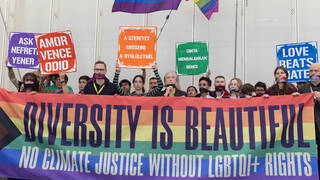
And to President Erdoğan, I would make an appeal to him: Please be consistent. You say the right things on Palestine, but to continue to fuel the genocide by giving them war takes away the legitimacy of what you are saying. But more so, we have to say to President Erdoğan, as well, that you must release the political prisoners, who are in the thousands in Turkish prisons. They include politicians. They include writers, journalists and so on. And it’s also important that we note that just as this happens, on the eve of it, the LGBTI community has been attacked on a massive basis here. And what we need to understand is the climate justice issue and social justice issues are absolutely connected.
And as a South African and somebody who fought for human rights, we feel that right now the United States, under President Trump, is not only undermining the climate agenda; they are setting back us on democracy. They’re setting back us on human rights. And actually, today, the United States, under Trump, has become, without any doubt, a net negative source in the world. And we hope that the American people, who are rising up through the midterms and so on, continue to stand in partnership.
The important thing, I would say, is, which you mentioned, three states in the U.S., their legislatures have passed formal resolutions endorsing the idea of a fossil fuel treaty: California, Hawaii and Maine. And in addition to that, about 40 United States cities, from Philadelphia to San Francisco to Pittsburgh, have all endorsed it. So, the people of the U.S. are saying they want to be part of the global effort to phase out fossil fuels, to get a binding agreement. And what we would say to the American people, your brothers and sisters around the world are ready to embrace you, and we do not see American people as what the Trump administration represents to the world today.
AMY GOODMAN: And we are going to talk about the U.S. in just one minute, but I wanted to extend our condolences on the death of Desmond D’Sa, the South African anti-pollution campaigner who died in a car accident.
KUMI NAIDOO: Desmond D’Sa was an inspiration to all of us. I was at his funeral and memorial service. And Bobby Peek, who you might also have known, here, who worked with him. It’s a devastation. But what’s so beautiful about his life is that he was a working-class person. He got the biggest Goldman Prize of Environment. He never changed. He lived a working-class life, lived close to the people. And what I saw in the U.S. midterm elections, I saw many Desmond D’Sas emerge. And I hope that the mainstream of the Democratic Party will allow those voices to actually become more prominent, because the world needs those kinds of voices in the leadership of the United States.
AMY GOODMAN: Let’s not forget Desmond D’Sa’s last name is spelled D-S-A. Kumi Naidoo, longtime human rights and climate justice activist from South Africa, president of the Fossil Fuel Treaty Initiative.
Coming up, while the Trump administration has pulled out of the U.N. climate summit, a number of U.S. mayors and governors came here. Many more are pledging to address the climate crisis at the state and local level. California Governor Gavin Newsom was one who came here and said he’s 100% behind a fossil fuel phaseout. We’ll speak with journalist Mark Hertsgaard. Stay with us.
[break]
AMY GOODMAN: Mirvari Dance Ensemble performing “Holiday Suite” during the Climate Week summit in September.



 Top
Media Options