








 Watch Full Show

Topics
Guests
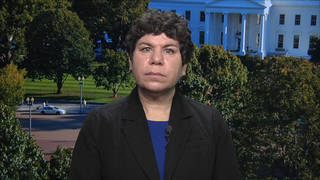
- Vali Nasrprofessor of international affairs and Middle East studies at Johns Hopkins School of Advanced International Studies.
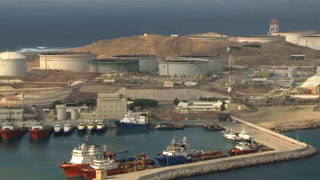
The Strait of Hormuz is closed to shipping traffic after Iran once again shut off access to the key waterway over the weekend in retaliation for the ongoing U.S. blockade on Iranian ports. This comes as the U.S. Navy intercepted and seized an Iranian-flagged cargo ship in the Sea of Oman on Sunday. Iran said the seizure violated the ceasefire reached earlier this month. Despite the escalation, President Trump announced a U.S. delegation is heading to Pakistan for a new round of peace talks. Iran’s Foreign Ministry says Tehran has “no plans” to participate.
There has been a “gradual escalation” in hostilities between the U.S. and Iran since the last round of talks in Islamabad, says Iranian American analyst Vali Nasr, professor at the Johns Hopkins School of Advanced International Studies. Iran’s leadership is “suspicious that President Trump was really using the talks in Pakistan as a cover for renewing war on Iran and that he was not serious about diplomacy.”
Related Story
 StoryApr 29, 2026“Political Disaster for Donald Trump”: Jeremy Scahill on Stalled U.S.-Iran Talks
Transcript
AMY GOODMAN: Hopes for an end to the U.S. and Israeli war on Iran have dimmed after another dramatic weekend. On Sunday, the U.S. struck and then seized an Iranian-flagged cargo ship. Iran has vowed to retaliate. This marks the first time the U.S. has seized an Iranian ship since President Trump announced a naval blockade of all maritime traffic entering and exiting Iranian ports. On Friday, Iran announced it would reopen the Strait of Hormuz, but then reversed course after the U.S. refused to lift its blockade.
Meanwhile, the U.S.-Iran ceasefire is set to expire Wednesday, and the two sides have yet to agree to hold another round of talks. On Sunday, President Trump said a U.S. delegation is heading to Pakistan for possible talks. The delegation will reportedly include Vice President JD Vance, envoy Steve Witkoff and Trump’s son-in-law, Jared Kushner. But Iran says it has no plans — no plans to engage in a second round of talks. Iran’s Foreign Ministry spokesperson spoke earlier this morning.
ESMAIL BAGHAEI: [translated] As of now, as I am speaking to you, we have no plan for the next round of negotiations. No decision has been taken in this regard.
AMY GOODMAN: On Saturday, President Trump told a reporter at Fox News, quote, “If Iran does not sign this deal, the whole country is getting blown up,” unquote. In a post on social media, Trump also threatened again to, quote, “knock out every single Power Plant, and every single Bridge, in Iran,” unquote. UNQUOTE, if Iran doesn’t agree to a deal. Trump’s threats come less than two weeks after he warned, “A whole civilization will die tonight, never to be brought back again,” unquote.
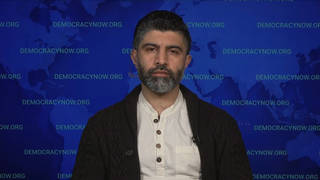
We begin today’s show with Vali Nasr, Iranian American professor of international affairs and Middle East studies at Johns Hopkins School of Advanced International Studies. He’s the author of Iran’s Grand Strategy: A Political History. His piece for the Financial Times is headlined “Iran is playing a long game.”
Professor Nasr, thanks for joining us again. If you can explain and respond to the latest news of the U.S. occupying the Iranian ship and the Strait of Hormuz closed again?
VALI NASR: What we have been witnessing since the end of the last round of talks in Islamabad is actually a gradual escalation between U.S. and Iran. Initially, things looked good. The United States pushed for a ceasefire in Lebanon. Iran announced that the Strait of Hormuz would be open to all commercial shipping. But then President Trump came out and said that, no, his blockade would stay put, and he was going to fully enforce it. And then he issued a series of tweets and posts in which he claimed that Iran had already agreed to give up all of its nuclear program, even before there was an agreement or a second round of talks, insinuating that Iran was essentially surrendering to his demands.
That changed the mood in Tehran. Iranians grew very angry that the president was insinuating that they had surrendered and there was an agreement where there wasn’t one. And they were suspicious that President Trump was really using the talks in Pakistan as a cover for renewing war on Iran and that he was not serious about diplomacy. And so they began to try to emphasize to their own population and to the world community that there was no agreement and that President Trump was not correct in what he was saying. They refuted these claims, and then they closed the Strait of Hormuz even more fully. And that has led to a series of attacks on ships, Iran on tankers and on cargo ships, and the United States on an Iranian ship. And that leaves us where we are. There are now a lot of people in Tehran who are saying, “There’s no point in going to Islamabad. The president is preparing for war, and Iran may as well do so.”
AMY GOODMAN: Who’s in charge, Professor Nasr, in Iran right now? Who is negotiating? Who do you think is the real force or forces behind the scenes?
VALI NASR: I think this is a — this is not a right way of looking at this. Iran has a leadership, has a supreme leader. Under supreme leader, there’s a series of people he’s appointed, or his senior advisers and senior security people. He has assigned and delegated the Iran speaker of the parliament to go and negotiate with President Trump. And ultimately, he’s the final decision-maker. And the leadership in Iran is cohesive. It’s, you know, well in charge, just as much as the American leadership is well in charge. I think this speculation about who’s in charge, who’s not, that Iran is divided, actually, is not correct.
What we’re seeing in Iran is that the Iranian leadership is reacting to what it’s seeing as erratic American messaging, that, on the one side, he wants to talk; on the other side, it is sending contradictory messages in the Gulf with the blockade, as well as also claiming things about the diplomatic process itself, which actually is creating confusion in Tehran.
AMY GOODMAN: Can you talk, though, specifically about Khamenei’s son, his relationship with the Iranian Republican Guard and how he is seen in Iran?
VALI NASR: Well, he was elected by the Council of Experts to succeed his father. That’s a controversial choice, because, supposedly, the father did not want a kind of a primogeniture in Iran, in other words, father — son replacing the father. But he was the choice during a war.
He has had tight relationship with the Revolutionary Guard going back decades. He fought with the Revolutionary Guard during the Iran-Iraq War in the 1980s. And since he has ascended to the top, he has appointed his key advisers from the Revolutionary Guards, his key allies, to the main positions, to lead the Revolutionary Guards, to serve in his special bureau. And he has had also a long-term relationship with the current speaker of the parliament, who is Iran’s chief negotiator.
So, what we’re seeing at the top is Mojtaba Khamenei’s team in place, and he ultimately is the final decision-maker, although we’ve heard that he also was gravely injured during the bombing that killed his father.
AMY GOODMAN: I want to go to Iran’s parliament speaker and chief negotiator, Mohammad Ghalibaf, emphasizing the need for a permanent peace on Saturday, describing Iran’s policy towards the U.S. as a commitment-for-commitment process, where the U.S. takes one step and Iran takes one.
MOHAMMAD GHALIBAF: [translated] Our policy is also step-by-step action, commitment for commitment. They take one step, we take one step. It should not be the case that we fulfill our commitments while they do not. We have tried to proceed by taking into account past experiences, despite the prevailing atmosphere of distrust. … The first essential point is that this peace must be durable and must include guarantees that this issue will not be repeated, neither by Israel nor the United States.
AMY GOODMAN: Iran’s chief negotiator added there were several key points on which the United States and Iran disagree.
MOHAMMAD GHALIBAF: [translated] There are currently several issues on which differences of opinion exist. They have certain views regarding the nuclear field and certain views regarding matters related to the Strait of Hormuz and similar issues. We remain firm on our own positions.
AMY GOODMAN: Professor Vali Nasr, your response?
VALI NASR: Well, I think Iran — what Iran really wants out of these negotiations is two fundamental things. One is that war would not be repeated — in other words, every six months they don’t end up in a war with America and Israel. And secondly, that there is real economic relief for Iran, that it hasn’t achieved and it really needs.
But I think what really separates Iran and the United States is not just that they disagree on certain things. It’s actually a gulf of trust. Iran thinks that it signed a nuclear deal in 2015; the United States took whatever Iran gave during that deal, did not genuinely reciprocate, and then left the deal. And then President Trump has negotiated with Iran twice and then bombed Iran in the middle of the negotiations.
So, when the speaker of the parliament says that we want a step-by-step process, he’s saying that, unlike the last time, we don’t want to give everything, and then the United States pocket those gains and then leaves the deal again, and, secondly, that Iran really does not trust that President Trump actually will implement the deal that he signs, that he would not leave the deal again. And exactly the kind of messaging the president has been sending the past week since the first round of the talks has escalated this distrust in Iran.
So, what he was doing was really explaining to the Iranian public and also messaging to Washington that the United States has to work on the trust issue with Iran, that it has to actually commit to implementing a deal that it signs. If and when Iran and the United States agree on those fundamental differences, Iran also wants to make sure that the deal will stick and will actually be implemented.
AMY GOODMAN: On Saturday, President Trump told reporters the U.S. is taking a “tough stand” against Iran, but that conversations with Iran were “going very well.”
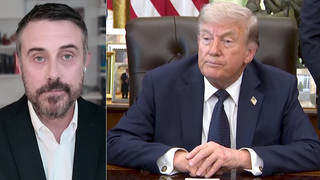
PRESIDENT DONALD TRUMP: We have very good conversations going on. It’s — it’s working out very well. They got a little cute, as they have been doing for 47 years. Nobody ever took them on. We took them on. They have no navy. They have no air force. They have no leaders. They have no nothing. Actually, their leaders are — it is regime change. You call that enforced regime change. But we’re talking to them. They wanted to close up the strait again, you know, as they’ve been doing for years. And they can’t blackmail us.
AMY GOODMAN: So, Professor Nasr, if you can respond to that and also what Trump told reporters? He said, “They’ve agreed to give us back the nuclear dust that’s way underground because of the attack we made with the B-2 bombers.” I don’t think this is a technical term, “nuclear dust,” but he has to somehow explain how he said that the U.S. had obliterated Iran’s nuclear material, and so, instead of calling it “material,” he’s calling it “dust.”
VALI NASR: Well, I mean, none of this is actually true, because Iran says there is no agreement about the fate of Iran’s highly enriched uranium. They have discussed it, but they didn’t arrive at an agreement. And secondly, the talks with Iran are actually not going well, as we see. The Iranians haven’t even agreed to come back to Islamabad and are actually — are not happy with the way U.S. did not reciprocate. For Iran saying that it will open the Strait of Hormuz, U.S., actually, its answer was that we will not lift the blockade, and we will enforce the blockade.
So, the president essentially is trying to put the best face on what is actually a deteriorating situation, that instead of the first round of talks creating momentum and greater trust between the two sides, very soon after, things have been falling apart. And the president is resorting to, on the one hand, claiming that Iran has agreed to everything, and, on the other hand, saying we’re going to attack them, and we’re going to destroy their power plants, and we’re going to force them to basically surrender to our demands. And so, Iran is also responding to this double-talk that’s coming from Washington.
AMY GOODMAN: I want to end by asking you also about this piece in The Wall Street Journal headlined “Behind Trump’s Public Bravado on the War, He Grapples with His Own Fears.” The piece reveals Trump shouted for hours at aides after a U.S. jet had been shot down in Iran earlier this month. The Journal reported, quote, “Aides kept the president out of the room as they got minute-by-minute updates because they believed his impatience” — they believed that his impatience — and it goes on from there. If you could respond to that? He said, “They believed his impatience wouldn’t be helpful, instead updating him at meaningful moments, a senior administration official said.”
VALI NASR: Well, I’m not surprised, because President Trump went into this war thinking it’s going to be only a war of one or two, three days, and he wasn’t expecting that the war would go on for 40 days, that it would prove so costly, it’s still indecisive, and that a U.S. jet would be shot down, the Strait of Hormuz would be closed, and the United States would be finding itself struggling to find a way to end this war and get what it wanted. President Trump’s playbook did not work out here.
And in fact, in the end, the United States did get its pilot out, but after a very harrowing several days of trying to find him, a shootout that ultimately got him out. But also, the Iranians claim that, actually, under the cover of the operation to get the pilot out, the United States did try to carry out an operation to recover the highly enriched uranium in the city of Isfahan, and that failed, and that’s the only reason why the United States agreed to go to Islamabad.
So, it’s very clear that the president is struggling to find a strategy that would actually bring this war to conclusion in a way that he could get the objectives for which he actually started the war. So, looking past all the rhetoric, the sort of blizzard of tweets he puts out, the threats, the talk of great conversations with Iranians, threatening them, etc., the fact remains that he started a war that he cannot easily end on terms that he can claim victory over.
AMY GOODMAN: Vali Nasr, I want to thank you for being with us, Iranian American professor of international affairs and Middle East studies at Johns Hopkins School of Advanced International Studies, SAIS. He’s the author of Iran’s Grand Strategy: A Political History.



 Top
Top
Media Options