










 Watch Full Show

In the wake of devastating flash floods triggered by glacial collapse in the Himalayas, Nepal is demanding climate reparations from polluter countries as it embarks upon the grueling process of rebuilding. Over 1,400 bodies have been recovered from the disaster, with around 6,000 others still missing. Nepal’s government estimates that the cost of infrastructure reconstruction is likely to exceed $4 billion. Nepal contributes less than 0.1% of global carbon emissions, yet as a mountainous country surrounded by glaciers, continues to be vulnerable to the effects of climate change. Recent studies estimate that global surface temperatures will likely exceed 1.5°C above preindustrial levels by the end of the decade.
We go to a rally outside of United Nations headquarters, where Nepali activists, including our guest Anisha Buda, are demanding climate justice, reparations and a just transition out of fossil fuels. Buda, a member of the region’s ethnic minority Kaike-speaking Magar community, says that almost 90% of the victims impacted by August’s flash flooding were part of Nepal’s Indigenous communities. “It is not just the lives of the people lost. It’s not just the houses swept, but it’s their culture, tradition and their very identity that is being lost by the floods, by the climate-induced disasters.”
Related Story
 StorySep 22, 2026Climate Activists Target AI Data Centers & Amazon’s Plan to Build Largest U.S. Gas Power Plant
Transcript
AMY GOODMAN: This is Democracy Now!, democracynow.org. I’m Amy Goodman, with Anjali Kamat.
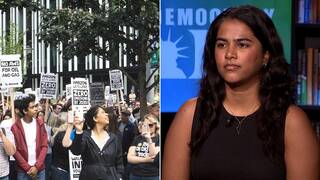
ANJALI KAMAT: While world leaders are meeting inside the United Nations for the General Assembly, it’s also Climate Week here in New York. Just outside the U.N., members of the Nepali diaspora and frontline communities from the Global South are rallying right now, along with environmental campaigners and others, to highlight the consequences of global inaction on climate change and to demand global emitters take responsibility for the cost of damages and immediately phase out fossil fuels.
Last month, 7 billion cubic feet of glacial rock and ice collapsed in the Himalayan mountains and crashed into the river valley below, triggering catastrophic flooding that wiped out entire villages. More than 8,000 people in Nepal and across the border in Tibet are dead or missing. Scientists say climate change contributed to the disaster. Nepal contributes less than .1% to global emissions.
AMY GOODMAN: For more, we go to the rally just outside the United Nations, I believe at Dag Hammarskjöld Plaza, where we’re joined by Anisha Buda, program officer at the National Indigenous Women Forum–Nepal, member of the Asia Pacific Network of Environmental Defenders.
If you can start off — thanks so much, Anisha, for being with us — by talking about — well, it’s been almost a year since Nepali young people protested in Nepal, ushering in a new prime minister, Balendra Shah. Can you talk about the significance of what he is calling for when he talks about climate justice and what Nepal needs right now after the melting of the glacier? There are thousands of glaciers in Nepal, this one resulting in the deaths of what could be up to 8,000 people. Can you hear us, Anisha?
ANISHA BUDA: Yeah, I can hear you now. I’m so sorry the connection left.
AMY GOODMAN: So, if you can tell us why you’re out there and the significance of your new prime minister, brought in by Gen Z, calling for climate justice, what this means?
ANISHA BUDA: Hi, it’s Anisha from Nepal. I’m here in New York for the Climate Week, and we are gathered here outside the U.N. to call for global solidarity. We are here as the Global South to hold the Global North accountable for their responsibility in more than 90% of the global emission of carbon, which is leading to global warming and climate change, which also resulted in one of the most devastating floods that happened in Nepal on 26th August.
And it’s important for our prime minister to be here. He is going to be speaking at the U.N. General Assembly tomorrow, and we’re really excited and looking forward to that. So, it’s important for our prime minister to be here, because Nepal is facing the brunt of the climate change that the Global North — that the Global North are doing. So, he is here to demand climate justice and also to ask the international fund for loss and damage of $20 million, which is not — which is nothing compared to the estimation of around $2 billion that the devastating flood has occurred and done in Nepal. So, it’s really important for our new prime minister to be here, and also for us Indigenous peoples, Indigenous organizations’ representatives to be here to speak up and to say that we are the victims, and we are not here to be quiet, and we are here to demand climate justice and climate reparations and also to demand just transition.
ANJALI KAMAT: Anisha, Nepal is responsible for less than 0.1% of global emissions. Talk about the impact of climate change on people in Nepal, the disproportionate impact, and especially on Indigenous communities.
ANISHA BUDA: I think the climate change impact disaster each year has been worsening. In 2024, there was a huge flooding that swept away so many households in Roshi, the Roshi River flooding. And now in 2026, it’s one of the most devastating floodings that we have seen, with over 8,000 people dead or missing.
So, it’s — so, like we said, Nepal contributes to only 0.1% of the global carbon emission, which is almost zero compared to the Global North, and which is why it’s so important for us to come here and to raise our voices against it, because Nepal, topographically and geographically, it’s a mountainous country, which is why it is vulnerable to the glacial outbursts. And this is not the last of the glacier outbursts that we will see. And Nepal will keep seeing disasters like this.
And the victims that are impacted are Indigenous communities. Almost 90% of the victims that were impacted by the flooding on 26th August are Indigenous, are Tamang Indigenous communities. Our organization, National Indigenous Women’s Forum, went there. We visited the community. And what we, as Indigenous organization, understand, that it is not just the lives of the people lost. It’s not just the houses swept, but it’s their culture, tradition and their very identity that is being lost by the floods, by the climate-induced disasters.
AMY GOODMAN: Anisha Buda, we want to thank you for being with us, program officer of the National Indigenous Women Forum in Nepal, member of Asia Pacific Network of Environmental Defenders, one of thousands who are participating this week also outside the U.N. General Assembly that leaders are addressing in this Climate Week.
Coming up, 2026 is the deadliest year for measles in the United States since the disease was declared eliminated a quarter of a century ago. We’ll speak to Dr. Paul Offit with the Children’s Hospital of Philadelphia. Four people in the last month in Pennsylvania have died of measles. Stay with us.
[break]
AMY GOODMAN: Julieta Venegas in the Democracy Now! studio.





 Top
Top
Media Options