









 Watch Full Show


A competitive Senate race has gripped the once reliably Republican state of Alaska. If Democratic challenger Mary Peltola wins the election against incumbent Republican Senator Dan Sullivan, it could tip the balance of power in Washington. Attorneys for Peltola and the Democratic Senatorial Campaign Committee have submitted a motion to dismiss a Department of Justice lawsuit filed last week that seeks to block the certification of the election results in Alaska if Sullivan loses. President Trump confirmed on Friday he had ordered the DOJ to file the lawsuit, which alleges that the appearance of another candidate on the ballot with a similar name, Daniel J. Sullivan Jr., would mislead voters. The Alaska Supreme Court ruled ahead of the primary that Sullivan Jr., a retired schoolteacher who is running unaffiliated, could appear on the ballot.
The ACLU — on behalf of two Alaska voters, the League of Women Voters of Alaska and Common Cause — has moved to intervene in the case and has also filed a motion asking the court to dismiss it.
“There is no merit to this claim,” says Sophia Lin Lakin, director of the ACLU’s Voting Rights Project. “We’ve asked the court to consider sanctions, because the courts shouldn’t be used to launder baseless claims into distrust in our elections. There should be consequences for that.”
Related Story
 StoryNov 03, 2026Election Protection: NAACP on Voter Suppression & Deployment of Federal Poll Monitors
Transcript
NERMEEN SHAIKH: Early voting is underway in Alaska, where a competitive Senate race has gripped the once reliably Republican state. If Democratic challenger Mary Peltola wins the election, it could tip the balance of power in Washington. Earlier this month, President Trump campaigned with Republican Senator Dan Sullivan.
SEN. DAN SULLIVAN: Ladies and gentlemen, the conflict in the Middle East is temporary. The true forever war is the national Democrats’ war against Alaska oil and gas and our jobs. That’s the forever war.
PRESIDENT DONALD TRUMP: Mary is no friend of Alaska. So, on November 3rd, you need to vote for the man that delivers Alaska like no one else, and that’s the real Dan. Have to do it.
NERMEEN SHAIKH: Well, last week, the Department of Justice filed a lawsuit seeking to block the certification of the election results in Alaska if Republican incumbent Senator Dan Sullivan loses. The lawsuit alleges that the appearance of another candidate on the ballot, named Daniel J. Sullivan Jr., would mislead voters. Daniel J. Sullivan Jr. is a retired elementary school teacher from Petersburg, Alaska, who’s running unaffiliated. The Alaska Supreme Court ruled ahead of the primary that he could appear on the ballot. Speaking in Florida on Friday, President Trump confirmed he had ordered the Department of Justice to file the lawsuit less than two weeks ahead of the midterms, saying, quote, “I’m the one that said do it.”
AMY GOODMAN: Meanwhile, Alaska’s other Republican senator, Lisa Murkowski, said she opposes the Justice Department’s lawsuit, saying, quote, “Alaskans don’t need any help voting for their preferred candidates, and the State of Alaska has already handled this by clearly distinguishing the candidates on this year’s ballot. The Department of Justice should never have filed this lawsuit,” she said.
Attorneys for Alaska’s Democratic Senate candidate Mary Peltola and the Democratic Senatorial Campaign Committee have filed a motion to dismiss the lawsuit, which they denounced as, quote, “an unprecedented preemptive strike on democratic elections.”
The ACLU — on behalf of two Alaska voters, the League of Women Voters of Alaska and Common Cause — moved to intervene in the case and have also filed a motion asking the court to dismiss.
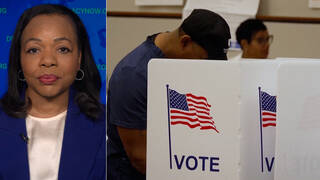
To discuss this latest DOJ lawsuit and more critical cases ahead of the midterm elections, we’re joined now by Sophia Lin Lakin, director of the ACLU’s Voting Rights Project. She’s joining us from Brooklyn, New York.
Hi, Sophia. Thanks so much for being there. Can you explain what’s going on in Alaska?
SOPHIA LIN LAKIN: Well, we have a baseless lawsuit brought by the Department of Justice. It is — there’s no basis in the law for this. There is no merit to this claim. We’re really scraping the bottle when it comes to true legal arguments to take over, essentially, the certification process if the administration’s preferred candidate doesn’t win. This is an extraordinary ask for an election that hasn’t even — the votes in this election haven’t even been counted. It is a press release with a case number.
And the ACLU has asked the court to dismiss this lawsuit in the strongest terms, and we’ve asked the court to consider sanctions, because the courts shouldn’t be used to launder baseless claims into distrust in our elections. There should be consequences for that.
NERMEEN SHAIKH: [inaudible] go to comments made by U.S. Attorney General Todd Blanche about this case, which he defended, defended the Department of Justice lawsuit blocking Alaska’s Senate results if Republicans lose. He was speaking on CBS’s Face the Nation.
ATTORNEY GENERAL TODD BLANCHE: There’s not two Dan Sullivans, one an incumbent and one running. That’s not true. The head of the Alaska Election Commission — not President Trump, not me — has said that the second Dan Sullivan is running solely to confuse voters, solely to pull votes away from the incumbent senator. …
All we are doing is trying to put guardrails in place so that if that — this — that happens, there’s a system allowed where the ballots are kept in a way so that we can determine whether there was confusion. It’s not saying don’t certify. It’s saying if a court ultimately determines that it was decided because of confusion and not the will of the voters, then we do not think the state should certify. And that’s consistent with federal law and consistent with even Alaskan law, if that happens.
NERMEEN SHAIKH: So, Sophia, if you could comment on what Blanche said? And also, is there any precedent for two candidates with virtually indistinguishable names to be on the ballot?
SOPHIA LIN LAKIN: Well, look, the Alaska Supreme Court already decided this issue and said that these two candidates can be on the ballot and that there is — there are distinguishing features for voters if they are at all confused. One of the candidates, the incumbent, has “incumbent” listed next to his name, as well as the notation that he is the Republican. So, voters should be able to distinguish, and the courts and the state of Alaska have already addressed this issue.
Now, in terms of the case, the merits of the case itself, the Department of Justice cites a national voter registration law. That’s the name of the law. It has to do with voter registration. It has nothing to do with the certification or the counting of ballots at all. And not only that, the lawsuit doesn’t cite any substantive provisions of this National Voter Registration Act. It cites merely the preamble, the introductory paragraphs. So it doesn’t even cite any authority, any basis that gives the Department of Justice any ability to enforce these claims about confusion, these claims about the possibility that voters might not be able to distinguish what’s pretty clear on the ballots.
NERMEEN SHAIKH: Sophia, the implications of Trump just coming out quite openly in support of this lawsuit, indeed saying that he is the one who said, “Do it”?
SOPHIA LIN LAKIN: Yeah, that is quite extraordinary to have, and it is part of a broader effort that the Trump administration started the moment that Trump took office the second time. It’s part of an attempt to undermine confidence in our elections, to interfere in election administration, to create pretext to challenge results that the administration doesn’t like. It’s part of that broader pattern.
But courts, we have pushed back. Courts have held that the Constitution is really clear on this point. The president doesn’t have any role in setting the rules of elections. The president doesn’t have the ability to interfere in our elections. States run our elections, and voters are the ones who decide the outcomes, not the president, not the Department of Justice.
AMY GOODMAN: In California, Los Angeles election officials say a list compiled by the Department of Justice of some 20,000 alleged noncitizen registered voters includes a high percentage of people born in the United States. The new revelations come after a court filing by California state and local officials in response to a lawsuit filed by the Trump administration. Earlier this month, the Justice Department gave California 48 hours to segregate the ballots of those named on the list, which local officials blasted as unreliable after an early review of the voters’ records. Can you comment on this?
SOPHIA LIN LAKIN: Yes. Once again, this is another attempt, a part of that broader effort, to undermine confidence in our elections, this time using an unverified, completely undisclosed list that we know causes errors. We know that it’s going to sweep up eligible voters, and California and the L.A. County have identified some already. And what we do know is that this, again, is a claim, is baseless, that it’s an attempt to decide in advance which votes should count, and give a pretext to challenge outcomes that the administration doesn’t like. We’re seeing this once and once again, and again, these claims are meritless. We’re scraping the bottom of the barrel when it comes to arguments here. These are press releases masquerading as lawsuits.
NERMEEN SHAIKH: And could you put this, Sophia, in the broader context of attacks on voter rights as we approach the midterms?
SOPHIA LIN LAKIN: Well, unfortunately, we are seeing unprecedented assaults on voting rights from the Trump administration, from the Trump administration’s allies in the states, in local — in the localities, as well. And we’re doing everything we can to push back. Courts have been holding. Partners on the ground have been pouring out in numbers. We have over 100,000 volunteers at this point who are ready to mobilize and organize to make sure that these threats that the Trump administration, its allies are putting on our elections to undermine confidence in our elections are put to bed, that these elections run according to law, and that we can have a new seating of Congress that is peaceful, and that people feel confident in those election results.
AMY GOODMAN: Sophia Lin Lakin, we want to thank you so much for being with us, director of the ACLU’s Voting Rights Project.
Coming up, Anti-Fascist Economics: In Defense of Affordability, Dignity, and Democracy. We’ll speak with the acclaimed economist Isabella Weber. Stay with us.
[break]
AMY GOODMAN: “Fascists in Our Midst” by Montreal musician Paul Cargnello.





 Top
Media Options