




 Watch Full Show


Guests
- Farhana Yamininternational environmental lawyer who helped write the landmark 2015 Paris Agreement.
As delegates, industry lobbyists and civil society activists attend this year’s United Nations climate summit, known as COP31, we speak with international environmental lawyer Farhana Yamin about the state of global climate efforts. Yamin helped write the landmark 2015 Paris Agreement and has attended 28 of the last 31 U.N. climate summits. The Paris Agreement aimed to keep global temperatures below 1.5 degrees Celsius above preindustrial levels, a threshold that climate scientists say the world will now overshoot.
“It’s a moment of great sadness, actually, for the world community that we weren’t able to start the phaseout, start the acceleration of the transition away from fossil fuels 10 years earlier,” says Yamin. “So, we’re about 10 years behind, but I hope that over time that we can accelerate.”
Related Story
 Web ExclusiveNov 17, 2026Electrification Must Be Powered by Renewables to Reduce Fossil Fuel Use: Oil Change International
Transcript
AMY GOODMAN: This is Democracy Now!, democracynow.org. I’m Amy Goodman.
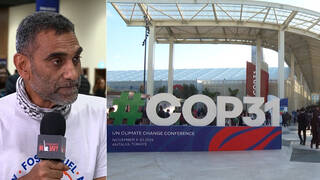
We’re broadcasting from the U.N. climate summit. That’s COP31 here in Antalya, Turkey. The U.N. summit comes 11 years after nations reached the landmark 2015 Paris Climate Agreement to limit global warming to 1.5 degrees Celsius — that’s 2.7 degrees Fahrenheit. But that limit is on track now to be surpassed.
On Friday, U.N. Secretary-General António Guterres addressed the summit. He urged nations to enact immediate and drastic reductions in greenhouse gas emissions.
SECRETARY-GENERAL ANTÓNIO GUTERRES: An overshoot of 1.5 degrees is now inevitable. And our responsibility is to keep it as small as possible for as short time as possible and bring temperatures back below 1.5 degrees as quickly as we can. But that requires immediate and drastic emissions cuts, on the order of 6% every year over the next few years. But on the basis of current commitments of national determined contributions, the countries’ climate plans, we are heading for an overshoot as far as the eye can see, with temperatures about 2.5 degrees by the end of the century. And that is a recipe for catastrophe. Even a limited, temporary overshoot will intensify the devastating impacts we are already seeing. And that makes climate justice even more urgent.
AMY GOODMAN: That was U.N. Secretary-General António Guterres Friday.
We’re joined right now by Farhana Yamin, an international environmental lawyer who helped write the landmark 2015 Paris Agreement. She’s attended 28 of the last 31 U.N. climate summits.
Welcome back to Democracy Now! It’s great to have you with us. You know, sometimes I think with the U.N. jargon and the letters or abbreviations of things most people in the world don’t know, it is — there are a hundred languages spoken here. That one is the hardest. So, first, I’d like you to talk about how you got involved, to the point where you were a key architect of the 2015 Paris Climate Agreement, and what it means now that that 1.5 degrees — and what’s that all about? — is set to be surpassed.
FARHANA YAMIN: Yes. Thank you so much for having me, Amy.
I got involved because, actually, I stepped back from the negotiations and from my work in philanthropy, in climate philanthropy, in 2012, and I realized, actually, we were not phasing out greenhouse gases, which is what the key purpose and point of this process was. So I came up with this idea of phasing out greenhouse gases by 2050 to zero, which is the — which is the emissions target that is needed to be, at that time, in line with keeping temperatures to 1.5 degrees and well below two degrees. That was the emissions target. This is a temperature target. Most people, as you said, don’t really understand what the big difference is between 2 degrees, 1.5 degrees, let alone 3 degrees. This is temperature changes that we experience in the course of a day —
AMY GOODMAN: Right.
FARHANA YAMIN: — let alone a season. But globally, the whole of the Earth, its water, its oceans, its landmass, changing temperatures by that much means, you know, a calamity for the world’s ecosystems, for the oceans, for soils, for forest health. And that is what we’re seeing now. We’re seeing —
AMY GOODMAN: In fact, you were working with the Marshall Islands at the time.
FARHANA YAMIN: I was working with the Marshall Islands. And, actually, it was the minister of the Marshall Islands, Minister Tony deBrum, who pulled together this big coalition called the High Ambition Coalition in the run-up to the Paris Agreement, that struck a bargain amongst themselves. The ministers and the leaders of these countries said, “We will not fail,” as the Copenhagen conference — sorry to go back in time a little bit — which was COP15, had failed to adopt a successor treaty to the Kyoto Protocol.
AMY GOODMAN: That was the first climate summit that Democracy Now! attended, in Copenhagen.
FARHANA YAMIN: Yes, you go back that way. So, that summit failed, and then it took basically five years to get the Paris Agreement agreed, and another year to get it rapidly entered into force. And the small islands and the smaller nations played a key role, because, for them, it was life or death.
And really, the implications of now what we call the overshoot, which is basically we are hurtling past the threshold for keeping temperatures below 1.5, with almost inevitability, that is a moment of great grief, it’s a moment of great anger, it’s a moment of great sorrow, and it’s a moment of great anxiety, because the impacts associated with that for the most vulnerable in the world, let alone all of us. You know, I live in London. We still have wildfires in London, in England. You’ve had wildfires across the globe. Countries like Nepal are showing us what it now means for glaciers to melt and for those waters to burst unexpectedly and inundate huge areas of land, devastating loss of life. So, we’re seeing those impacts firsthand.
People are seeing the impacts also of rising fuel prices as a result of fossil fuel dependency. They’re seeing that on the cost of — on the cost of living, on their wage packets, on their transport and mobility bills. So, we’re seeing the dependency on fossil fuels.
And it’s a moment of great sadness, actually, for the world community that we weren’t able to start the phaseout, start the acceleration of the transition away from fossil fuels 10 years earlier. So we’re about 10 years behind. But I hope that over time that we can accelerate, and that’s what this COP is about.
AMY GOODMAN: How does the United States pulling out again from the Paris Climate Agreement, President Trump doing it twice, for his both terms in office, affect the negotiations here?
FARHANA YAMIN: It impacts us enormously, because many other countries have slowed down or followed suit. And it is not just the — it is now the third time in my professional lifetime that the U.S. has withdrawn from the climate treaties. The first time was obviously under George Bush. So, we’ve lost, you know, about 15 years as a result of just the uncertainty and the political weight that’s associated with climate denialism and having an anti-climate action stance. And I cannot say enough what that means in terms of the immense power — intellectual, financial, economic — that the U.S. has still today in the world. It acts as a brake. It acts as a hamper. And it is truly disruptive. They may not be here, but the dead weight of their nonparticipation is being felt.
AMY GOODMAN: So, can you explain this dispute around the release of the next report to be published by the U.N.-backed, Nobel Peace Prize-winning Intergovernmental Panel on Climate Change, the IPCC? Why are countries like Saudi Arabia, Russia and India pushing the report’s delayed publication — all three countries among the largest fossil fuel exporters or importers in the world?
FARHANA YAMIN: I think there are a number of reasons, but the main one is essentially to try and delink the science from really informing this process. Science has been a bedrock and has provided the impetus and the urgency and the basis for action. Legally, we’re required to act as a result of and in response to the best science. And I’m afraid, sadly, these tactics of trying to undermine the science or refuse to incorporate the science, or refuse to even note or acknowledge what the IPCC is doing, this particular time, it’s even more egregious. But these have been commonplace for the last 30 years.
And in fact, I was pointing out to some of my old dinosaur friends that at COP2, which was in 1996, we had just had publication of the second IPCC report, which was meant to inform the then-negotiations of the Kyoto Protocol, and the same group of countries, very similar group of countries, blocked the adoption of a decision at COP2. And actually, in that case, all of the ministers of the world were gathered and said, “No way. We are going to issue a ministerial declaration acknowledging the science.” And the blockers, as it were, were then noted in the COP report as a footnote to that. So, procedurally, I’m sure we will also find a way in which to acknowledge the science, give light and weight and evidence and visibility to climate science here.
AMY GOODMAN: Explain what the global stocktake is. Former Vice President Al Gore, vice president of the United States, was here and said, “Saudi Arabia is trying to destroy the IPCC in order to prevent the next global stocktake from using the accurate scientific data on fossil fuels.” What is this global stocktake?
FARHANA YAMIN: Yeah, in the Paris Agreement, we invented, basically, a five-year cycle of ratcheting up nationally determined commitments — essentially, the pledges and the targets that countries have themselves committed to — and collectively taking a stock of that, and then renewing our global commitment every five years. So, the assessment is called the global stocktake. It takes a couple of years. The science and the evidence of the implementation, all of that combined goes into it. It’s input into it, and out the other end should come more explicit guidance to parties, as well as these revised and more ambitious NDCs. That is what is meant to happen. NDCs are these five yearly targets that are meant to be a report.
AMY GOODMAN: ”NDC” means?
FARHANA YAMIN: Nationally determined contributions, because they’re not internationally determined. We don’t have in the COP any right to tell a party individually what their target is, and they are not as legally binding in the way that the Kyoto Protocol commitments used to be. So these are a softer way of gaining international commitments to go forward. So, the global stocktake, the first one happened, and, in fact, it was very successful in giving a very clear signal to transition away from fossil fuel, to start that process and to ramp up ambition. And the second stocktake is now being readied for Ethiopia.
AMY GOODMAN: There are over —
FARHANA YAMIN: For the next — for COP32.
AMY GOODMAN: There are over 90,000 people here. And people right now can see people walking back and forth. Ninety thousand people people. I think it’s the largest COP yet. What are they all doing? And I don’t know if you know what percentage, because it’s grown every year, of fossil fuel lobbyists that are here and the enormous power that they exert.
FARHANA YAMIN: Yeah, I have — I have sort of mixed feelings about the sizes of the COPs, because sometimes it feels very overwhelming, and it’s very difficult to just navigate around. But in a sense, you can see that as a success of the climate regime. It is attracting more and more participants, including from developing countries, including from different constituencies — youth, women, Indigenous people. All of them have come in.
And sadly and unfortunately, the power and financial pockets of very powerful industries means that they can often send many more delegates. So, there is a disproportionate number of fossil fuel lobbyists here, as there were a few previous COPs. I think the numbers are something like, just alone — I read yesterday that there were over 600 delegates alone lobbying for carbon capture and storage, which essentially is one of the very contested solutions, a very expensive solution, a solution which means, once again, we will not be phasing out fossil fuels; we’ll be trying to continue with them.
AMY GOODMAN: What is the significance of this summit being held here in Turkey? President Erdoğan urged countries to make progress in the talks, but separately celebrated the discovery of two new oil fields with estimated potential of an enormous amount of fossil fuels.
FARHANA YAMIN: I think Turkey, like many other countries — Brazil last year, Australia, the U.K., where I am living — are, you know, I think, in a sort of very divided, confused state. On the one hand, they can see how much they’re benefiting, moving rapidly to green and clean sources of energy. Their populations, their citizens are voting with their feet and with their wallets in installing renewable energy, solar panels and so forth. Same with Australia. But at the same time, governments seem to be hedging their bets and expanding fossil fuels. And that is a tragedy. I hope that Turkey does not, in the end, go forward with that. But it is, in these very uncertain, volatile, chaotic war times, something that some countries are thinking, “I better also keep my options open.” And in fact, as we know — and all the economics are saying it — the shift to clean, renewable solar power, renewable wind power is much, much cheaper and doesn’t require a war, basically, to protect them.
AMY GOODMAN: And we’re going to talk more about war with our next guest, these times of war and the demands for accountability. Farhana Yamin is an international environmental lawyer who helped write the landmark 2015 Paris Agreement, has attended 28 of the last 31 U.N. climate summits.
Coming up, Asad Rehman of Friends of the Earth. He was out in the streets this weekend and now is inside the climate summit. Stay with us.
[break]
AMY GOODMAN: A performance during the COP31 opening session here in Antalya, Turkey.



 Top
Media Options