






 Watch Full Show

Topics
Guests
- Kaveh Madanidirector of the United Nations University Institute for Water, Environment and Health.
We take a look at how war in the Middle East is impacting the environment in “one of the most water-stressed regions in the world,” with Kaveh Madani, the renowned U.N. scientist, former Iranian politician and recipient of the 2026 Stockholm Water Prize. Madani discusses threats to civil water infrastructure in the Gulf region, how the Strait of Hormuz crisis highlights consumer countries’ overreliance on oil and gas, and his prize-winning work on the global effects of “water bankruptcy.” Madani ties the antiwar and climate struggles together and calls for wider popular resistance to the long-term environmental harms of global warfare. “All the weapons that have been produced have had carbon footprints — the missiles that fly, the jets, the tanks that are burned, the oil fields that are being attacked and the gas fields that are being burned. All of these are producing a lot of greenhouse gas emissions,” he says. “They are going to impact us in the long term.”
Related Story
 StoryMay 06, 2010History of BP Includes Role in 1953 Iran Coup After Nationalization of Oil
Transcript
AMY GOODMAN: This is Democracy Now!, democracynow.org, The War and Peace Report. I’m Amy Goodman.
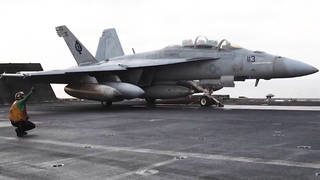
More than a month into the U.S.-Israeli war on Iran, concerns are mounting over the long-term consequences of the war on human health, land and marine ecosystems and aquifers, as well as war’s impact on global warming. Among many concerning incidents, Israel bombed oil facilities around Tehran in the first weeks of the war, causing fires to burn for hours, spawning a thick cloud of toxic smoke over the city of 10 million people. Many residents complained they had trouble breathing as black raindrops full of toxic chemicals fell across the capital.
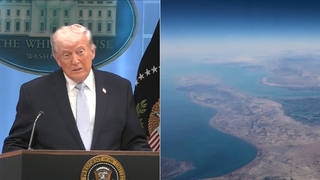
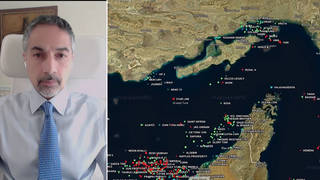
On Monday, President Trump threatened to blow up desalination plants in Iran. He wrote on Truth Social, quote, “If the Hormuz Strait is not immediately 'Open for Business,' we will conclude our lovely 'stay' in Iran by blowing up and completely obliterating all of their Electric Generating Plants, Oil Wells and Kharg Island (and possibly all desalinization plants!) which we have purposefully not yet 'touched,'” Trump said. In the Gulf, desalination is the primary source of potable water, and hundreds of desalination plants could be at risk if the conflict escalates.
To talk more about this and more, we’re joined by the Iranian environmental scientist Kaveh Madani. He’s director of the United Nations University Institute for Water, Environment and Health. Last month, he was awarded the 2026 Stockholm Water Prize for his pioneering work on the concept of water bankruptcy. Previously, he served as the deputy head of Iran’s Department of Environment, but went into exile after his work on water scarcity brought accusations of sabotage. He says war is the worst nightmare for someone fighting for the environment. He’s joining us now from Toronto.
Why don’t we start there? Why is war the worst for someone who is hoping to save the environment?
KAVEH MADANI: We know that even in peace times many governments struggle to pay attention and take serious action on the environment. So, if there is a war, the chance of getting the attention of government and societies would be much more limited. The society, the people who are fighting for their survival, and they’re trying to stay alive, would not think about the future generations and don’t have even the bandwidth to think about the environment, clean air, sustainable water and so on. So, this is just only the attention span and the depriority — the fact that the environment would get out of the priority list. But on top of that, just think about the long-term consequences of wars, all the chemical leftovers, all the debris, the greenhouse gases resulting from the war, explosions and everything. So, war is going to push us backward. And that’s why anyone who cares about the environment should also care about peace.
AMY GOODMAN: By the way, congratulations on this major prize you just won, Kaveh Madani, the Stockholm Prize for Water, considered the Nobel Prize for water. Can you respond to Trump threatening to blow up more civilian infrastructure, including Iran’s desalination — he calls them “desalinization” — plants, what exactly that would mean?
KAVEH MADANI: First, I should say, I’m not going to share my award with him.
But, you know, I think that’s the — that’s really scary, I mean, from multiple standpoints. But, you know, let’s break things down. First thing is that we know the war started with the violation of international law. But even if the enemies of the Islamic Republic consider that justified, wars have — even wars have rules. And there are rules to follow even during the wars. Attacking civilian infrastructure is a violation of international humanitarian law, and that can be a war crime. So, threatening to put the — essentially, to compromise the situation and endanger the civilians who have no agency in this war, the civilians that the attackers on the Islamic Republic claim to want to — you know, claim that they want to rescue, is contradictory. So, it’s not serving anyone if there would be a regime change, if they want to bring liberty to Iran. An Iran without water resources or energy resources would not be in a better place. So, that’s very confusing even for those who are the strong supporters of this war on the Iranian side.
But let’s understand the situation. So, first of all, Iran doesn’t heavily rely on desalination. It’s the rest of the countries in the region. Israel, the Gulf states and Saudi Arabia are heavily relying on desalination. So, if the first desalination plant is attacked, there would be retaliation, and the whole region would be on fire. The whole region would be losing. And we’re talking about the lives of people with no agency in this war, effect on drinking water, health implications. Some of the smaller states, unlike Iran, don’t have the luxury of having access to different sources of water. Some of them only have a few days or few weeks of water left. So, if their desalination plants are shut down, we are dealing with a major crisis.
But let’s not forget that there are other ways that you can disrupt the water system. If the electricity systems are shut down, pumps stop working, treatment plants stop working, water distribution systems fail. So, even by attacking the energy infrastructure, you can disrupt the water system. And we know, we have heard about Iran’s water problems. We have heard about water problems in the rest of the region. This is one of the most water-stressed regions of the world. Many of the countries are already water bankrupt. And just making them worse is not going to help anyone. So there is no purpose or gain or strategic gain in this threat or accomplishing this, essentially, threat. And I hope this is just a social media slogan and not a real action.
AMY GOODMAN: A recent analysis of the war has found 5 million tons of greenhouse gas emissions were released in the first two weeks of the war. The analysis by the Climate and Community Institute found that the first two weeks drained the global carbon budget faster than 84 countries combined. If you can talk about these climate impacts? And you have said we always blame the oil-producing states for gas emissions, but we don’t blame the buyer. Put those two things together.
KAVEH MADANI: Yes, I think this is something to argue. In climate activism, the countries in the region that now are going through a war, except for Israel, are commonly blamed for selling oil. Now that we see the Strait of Hormuz being shut down, we know who the buyers are, because we are seeing how different countries are complaining. And I’ve always said that, you know, it’s — if you really want to stop oil production and reliance on oil, blame the oil buyers. And if there are no oil buyers, these countries would not be selling oil. So, that’s kind of an issue, or ethical issue, that we have in the environmental campaigns. But now these countries are under threat. They cannot sell their oil, as we know, or at least their oil production is very limited.
But there is a war going on. All the weapons that have been produced have had carbon footprints — the missiles that fly, the jets, the tanks that are burned, the oil fields that are being attacked and the gas fields that are being burned. All of these are producing a lot of greenhouse gas emissions. Yet we are not seeing much complaint. We are not seeing climate activists out on the streets and calling for the stop of the war. And, you know, I have had a lot of Iranians questioning these things in the past from me, why we see hypocrisy when it comes to climate change activism or environmental activism. I’m not accusing anyone of anything, but I expect to see more people who fight for peace, who advocate for peace, who advocate for the environment. The impacts are lasting. What we are seeing in the Middle East, as we know, is affecting all of us right now, but also in the years and decades to come. The pollution that would remain in the region, the greenhouse gases that are going up into the atmosphere, they are going to impact us in the long term.
AMY GOODMAN: And, Kaveh, before we go, we just have a minute, but if you can talk about water bankruptcy, what that means?
KAVEH MADANI: So, water bankruptcy, just like financial bankruptcy, explains the situation where we are — we are suffering from insolvency, meaning that the amount of water used is far more than the rate of renewal or the income that nature gives us. We have the checking account: surface water. We have the savings account: our groundwater. We have exhausted our checking account. We have also — our savings accounts are also declining around the world. And as a result, we are seeing shrinking surface water systems, rivers, wetlands and so on, declining groundwater, land subsidence, desertification, biodiversity loss, wildfires and so on.
And this is a situation that we can no longer call it crisis, because these systems won’t bounce back. And we have entered an era called the era of water bankruptcy, in which systems lose their ability to restore their historical condition. Action for dealing with this situation is totally different. We need to admit that we have failed, if we want to save the future and enable the future; combine mitigation with adaptation to a new reality that is more restricted than before.
AMY GOODMAN: Kaveh Madani, we want to thank you for being with us. We’ll certainly have you back on to talk more about water bankruptcy. Kaveh Madani is director of the United Nations University Institute for Water, Environment and Health, previously served as the deputy head of Iran’s Department of Environment, just awarded the 2026 Stockholm Water Prize, often referred to as the Nobel of water, speaking to us from Toronto, Canada. He went into exile from Iran.
Coming up, days after Defense Secretary Pete Hegseth prayed for overwhelming violence against U.S. enemies, Pope Leo condemned the war in Iran and said warmongers have blood on their hands. Back in 15 seconds.
[break]
AMY GOODMAN: “Arc of Emotion” by Leonard C Miller.





 Top
Top
Media Options