










 Watch Full Show

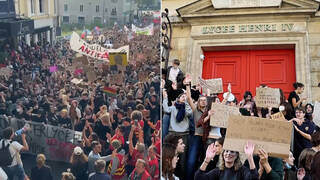
A prominent human rights lawyer in the United Kingdom has been charged with criminal contempt for his closing speech in the trial of his client, Charlotte “Lottie” Head, one of four Palestine Action activists who were sentenced as terrorists over their involvement in a 2024 protest and raid on an Israeli weapons factory. Their sentencing marked the first time a British judge issued terrorism sentencing enhancements on people who were not actually convicted of terrorism. An additional 21 currently jailed Palestine Action protesters could face similar sentences, which carry multiyear prison terms.
The charges against Rajiv Menon are similarly unprecedented in British legal history. He is accused of encouraging a jury to acquit Head according to their conscience. Menon denies this accusation and says he was simply informing the jury of a prior legal case. He adds that, along with the U.K. government’s ban on Palestine Action under anti-terrorism laws, the case against him is intended to have a “chilling effect” against pro-Palestine protest, and carries “serious constitutional implications.”
Related Story
 StoryAug 12, 2026Gaza Tribunal Co-Chairs MP Jeremy Corbyn, Neve Gordon & Shahd Hammouri on U.K. Complicity in Genocide
Transcript
AMY GOODMAN: This is Democracy Now!, democracynow.org. I’m Amy Goodman, with Anjali Kamat.
ANJALI KAMAT: We turn now to the case of a leading human rights attorney in Britain who is facing criminal charges himself over his representation of a client in court. Rajiv Menon KC, King’s Counsel, is accused of criminal contempt over his closing speech at the trial of six Palestine Action activists for their direct action protest at a weapons factory owned by Elbit Systems, a supplier of arms to Israel, in Filton in August of 2024. Menon is being accused of misleading the jury and ignoring the judge’s directions in his remarks. He is believed to be the first defense attorney in Britain to be prosecuted over statements in a closing speech.
Mr. Justice [Nicklin]'s court order read in part, quote, “the respondent made statements which were capable of suggesting to the jury that the court was not impartial, in that he referred to the defendants being prevented from giving evidence about Elbit Systems, and later referred to Elbit Systems being ’protected' and 'wined and dined in the corridors of power.'”
AMY GOODMAN: Garden Court Chambers, where Menon has worked as a barrister for 30 years, said the charges brought against him were unprecedented and have, quote, “sent shockwaves through the legal profession,” unquote. The chair of the Criminal Bar Association has said the charges have left attorneys afraid of doing their jobs. Amnesty International said, quote, “The prosecution of Palestine Action lawyer, Rajiv Menon KC, is a serious threat to fair trial rights and the right to protest,” unquote.
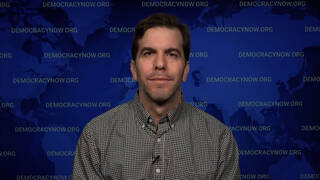
For more, we’re joined by Rajiv Menon KC himself in his first television broadcast interview since the charges were brought. He’s joining us from London, where Democracy Now! just was.
Thanks so much for being with us. Why have you decided to speak out? In fact, you encourage your clients, Palestine Action protesters, not to speak directly to the press, is that right? And yet, now you’re the focus of the court.
RAJIV MENON: Firstly, thank you for inviting me.
I’ve decided to speak out because for the last few months a number of senior judges in this country have decided to make the most serious allegations against me in public, publishing those allegations on the Judicial Office website. And, of course, you’ve already highlighted the fact that I’m the first lawyer, as far as I’m aware, as far as my lawyers are aware, ever to be prosecuted for contempt of court in this — in British legal history. And I just feel that it’s important that I have a voice in this and that I at least address some of the matters in general terms that I’m accused of, as opposed to simply waiting, you know, for my opportunity in court months from now to say what I need to say.
ANJALI KAMAT: And, Rajiv, can you explain what the — why these contempt charges are being brought against you? What exactly did you say that was considered contempt of court?
RAJIV MENON: So, I made a closing speech in a Palestine Action protest case, as you said, on the 8th of January this year on behalf of my client Charlotte Head, who was one of those engaged in direct action against the Elbit Systems factory. And the judge subsequently made seven specific allegations of contempt against me. I’m — probably not wise for me to go into the full detail of that, but suffice to say, perhaps, that I categorically deny deliberately breaching any judicial order, and, as far as I’m aware, as far as I believe, didn’t inadvertently breach any order, either. I mean, contempt of court is a complicated jurisdiction, but, in essence, it involves a serious interference with the administration of justice. And I categorically deny that anything that I said in that closing speech amounted to a serious interference with the administration of justice. But that’s the allegation in a nutshell.
AMY GOODMAN: Rajiv Menon, since our systems are a little different, the legal systems not only in the United States and Britain, but around the world, if you can say in lay terms, in your closing argument, what is the argument you were making? I mean, we have a defense in the United States, where we have a description, for example, called jury nullification. They can say someone did something, but they don’t feel they should be found guilty. Talk about what the Palestine Action defendants were accused of, who you represented, and what your argument was.
RAJIV MENON: Yes. So, my client Charlotte Head was charged with aggravated burglary, violent disorder and criminal damage. And she had statutory defenses to aggravated burglary and violent disorder. The problem was, in relation to criminal damage, there was no dispute that she had participated with others in damaging property belonging to the Israeli arms manufacturer Elbit Systems. And the trial judge had withdrawn her only available defense of lawful excuse to that charge. And so, on the face of it, she had no defense to the charge. But, of course, she’s innocent until proven guilty. And ultimately, the facts are for the jury, not for the judge. The jury are the sole judges of the facts.
And so, in my speech, I told the jury about a very famous case from 1670 — excuse me — of William Penn and William Mead, who had been charged with unlawful preaching on the streets of London. And in that case, the trial judge had directed the jury to convict, and the jury had refused to convict. And the jury was subsequently imprisoned and, when they continued to refuse to convict, were fined. And some of those jurors refused to pay the fine. They were locked up. And that case, that came to be known as Bushel’s Case, is one of the most famous cases in British legal history. And I told the jury about that case, as hundreds, if not thousands, of other lawyers have done before me. And I told the jury about a plaque at the Old Bailey, probably the most famous courtroom in the world, where that case is celebrated — again, something that’s been done by countless lawyers before me.
And what I’ve been accused of is that by doing that, I was informing the jury about their right to acquit a defendant according to their conscience and was inviting them to do so. And that is an allegation I categorically deny. What you call jury nullification in the United States is called jury equity here. But I categorically deny — I need to make this absolutely clear — that I either informed the jury of the existence of that principle, that fundamental principle, or invited them to invoke it. What I did do was tell them about that famous case and about the plaque that celebrates the case. And that’s at the very heart of the allegation that I face.
ANJALI KAMAT: Rajiv, I want to turn to a clip of your client, Charlotte Head, speaking to AJ+ earlier this year.
CHARLOTTE HEAD: Palestine will never be forgotten. And for me, it’s something that I will never stop supporting and fighting for and wanting to scream from the rooftops. … We wanted to stop the manufacturing of weapons on British soil that were being used by Israel in the genocide in Gaza. I think we had asked nicely. We had asked so many times, in every different way, and the government wasn’t listening. … Having been in prison, which is obviously, you know, not even comparable to what people are going through in Gaza, but experiencing a smidge of that isolation, having people tell you that you’re not alone and that people are there and that you’re never going to be forgotten, I think that’s probably the most poignant thing I could say.
ANJALI KAMAT: Rajiv Menon, tell us about your client, Charlotte Head, and what exactly she was charged with. And she’s back in prison now?
RAJIV MENON: She is. Well, she’s an extraordinary woman — I should say that from the outset — who has dedicated most of her adult life to helping those less fortunate than her. She spent three years working in the refugee camps in Calais, doing a number of different jobs at the time to assist refugees and asylum seekers. At the time of her involvement in the action against the factory in Filton, she was working with women suffering domestic — and children, suffering domestic violence and abuse in London. So, she’s someone who’s dedicated, as I said, most of her adult life to helping others, and was driven to participate in this action by the genocide that was being live-streamed onto our televisions and our mobile phones in this country.
As I said, she was charged with aggravated burglary, violent disorder and criminal damage. She was acquitted by the jury at the first trial of aggravated burglary, which was the most serious charge that she faced, a charge that can technically attract a sentence of life imprisonment. The prosecution subsequently dropped the charge of violent disorder against her. The jury at the first trial were hung on that charge.
As far as criminal damage is concerned, she was — the jury couldn’t decide at the first trial, but she had a retrial later in April and May, and at that retrial, she was convicted of criminal damage and was given a custodial sentence of five years’ imprisonment. She’s currently serving that sentence.
And in addition to that, the trial judge found that her offending, quite extraordinarily — the first time this has ever happened in a protest case in this country — that her offending had a terrorist connection. And as a result, she’s subject now to a draconian regime within the prison system, which has, in real terms, lengthened the time that she will have to spend in custody. And that is a matter that’s currently subject to appeal.
ANJALI KAMAT: And the judge in this case, in the first trial and the second trial, put several restrictions on what was allowed as a defense. Is that right? Can you explain that?
RAJIV MENON: Yes. So, because the trial judge had withdrawn their justifications from them — as I mentioned earlier, Charlotte’s defense of lawful excuse was withdrawn from the jury; other justification defenses were withdrawn — the judge restricted what the defendants could say about their underlying motivations, and specifically about what they could say about Elbit Systems. And so, on a number of occasions during the first trial, defendants were stopped from telling the jury what they had learned about Elbit Systems prior to their involvement in the action. But they still managed to say a great deal. And to be fair, the judge never directed the jury at the first trial that the jury should disregard what they said.
At the retrial, when they were solely facing the charge of criminal damage, further restrictions were placed on them, and they were not allowed to say anything to the jury at the retrial about the reasons or underlying motivations that they had for either joining Palestine Action or participating in the action against the Filton factory or their specific views about Elbit Systems. So, that further restriction was placed on them at the retrial, that was not there at the first trial, where they were facing other charges, as well. I mean, it’s quite complicated, this, but I hope that explains it in a nutshell.
AMY GOODMAN: Before we end, we want to talk about that larger issue of Palestine Action being considered a terrorist organization in London. I was there last week, and I asked the British MP Jeremy Corbyn about Prime Minister Andy Burnham’s apology for the Labour Party’s initial stance on Gaza, and part of his response was about that crackdown on Palestine Action. This is what MP Corbyn said.
JEREMY CORBYN: If he is serious about a complete change in policy, if he’s serious — it’s a big “if” — then why are we criminalizing people who take part in protest in Britain? A number have already been convicted and face long stretches in prison. These are nonviolent direct action protests. And there are also probably 2,500 to 3,000 people who have been arrested for holding a placard, in contravention of the Terrorism Act 2000, which is basically labeling anyone that holds a placard up saying “I support Palestine Action,” calling them a terrorist. This includes people in their eighties and even nineties, retired Anglican clergy people and many others. It’s an absurd situation.
AMY GOODMAN: So, that’s British MP Jeremy Corbyn when we were in London last week. As we wrap up, Rajiv Menon, if you can talk about how you’re fighting the charges against you, the contempt of court charges, and also the chilling effect this has on how far lawyers will go to represent cases like these?
RAJIV MENON: Absolutely. Well, let me deal with the latter first. I mean, there is no question, as the chair of the Criminal Bar Association and the chair of the Bar Council in this country have both publicly said, that the prosecution being brought against me for contempt of court is having a chilling effect on criminal defense lawyers and the worries that they undoubtedly have these days, particularly in protest cases, about what they can and cannot say. And that’s obviously because of the unique, extraordinary and unprecedented action being taken against me. I mean, I think that’s irrefutable. I mean, there’s so much evidence about it. And literally hundreds of people have contacted me, lawyers and others, to talk about that chilling effect. And, I mean, that clearly is something that is of — you know, is extremely worrying. It’s been described by some as a descent into authoritarianism.
As far as the case against me is concerned, already the Court of Appeal in this country, in a judgment in May, has held that the trial judge in the Filton case and another senior member of the British judiciary, a lord justice of appeal, a member of the Court of Appeal, acted unlawfully against me in an excessive jurisdiction by allowing a direct referral to the High Court being made against me for contempt of court. So, we have already had that victory. The case then went back to the trial judge, who has now instituted contempt of court proceedings against me under a different procedure. We are now appealing against that, as well, on the basis that that also was unlawful. We’re awaiting a date for that appeal. We think it’ll probably be in October or November. Depending on the outcome of that appeal, of course, there are different possibilities. If I win that appeal, then this may go away. Alternatively, it may be referred to the attorney general to make a decision as to whether or not I should be prosecuted. If I lose my appeal, then I will stand trial for contempt of court at some stage either later this year or early next year, with the risk of a potential two-year prison sentence hanging over my head. So, this is a serious matter with serious constitutional implications, which is of tremendous worry and concern to members of the criminal bar and other members of the legal profession in this country.
AMY GOODMAN: Rajiv Menon, I want to thank you for being with us and agreeing to do this interview, against your own lawyer’s wishes, a leading British human rights and criminal defense lawyer facing an unprecedented contempt of court charges, and could be sentenced up to two years in prison for his closing speech for a Palestine Action defendant, speaking to us from London.
Coming up, The Nerd Reich: Silicon Valley Fascism and the War on Democracy. Stay with us.
[break]
AMY GOODMAN: “We Are Here” by Scott Donaldson and Richard Samuel Nolan.






 Top
Top
Media Options