





 Watch Full Show

We look at the life and legacy of Dominican American historian, activist and prison abolitionist Dr. Johanna Fernández, who died on July 30 after a long battle with cancer. She was 55 years old. As a professor of history at Baruch College and the CUNY Graduate Center, Fernández was a leading scholar of the Young Lords, the radical 1960s civil rights organization founded in Chicago and New York and modeled on the Black Panthers. Fernández also created the Latinx Freedom Movement Archive and Exhibition Project, alongside historian Felipe Hinojosa. The exhibition is currently on view at The Shed in New York City, as well as in Chicago and Los Angeles. Iterations will also be presented in Houston and Washington, D.C.
Democracy Now! co-host Juan González, who was a founding member of the Young Lords before his career in journalism, remembers Fernández as “a consummate historian,” as well as a committed activist who devoted herself to advancing social justice. “She was an amazing person with enormous energy and spirit, and we are all better people for having known her,” he says.
Related Story
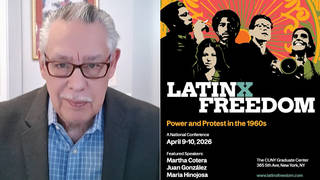
 StoryApr 07, 2026Juan González: “Latinx Freedom” Conference Will Be Landmark Gathering in NYC April 9-10
Transcript
AMY GOODMAN: This is Democracy Now!, democracynow.org. I’m Amy Goodman, with Juan González, as we turn to the life and legacy of the Dominican American historian, activist, prison abolitionist, Dr. Johanna Fernández. She died July 30th after a yearslong battle with cancer. She was 55 years old.
As a professor of history at Baruch College and the CUNY Graduate Center, Fernández was a leading scholar of the Young Lords, the radical 1960s civil rights group founded here in New York and modeled on the Black Panthers, also founded in Chicago. Juan González helped to found the one here in New York. Professor Fernández published the award-winning book The Young Lords: A Radical History in 2019. In 2015, she curated the exhibition “¡Presente! The Young Lords in New York.”
Fernández also created the Latinx Freedom Movement Archive and Exhibition Project alongside the historian Felipe Hinojosa. The exhibition is currently on view at The Shed in New York City, as well as in Chicago and Los Angeles. Iterations will also be presented in Houston and D.C. A statement by exhibit organizers, including Fernández, said, quote, “As scholars of U.S. history, we are deeply concerned about the widespread lack of knowledge about American history, particularly regarding the origins of Latinos in the country and their contributions to the expansion of American democracy. Closing the knowledge gap about Latino history through public education is central to our work,” they said.
This is Professor Fernández speaking on Democracy Now! in 2015 about the Young Lords.
JOHANNA FERNÁNDEZ: What we see is that the movements of the 1960s, what is known as the New Left and the Black Power movement, transformed the relationship between people of color and white people, challenged U.S. foreign policy, but also transformed our understanding of gender and sexuality. And those were the issues that the Young Lords were concerned with. The Young Lords are important because, in my opinion, from my research, they are the single group in the New Left that was most effective and most active, even though we know very little about them.
AMY GOODMAN: That was Dr. Johanna Fernández on Democracy Now! years ago. In 2020, Congress passed legislation to build a National Museum of the American Latino. A temporary exhibit was opened by the museum at the Smithsonian’s National Museum of American History in 2022 called “¡Presente! A Latino History of the United States.” Backlash to the exhibit led the Smithsonian to halt plans for a future exhibit on the Latino civil rights movement that was in development by Johanna Fernández. In 2023, I asked her about the exhibit and the significance of the backlash.
JOHANNA FERNÁNDEZ: What’s important is that it establishes the question: Who are Latinos? How did they get here? And what’s their relationship to their communities and to the nation and the world? …
Well, I think we have to look at this conflict in the broader history of the last 10 years, when conservatives have launched a calculated and broad-sweeping campaign to essentially eliminate the teaching of Black American history, Latino history, ethnic studies, women’s history and LGBTQ+ history in the schools. And now what we see is that through this witch hunt and by smearing historians and curators as Marxists, these conservatives are using fear to essentially push through their agenda. And now, again, this has reached a federal museum, and not just any federal museum, but the largest network of museums in the world, which is known as the Smithsonian. In many ways, this sounds and looks like a repeat of the Red Scare or previous moments of repression in the United States.
AMY GOODMAN: That was historian, professor and activist Johanna Fernández on Democracy Now! in 2023. Juan González, you knew Johanna for so many years. She died just last week at the age of 55. Talk about her significance.
JUAN GONZÁLEZ: Yes, Amy. Well, Johanna was, as you mentioned, a consummate historian, a committed activist, abolitionist and fighter for social justice, and also a warm and generous human being. She did more than any other scholar of the past half-century to chronicle and preserve the legacy of the Young Lords, to document and analyze the lasting impact the Lords had on movements of Puerto Ricans and other Latinos for self-determination, for civil rights and for revolutionary change.
I met her more than 25 years ago when she was a graduate student at Columbia University, and I was speaking there to some students. And over the years, she contacted me on many occasions, interviewed me and many — practically all — of the Young Lords and did enormous archival research to produce her book, which, by the way, won one of the top prizes of the Organization of American Historians, the prestigious Frederick Jackson Turner Award, for a history book.
But she was also an activist. She did a lot of work in support of Mumia Abu-Jamal, produced a film, Justice on Trial, about Mumia’s case, and, of course, as you mentioned, organized the Latinx Freedom Movement Conference, which brought together scores of former ’60s and ’70s activists of the Chicano, Puerto Rican, Dominican, Cuban revolutionary movements in New York just in April. That was the last time I saw her, was in April at that conference. And even then, as she was battling cancer, she still found time to finish the work of that conference and to do all the oral histories of all of the activists.
She was an amazing person with enormous energy and spirit, and we are all better people for having known her, but, obviously, all feeling very much her loss, the loss of her at this time.
AMY GOODMAN: Well, Juan, we’re going to end with the words of professor Johanna Fernández as she long talked about the case of Mumia Abu-Jamal, talking about his lack of a fair trial, the politicization of his case. This is Johanna Fernández speaking about Mumia Abu-Jamal in 2018.
JOHANNA FERNÁNDEZ: Philadelphia is the city that imprisons the majority of Black and Brown youth. This is the city that has also imprisoned and attempted to silence the most important political prisoner in the history of the United States — essentially, the Nelson Mandela of our time. So, if there is a victory in this case, in the case of a man who has been demonized for essentially illuminating the truth about Black oppression, about the predations of capitalism and imperialism, a man who is mild-mannered but is unwilling to compromise with justice — this is the reason why he’s been demonized by the police.
AMY GOODMAN: Those were the words of professor Johanna Fernández. She was a professor at Baruch College. She died last week at the age of 55, continuing to champion the case of Mumia Abu-Jamal, who remains in prison after 44 years. To see all our interviews with Johanna Fernández and Mumia Abu-Jamal and beyond, go to democracynow.org.
That does it for our show. Again, I’ll be in Edinburgh on August 11th at the Edinburgh [Ideas] Festival. I’m Amy Goodman, with Juan González.



 Top
Top
Media Options