











 Watch Full Show

Sarah Jones has been described as “a one-woman global village” for her remarkable one-person, multi-character shows. The Tony- and Obie Award-winning writer and performer is best known for her Broadway hit Bridge and Tunnel. She is back in New York with her latest solo performance, America, Who Hurt You?, which is being presented by the National Black Theatre and the Theatre for a New Audience at Polonsky Shakespeare Center in Brooklyn.
America, Who Hurt You? “starts with our history of genocide as a country, our history of enslaving African people, our history of indentured servitude,” says Jones. “This show … is about restoring the history that has intentionally been erased.”
Related Story
 StoryMar 31, 2025“Taking Down Everything Black”: Fired Kennedy Center VP Marc Bamuthi Joseph on Trump’s Takeover
Transcript
AMY GOODMAN: This is Democracy Now!, democracynow.org. I’m Amy Goodman.
We end today’s show with the Tony- and Obie Award-winning writer and performer Sarah Jones. Known for her Broadway hit Bridge and Tunnel, she’s back in New York with her latest solo performance, America, Who Hurt You? It’s being presented by the National Black Theatre and Theatre for a New Audience at Polonsky Shakespeare Center in Brooklyn, produced in association with Foment Productions, Cinereach and Jayson Jackson. Sarah Jones has been described as a “one-woman global village” for her remarkable one-person, multi-character shows. Her past productions include Sell/Buy/Date and Surface Transit. The acting legend Meryl Streep has called Sarah Jones a “once-in-a-lifetime artist.” She’s also a board member of Democracy Now!
I sat down with Sarah Jones last week and began our conversation by asking her about the title of her new show, America, Who Hurt You?
SARAH JONES: So, Amy, I’m going to bring a bit of the theater here into the Democracy Now! studios. First of all, I’m so grateful for you and the work you do. And America, Who Hurt You? started off as, really, a podcast thinking about this moment we’re in, and it was sort of facetious. “America, girl, who hurt you? Why are you like this? Are you all right? You’re in danger.” You know, it was sort of like a joke. And you’re hearing me in a British accent because I was also thinking about the relationship between these two histories. We’re in the 250th year of the United States even coming into existence — right? — officially. But if people come to the theater, or if they know me, they know that part of what I’m playing with is identity. And so, I do speak the Queen’s English, because I’m from Queens, New York, but bringing the idea of America’s, really, trauma, which seems to drive our politics. And, you know, you can watch Democracy Now! to see how that plays out.
But it starts with our history of genocide as a country, our history of enslaving, you know, African people, our history of indentured servitude. So many of our, you know, ethnic backgrounds, there’s a history of inequality that America has never really talked about or overcome. And now we’re erasing it and sweeping it under the rug in wild ways, right? Literally, you go to the Smithsonian, and it’s like, “Nothing to see here. You know, all of this isn’t true anymore.” And so, if we don’t deal with the reality of how we got here, our history, we’re going to keep playing out the same nightmares that we’re seeing. So, that’s a huge part of why the show exists.
AMY GOODMAN: Your family seems to run counter to everything the government represents today. As you say, you come from Queens, the most diverse borough in the world.
SARAH JONES: Yeah.
AMY GOODMAN: Talk about your family.
SARAH JONES: Yeah, well, my joke in the show, I come from a multiracial, multireligious family. So, you’ll meet people in the show who are based on my real life. Here, let me bring somebody out now. Don’t — you know, hopefully, don’t spit out your coffee, but… Hi there, everybody. Hi, Amy. Wonderful to see you. So, Sarah Jones, who you just met, she brings all of us out. I’m related to her. She has older white relatives, Black, Latino. We have Christians and Jews. Everybody who’s ever been persecuted, you’re going to see them on that stage. Anyway, the idea is that across —
AMY GOODMAN: Hi, Lorraine.
SARAH JONES: Hi. Across genders and across ages and across races, so many of us have experienced an American story that doesn’t look like the sanitized, you know, American dream that some people are trying to pretend is our reality. So, we’re just trying to bring some more truth, you know, into the story. And we want to have a good time. We want to laugh, because that’s one of the antidotes to the nightmare. You know, they win if we’re all in complete misery and isolated. So, we’re getting into the theater. You know, people should come to Brooklyn and be in real space together, instead of doomscrolling and, you know, kind of not connecting up.
AMY GOODMAN: In your recent Vogue piece, you write about the collective trauma of century-old truths.
SARAH JONES: Yeah, I think that all of us — right? — we are such an interesting country in that we have selective amnesia. There are people who can recite, you know, they go do reenactments of Civil War battles, but they don’t think about the significance of the genocide of Native Americans and that that’s in our land. They don’t think about, you know, how there are still laws on the books to this day that discriminate against people that are left over from — you know, like, if you look at how our voting, for example, preventing people from voting goes all the way back to making sure certain people — women, Black people, you know, the list goes on — but if you look at our voting today, what are they doing? Dismantling the post office and, you know, creating all kinds of barriers that look just like the grandfather laws of the past. So, I think, unfortunately, we have historic trauma that is being replicated in different clothes, if you will. But we never really let go of the Civil War, clearly, because some people are making a reboot right now.
So, the show is kind of trying to look at not shaming and blaming each other, but in the way that trauma comes from somewhere. And I’ll give you an example. There’s a certain leader who, you know, grew up as a little kid with a de facto Nazi Klansman for a dad, and that dad screamed at him, “You’re a loser! You’re a loser!” Well, now he’s running our country and screaming at the world, “You’re a loser! You’re a loser!”
AMY GOODMAN: Doesn’t he come from the same borough you do?
SARAH JONES: He not only comes from the same borough of Queens, he went to the same school as my sister — a few years apart. But I always say, “You can’t spell Donald Trump without trauma.” You have to use the A twice. But this is what happens when childhood trauma and privilege are mingled together, and you just keep letting people fail up and, you know, bankrupt themselves. Now he’s bankrupting the country.
AMY GOODMAN: How does the show explore the issue of patriotism?
SARAH JONES: You know, I think about how patriotism, you know, if you go back to — the Declaration of Independence is featured prominently in the show, and we look at how are they trying to rewrite some of us out of it altogether — right? — literally.
AMY GOODMAN: Your father was a little obsessed with it?
SARAH JONES: My father was a little obsessed with the Declaration of Independence. He could recite it from memory, not always at the most opportune times. You didn’t want him at a party if he was just going to launch into the Declaration. It’s not quite cocktail chat.
But patriotism, I think about how the best aspects of America are people’s movements. It’s journalism, like what you find on Democracy Now! It’s people who stood up to power. Whenever people admire Americans, or, you know, if you celebrated Labor Day, thank a union, for God’s sake, like right here in America. So, looking at how patriotism really can be about, you know, our values and diversity, equity, inclusion — these shouldn’t be curse words. This is, you know, part of what patriotism can look like, or being proud of the best aspects of America. So, that’s why I’m trying to sort of shift that lens, because I don’t hate this country. I just am saddened and disappointed and afraid of the cliff we’re going over if we abandon the best of what America can be.
AMY GOODMAN: Lonnie Bunch, the first African American head of the Smithsonian Institution, which runs so many of the museums in Washington —
SARAH JONES: Yeah.
AMY GOODMAN: — he was also, happened to be the founding director of the Smithsonian’s National Museum of African American History and Culture —
SARAH JONES: Yeah.
AMY GOODMAN: — has stepped down under enormous pressure, not that he has said that’s the reason why.
SARAH JONES: Why, yeah.
AMY GOODMAN: The signs that President Trump has wanted to put up in front of various museums saying that this information is actually not true in the museums, those signs haven’t been put up yet. But what this all means? And, I mean, I think of the federal exhibit in Philadelphia at the first White House, George Washington, that talked about George Washington having slaves, has been totally dismantled. But in all of these cases, in that case, you have people continuing to read what was on in the exhibit in front of the dismantled exhibit.
SARAH JONES: Yeah, I mean, we’re in a moment, and I think this connects up with the show. I had this idea come to me that we think democracy is won or lost at the ballot box, and really it’s won or lost at the box office. It’s the movies. It’s the stories. It’s the television we watch. It’s our museums. It’s our culture, social media, not what we’re thinking about every four years. It’s 24 hours a day, seven days a week. Ideas that we are picking up from the culture inform how we behave as public citizens and how we vote, right? So, if you don’t want the truth out there, because you know it would derail your agenda, you’re going to put up all the signs that say, you know, “Pay no attention to that history behind the curtain,” and you’re literally going to try to erase history.
This show, America, Who Hurt You?, is about restoring the history that has intentionally been erased, in hopes that no matter how — I mean, we can see it with the consolidation of media, right? If everybody is watching one mouthpiece that’s connected to the president, the truth is over. Like, it’s a wrap for the truth if we don’t hold on to independent media, independent voices and theater, you know, and culture.
AMY GOODMAN: So, talk about where America, Who Hurt You? started. You start with the British accent.
SARAH JONES: I do. I know.
AMY GOODMAN: So, talk about where this incubated and these parallel histories.
SARAH JONES: Yeah, so, part of it — OK, so, this is really fun to go back and forth, Amy. Thank you for being a good sport. So, part of it is that, as I mentioned, it started as a podcast, and we had guests like Jane Fonda talking about climate and Bryan Stevenson talking about civil rights, kind of trying to do that unerasure of the truth, right? That, I mean, we’re in a country where the websites are being scrubbed daily, and you can just lose information, you know, right through your fingertips. But that podcast was originally hopeful and happening around the 2024 election, when we hoped sanity might prevail.
And then, once we got the result, that, frankly, still seems a little suspicious to me, speaking of, you know, rigorous honesty and truth — I sometimes worry that we’re all missing the reality of what happened with that election, but that’s a whole other story. Right around that time, I got a commission from Oxford University. And the irony of that is, while it was a great honor, you know, to get to — I got to be the first — they had never had a performing arts center. And part of me wants to say, “Oh, you’re a thousand-year-old institution. You’re the, you know, oldest academic institution in the English-speaking world, and you have no arts. That should tell us why colonialism kind of played out the way it did.” But it was wonderful to go there and get to develop work and perform there.
But it was not lost on me that in order to write the truth about what’s happening in America, I had to go to the U.K., because my work was being defunded. We’re still trying to — I mean, you know, we know how many kind of journalists are being lost in our economy. Black women, in particular, I think we’ve lost half a million jobs. We’re not even — are there enough of us to lose half a million jobs? So, we know that we’re under threat as artists, as journalists, and, you know, sometimes we have to look farther afield. So, Oxford is really kind of the birthplace of a particular version of America, Who Hurt You?
And it’s been incredible to bring it back here as this 250th year and beyond. You know, our standing in the world, our reputation — not that we were ever perfect, let’s be clear. We’ve needed a reckoning for a long time to talk about our foreign policy, our interventions. But now we’ve taken the, you know, violence of our foreign policy, and now we’re enacting it in bigger ways on our own country. And I think we have to talk about that if we’re going to survive.
AMY GOODMAN: Tony- and Obie Award-winning writer and performer Sarah Jones, back in New York with her latest solo performance, America, Who Hurt You?, presented by the National Black Theatre and Theatre for a New Audience at Polonsky Shakespeare Center in Brooklyn, for just the next few weeks, so check it out.
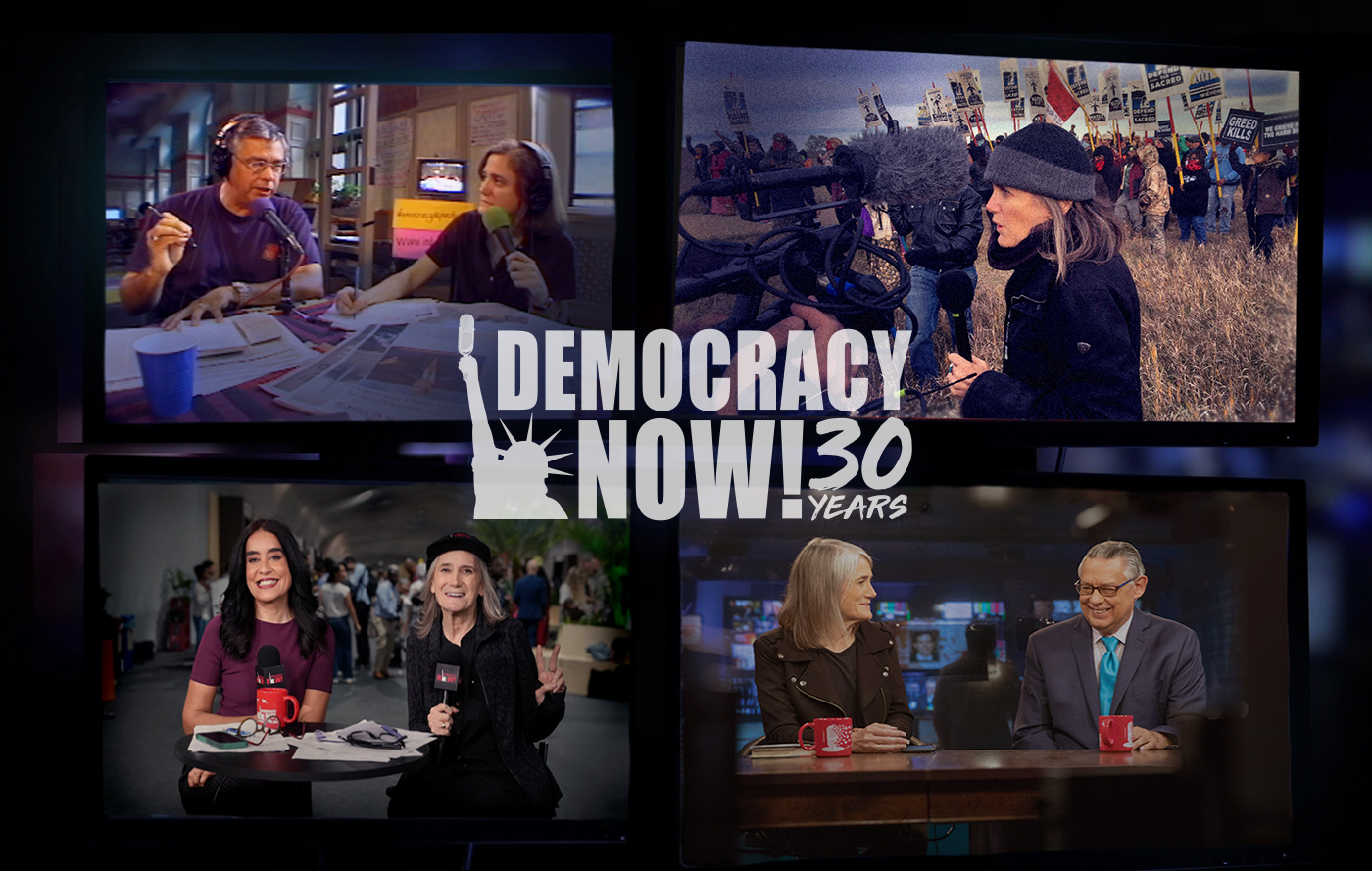
And that does it for our show. This week, I’ll be speaking after screenings of the film about Democracy Now!, Steal This Story, Please!, with the film directors here in New York at the IFC Tuesday, Wednesday at the Museum of Contemporary Art in Westport, Connecticut. Then I’ll be in London, England, Friday through Monday, Friday night at 8:00 at the Hackney Picturehouse, Sunday at Cinéma Lumière in London at noon, and next Monday at the Lewes Depot near Brighton at 8 p.m. Then I head to Copenhagen, Denmark, Tuesday for the screening of Steal This Story, Please! at Grand Theatre at 7:00. Next Wednesday through Friday, I’ll be in Berlin broadcasting Democracy Now!, September 30th through October 2nd. On Thursday, October 1st, the film will play at Spore in Berlin at 7:00. Check our website for all the details at democracynow.org. I’m Amy Goodman. Thanks so much for joining us.



 Top
Top
Media Options