










 Watch Full Show

Topics
Guests
- Wiebke Judithlegal policy spokesperson for PRO ASYL, a German NGO working for the human rights of asylum seekers and refugees.
Links
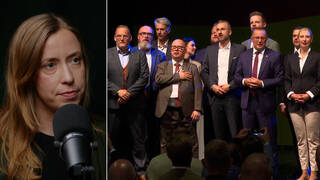
As we continue our coverage on the rise of right-wing political parties across Europe, we speak to Wiebke Judith from the German organization for asylum seekers’ rights, PRO ASYL, about Germany’s far-right party Alternative für Deutschland, or AfD, and its recent wins in September’s state elections. Judith calls the historic wins — won by margins not seen in German elections since the Nazi era — “deeply concerning for everyone who cares about our democracy,” and says that the growing influence of the AfD’s anti-immigration stance over the German political landscape poses grave risks to refugees, asylum seekers, immigrants and ethnic minorities in the country.
Related Story
 StoryJun 11, 2024“Clear Shift” Toward the Far Right: Anti-Immigrant Nationalists Gain Ground Across Europe
Transcript
AMY GOODMAN: This is Democracy Now!, democracynow.org. I’m Amy Goodman in Berlin, Germany, with Nermeen Shaikh in New York.
NERMEEN SHAIKH: We end today’s show with a look at broader militarization and the immigration crackdown in Germany and the European Union. This is EU Migration Commissioner Magnus Brunner speaking to Reuters last week, saying that the European Union needs to, quote, “control migration flows.”
MAGNUS BRUNNER: Well, 10 years ago, when the first crisis started with the migration flows towards Europe after the Syrian crisis, Europe took a lot of responsibility. But we didn’t have a system. We didn’t have rules. And that’s why we didn’t have control over who comes into the European Union, who can stay, and who has to leave again. And that’s why the member states agreed, after years and years of discussion, on the Pact for Migration and Asylum. And that was — that was the actual reason, to get control back. This is actually what we need in the European Union.
AMY GOODMAN: So, this comes as Germany’s far-right AfD party has made significant electoral gains in state elections in September, which could result in the German state being controlled by a far-right extremist party for the first time since World War II. AfD champions restrictions on migration and promotes so-called remigration, which amounts to a policy of mass deportation.
For more, we’re joined here in Berlin by Wiebke Judith. She’s the legal policy spokesperson for PRO ASYL, a German NGO working for the human rights of asylum seekers and refugees in Germany and Europe.
Thank you so much for being with us. In these last few minutes we have together, can you talk about what the AfD victories mean for asylum seekers and refugees in Germany?
WIEBKE JUDITH: Yeah. Thank you so much.
First of all, of course, the win of the AfD in Saxony-Anhalt, but also the gains they have made across Europe, is deeply concerning for everyone who cares about our democracy, but especially for people who are targeted by their policy. And for the first time ever, them taking control of government could mean that they can make policies that will directly impact refugees, asylum seekers, of course, also other people with a migration background. And this could mean excluding refugee children from schools. This could mean further restricting of benefits. They might try to stop any asylum seekers being brought to that specific federal state. So, a lot of people have fear. But I also do want to highlight, I think already in the last years they have quite successfully managed to push the center parties towards their policies, and I think that is just as concerning.
NERMEEN SHAIKH: And, Wiebke, if you could talk about the transformation of the discursive, the conversation around immigration in Germany? I mean, it was in 2015 that Angela Merkel made it a policy to admit refugees, in particular from Syria, to the point that now there are almost, I believe, a million Syrian refugees in Germany, and now — so, that was 2015. What has happened that has led to this kind of backlash against refugees in Germany?
WIEBKE JUDITH: Over the last 10 years, we for sure have seen quite a shift of the German migration policy towards the right. It’s not like a straightforward at this time it went in the other direction, but it’s just something that has developed. And there have been, you know, a lot of anti-migration campaigns in the media by right-wing or even center parties. So, for almost 10 years, migration has again and again been put on the top of the agenda as supposedly the biggest issue in Germany.
What I do think we currently see is that, again, it’s shown no — it’s other issues that are very concerning, with regards to housing or the retirement system. But I think constantly having put migration and asylum on top of this agenda has led to quite a hostile environment. But what we have seen in the past, as well, is also there is still a lot of solidarity with refugees in Germany. Also, Ukrainian refugees were welcomed in the last years, and we still see a lot of people, day to day, supporting refugees in their work. So, I think this, really, we have to consider, as well.
AMY GOODMAN: And finally, your group, the work that it carries out in Germany and Europe, the space you find for it, and the movements, how successful they are in pushing for the rights of migrants and asylum seekers?
WIEBKE JUDITH: What we do focus on currently, but have been doing for many years in Germany, but with partners across Europe, is really litigation, because it is quite hard at the moment to have political wins. But we have fundamental rights. We have human rights. And there is still a functioning court system that we can use.
What is quite concerning is that we see that if there are wins in front of courts, governments are not perceiving it that well anymore. They might implement it or might not, and they might use it to really also campaign against our core human rights, such as the European Human Rights Charter. So, these are developments that we see increasing, and we are quite worried. But for the moment, I think going to court is still a good way.
AMY GOODMAN: And how much public support do you have?
WIEBKE JUDITH: Well, it always depends, of course, who you ask. And we can’t deny that there has been a shift within the German population, as well. But again, I want to highlight, there are many people who every day support refugees and other people coming to Germany. So, I think people are, of course, a bit swayed by some of these narratives that have been pushed again and again and again, as migration being the main concern, but there are also many people who see and who know people in their daily life who’ve arrived 10 years ago, perhaps, but who are now member of the community, who arrive and who fill job gaps that otherwise are not filled, who arrive, who are part of school, etc. So, we also then, again, always see a lot of protests when there’s, for example, an effort to return such people. And people come together to protect their neighbors, to protect people at their workplace.
AMY GOODMAN: I want to thank you so much, Wiebke Judith, legal policy spokesperson for PRO ASYL, a German NGO working for the human rights of asylum seekers and refugees in Germany and Europe.
Democracy Now! is currently accepting applications for an individual giving manager to support our fundraising team. Learn more and apply at democracynow.org.
Tonight, I’ll be at Spore here in Berlin, Germany, for the screening of Steal This Story, Please!, the documentary about 30 years of Democracy Now! I will be there with the director of the film, Carl Deal. It’s at 7:00. It’s free. People should come early. Check our website. I’m Amy Goodman, with Nermeen Shaikh.




 Top
Top
Media Options