











 Watch Full Show

Topics
Guests
- Laiken Jordahlnational public lands advocate with the Center for Biological Diversity who previously worked at Big Bend National Park.
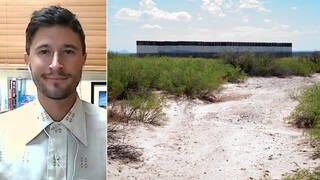
In a victory for environmentalists and immigration rights’ advocates, a federal judge in El Paso, Texas, has blocked further border wall construction inside Big Bend National Park. “We slammed the brakes on $7 billion worth of corrupt construction contracts,” says Laiken Jordahl, a national public lands advocate with the Center for Biological Diversity, which sued to block the expansion. “We have effectively stopped construction across West Texas, and it’s incredible.”
Jordahl also responds to the Trump administration’s excavation of a 200-year-old cottonwood tree on the Arizona-Mexico border that had been protected by activists for months. “Watching those videos of them toppling this ancient tree that was very likely older than the border itself is symbolic of how DHS has treated the border region. They see our communities, our wildlife, our nature as a sacrifice zone,” says Jordahl.
Related Story
 StoryAug 28, 2026“Shut Down Dilley”: Rep. Joaquin Castro on “Abusive” ICE Family Jail, Targeting of Military Families
Transcript
AMY GOODMAN: This is Democracy Now!, democracynow.org. I’m Amy Goodman, with Juan González.
We end today’s show with a victory for environmentalists. On Friday, a federal judge in El Paso, Texas, temporarily blocked the construction of new border wall and roads in Big Bend National Park and nearby areas. Judge Kathleen Cardone said her preliminary injunction will remain in place until a lawsuit filed by the Center for Biological Diversity and others is resolved. The judge also signaled the plaintiffs’ constitutional claims against the border wall expansion are likely to succeed in court.
In August, bulldozers started tearing into Big Bend National Park but were met with growing resistance from protesters and advocates who have long warned of the devastation border militarization has had on desert and other sacred ecosystems along the U.S.-Mexico border.
Well, for more on this, we go to Tucson, Arizona, where we’re joined by Laiken Jordahl, national public lands advocate with the Center for Biological Diversity.
Welcome back to Democracy Now!, Laiken. Explain this victory. And wasn’t this a Republican-appointed judge who ruled against the Trump administration?
LAIKEN JORDAHL: Yeah. It’s so nice to be back to share some incredible news. We had what I would call a truly historic victory in court on Friday. Effectively, we slammed the brakes on $7 billion worth of corrupt construction contracts, not just in Big Bend National Park, but across almost one-third of the entire U.S.-Mexico border. No victory like this has ever happened before. Of course, you know, this is not the end of the road. We have a lot to continue to fight for. But we have effectively stopped construction across West Texas, and it’s incredible.
JUAN GONZÁLEZ: And could you talk about the growing opposition to Trump’s border enforcement militarization campaign, not only in Texas but across the border in states like Arizona, as well?
LAIKEN JORDAHL: Yeah, you know, it really feels like an incredible moment for the borderlands. We’ve got so much solidarity and connections to what’s happening in Lochiel with the cottonwoods being cut down, what’s happening in the Rio Grande Valley, where walls are still going up.
And while this victory only applies to about one-third of the border in West Texas, we really hope that this shows that DHS’s power is not infinite. They have used this waiver authority to strip away the rights of communities, of wildlife, of Indigenous nations, and now for the first time, a court has said that this waiver authority is very likely unconstitutional. So, my hope is that this win can spread across the borderlands and that we’ve really shown the chink in the armor of this waiver authority that has been abused by DHS and enabled so much damage across the borderlands for more than two decades now.
JUAN GONZÁLEZ: And could you talk a little more about how these border communities have been disrupted, especially the desert and the ecosystems of these communities?
LAIKEN JORDAHL: Yeah, the wall has already inflicted so much damage across the entire border region. We’ve seen walls go up through national park units like Organ Pipe and Coronado National Memorial in Arizona. We’re now seeing the huge fight to build walls across the sovereign Tohono O’odham Nation on the border in Arizona.
So, when these walls go up, they are not following any of our nation’s most important environmental laws. That means they’re not doing meaningful surveys for Indigenous grave sites or sensitive species. It means that they’re not following laws like the Clean Air Act, the Clean Water Act, so tons of public health issues have arisen from wall construction. We have seen walls go up across the vast majority of my home state of Arizona, and that means that no wildlife larger than a jackrabbit is able to cross north or south. That’s a direct threat to their survival and leads to localized extinction. We are doing everything in our power to protect the remaining wildlife corridors left along the border. And the Big Bend region is the largest stretch of unwalled border. So, we’ve got a ways to go.
Interestingly, this injunction cannot be appealed to the 5th Circuit. It’s a bit of a poetic twist, because the way they wrote these waivers, they actually did not allow for appellate court review. So, if DHS wants to challenge this injunction, they’re going to have to go straight to the Supreme Court, which is a process that, for one, takes some time, and, for two, the Supreme Court has a lot on their docket. And there’s some indications that, you know, the arguments that we’ve used to win this case are actually more favored by conservative justices.
So, this is a historic time. It’s amazing. It feels — you know, it’s the biggest win of my life, and it belongs to everybody who’s been fighting so hard to stop this destruction across Big Bend. And we should absolutely savor it.
AMY GOODMAN: We want to thank you so much, Laiken Jordahl, for being with us. A 20-second response to what happened in Lochiel, in your state of Arizona, with the large excavator brought in by the Border Patrol agents destroying a more than 200-year-old cottonwood?
LAIKEN JORDAHL: Yeah, just. horrific. I mean, watching those videos of them toppling this ancient tree that was very likely older than the border itself is symbolic of how DHS has treated the border region. They see our communities, our wildlife, our nature as a sacrifice zone, that have allowed presidents from both parties, honestly, to play out security theater at the expense of our homelands. So —
AMY GOODMAN: Laiken Jordahl, we have to leave it there, of the Center for Biological Diversity, joining us from Arizona. I’m Amy Goodman, with Juan González, for another edition of Democracy Now!





 Top
Top
Media Options