






 Watch Full Show


Guests
- Viktor Suliandziga-BagatIndigenous rights activist and representative of the Udege people from the Russian Far East living in exile for fear of persecution.
Human rights and climate groups are calling on Russia to release two prominent activists, Daria Egereva and Natalia Leongardt, who have been held in pretrial detention in Moscow for nearly a year, since December 2025. Egereva, a leading Indigenous rights activist in Russia, was arrested shortly after attending the COP30 United Nations climate summit in Belém, Brazil, where she served as co-chair of the International Indigenous Peoples Forum on Climate Change. Leongardt has worked for decades to support Indigenous rights.
“Right now all we are demanding is the release of Daria and Natalia, because they shouldn’t be in prison. You shouldn’t be arrested for activism,” says Viktor Suliandziga-Bagat, an Indigenous rights activist and representative of the Udege people from the Russian Far East. He is living in exile due to the risk against activists. “I don’t think I can come back to Russia,” he says.
Related Story
 StoryNov 19, 2026“Defend the Sacred”: Indigenous Activist on Climate & Alaska Native Mary Peltola’s Senate Victory
Transcript
AMY GOODMAN: This is Democracy Now!, democracynow.org, at COP31. I’m Amy Goodman, with Nermeen Shaikh.
NERMEEN SHAIKH: Human rights and climate groups are calling on Russia to release a prominent Indigenous climate activist, Daria Egereva. She’s been held in pretrial detention in Moscow for nearly a year, since December 2025. She was arrested shortly after attending the U.N. climate summit last year in Belém, in Brazil, where she served as co-chair of the International Indigenous Peoples Forum on Climate Change. She’s facing terrorism charges, which have been denounced by Amnesty International and other groups.
AMY GOODMAN: This is a clip of Daria speaking at the U.N. climate summit in Madrid, Spain, in 2019.
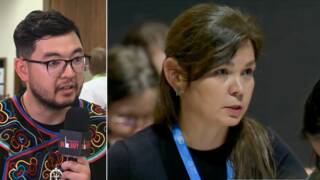
DARIA EGEREVA: My community is located deep, deep in the forest, taiga forest, and my people call themselves forest people. It means our life and our future depends on forest and products of forest, its nuts, berries. mushrooms, and rivers, which are also in the forest. So, we call them some forest people, and it means life for us.
AMY GOODMAN: So, that was Daria Egereva speaking at the U.N. climate summit in Spain, 2019. She was also in Belém at COP30. And when she came back to Russia, she was arrested, December 17th last year, when Russian authorities conducted raids across the country targeting Indigenous activists and human rights defenders.
We’re joined right now by Viktor Suliandziga. He is an Indigenous rights activist and representative of the Udege people from the Russian Far East. He’s living in exile, fearing persecution over his advocacy for environmental protections, land rights and the sovereignty of Indigenous communities in Russia’s north, Far East and Siberia.
Viktor, thanks for joining us here. I’m wondering if you can start off by talking about Daria, also another leading activist, who has been in prison since that raid, and what you’re calling for.
VIKTOR SULIANDZIGA-BAGAT: Well, you mentioned Daria Egereva. She is the co-chair of Indigenous Peoples Caucus of Climate Change. But also another person was arrested in Russia, which is Natalia Leongardt. She is not Indigenous, but she did all the hidden work to help Indigenous peoples, independent Indigenous activists, to come to these spaces and actually talk about the real problems that Indigenous peoples in Russia are facing.
And along with them, there were 17 other Indigenous leaders and activists who were raided. Their technical devices were confiscated. And some of them had to leave Russia because of — also because of the risk of their arrests. And those people are also still — they’re still coming to COPs to speak about these problems, because all these voices were taken from the others, and now it’s their responsibility to share with the world of what is actually happening in Russia.
NERMEEN SHAIKH: But explain. Explain. Why is Russia targeting Indigenous communities? And talk about this Aborigen Forum.
VIKTOR SULIANDZIGA-BAGAT: Aborigen Forum is one of the 55 organizations that was recognized as separatist organization, but it’s actually — it’s not a real — like, it’s not formalized organization. It’s just a group of leaders who would come together, who would share their problems, make a strategy, and, like, they’ve just participated independently and not seeking support from the Russian government to speak about the problems, because there are organizations that are funded by the government and that are spreading the propaganda in such spaces.
AMY GOODMAN: In this last minute we have, if you can talk about what you’re calling for now, the number of Indigenous people in Russia, and what’s at stake?
VIKTOR SULIANDZIGA-BAGAT: There are — according to Russian legislation, there are only 40 ethnic Indigenous that population of which is less than 50,000. And all those peoples, they really rely on the nature. They rely on the forest. And the climate change has a tremendous effect on them. So we need those voices to actually speak, to share, because they have, like, those, like, sustainable practices that could be shared with the world. But their voices are being silenced, and they cannot come anymore.
AMY GOODMAN: And you’re here participating in U.N. COP31. What are you calling for when it comes to climate activism, specifically in Russia, what Daria was calling for last year before she was arrested?
VIKTOR SULIANDZIGA-BAGAT: Like, right now all we are demanding is the release of Daria and Natalia, because they shouldn’t be in prison. They shouldn’t be arrested for their activism, just for promoting —
NERMEEN SHAIKH: Are you concerned that you might be arrested?
VIKTOR SULIANDZIGA-BAGAT: I don’t think I can come back to Russia.
NERMEEN SHAIKH: Ah.
AMY GOODMAN: Well, we’re going to leave it there, and I thank you so much for being with us. Viktor Suliandziga is talking about Daria Egereva and Natalia Leongardt, both who remain in prison in Russia. Viktor is an Indigenous rights activist and representative of the Udege people from the Russian Far East.
Special thanks to our team here in Turkey, to Anjali Kamat, Nicole Salazar, Nermeen Shaikh, Tey-Marie Astudillo, Hany Massoud and Denis Moynihan, and in New York, Mike Burke and Deena Guzder and Messiah Rhodes and María Taracena and John Hamilton and Sara Nasser. This is Democracy Now!, broadcasting from the U.N. climate summit in Antalya, Turkey. I’m Amy Goodman, with Nermeen Shaikh.




 Top
Media Options