






 Watch Full Show

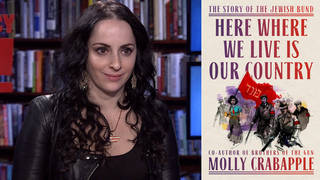
We speak with the acclaimed artist and author Molly Crabapple about her new book, Here Where We Live Is Our Country: The Story of the Jewish Bund. Although largely forgotten today, the Jewish Labor Bund was once a powerful secular, socialist revolutionary party that fought for freedom and dignity for Jews in Europe. The movement formed in the waning days of the Russian Empire in an atmosphere of intense antisemitism, but it “rejected, from the very start, calls to create a Jewish ethnostate in Palestine,” Crabapple says. “They felt that Zionism was a capitulation to the same bigots that wanted to kick Jews out of Europe.”
Bund members — known as Bundists — navigated profound historical changes from the founding of the movement in 1897 until its ultimate destruction in the Holocaust. But Crabapple, who learned Yiddish for the book, says the Bund is not just Jewish history.
“This is a history that belongs to all rebels. It belongs to everyone who believes in the necessity of human solidarity,” she says.
Related Story
 StoryApr 15, 2026“The Future Is Peace”: Maoz Inon & Aziz Abu Sarah on Israelis and Palestinians Working Together
Transcript
AMY GOODMAN: This is Democracy Now!, democracynow.org, The War and Peace Report. I’m Amy Goodman, with Nermeen Shaikh.
NERMEEN SHAIKH: A new study finds a dramatic increase in Israel’s attacks on the Gaza Strip in the five weeks since it halted its airstrikes on Iran. According to the conflict monitoring group ACLED — that is, Armed Conflict Location and Event Data — Israel carried out 35% more attacks on Gaza in April than it did in March. According to the Gaza Health Ministry, 120 Palestinians, including 13 children, have been killed since April 8th. All the attacks came despite a U.S.-brokered ceasefire agreement that was supposed to have taken effect in October.
This is Faiza al-Ajrami, a displaced Palestinian living in a tent in Gaza City.
FAIZA AL-AJRAMI: [translated] The war has not stopped yet. The war has not stopped in order for me to worry that it will return. The war is ongoing. The bombing continues. And every day we hear that there are martyrs here and there. There is grave danger everywhere. Every moment we are expecting a missile to fall on us, on my son or daughter. We are scared.
AMY GOODMAN: Israeli forces continue to occupy more than half of Gaza, forcing over 2 million people to crowd into a thinner sliver of land along the coast. More than a million people are living in makeshift tents, most others in damaged structures.
On Friday, Palestinians across the Occupied Territories plan to mark Nakba Day, the day that marks the mass expulsion of Palestinians from their homes during Israel’s founding in 1948.
NERMEEN SHAIKH: Well, today, we spend the rest of the hour looking at an often-forgotten piece of history about Jewish anti-Zionist activists in Eastern Europe who opposed calls in the early 20th century to form a Jewish ethnostate in Palestine. We’re joined by the award-winning artist and author Molly Crabapple. Her new book is titled Here Where We Live Is Our Country: The Story of the Jewish Bund. The Guardian praised the book, saying, “The relevance of her material for our present moment is impossible to ignore.” Molly Crabapple is an award-winning artist and author.
Thank you, Molly, so much for coming into the studio to talk to us. First of all, congratulations on this spectacular book. If you could just begin by explaining the title of the book, Here Where We Live Is Our Country: The Story of the Jewish Bund?
MOLLY CRABAPPLE: I’m so honored to be here and to be talking with you guys about my new book.
“Here where we live is our country” is a slogan from a Bundist campaign poster in 1918. And I chose it because it encompasses this value that the Bund always held, the value of doikayt, hereness. Born in probably the most antisemitic place on Earth in 1897, the Bund built their philosophy on the defiant insistence that Eastern Europe was their home, and they had a right to live in freedom and dignity and have a beautiful, flourishing life there. And they also rejected, from the very start, calls to create a Jewish ethnostate in Palestine.
AMY GOODMAN: Why?
MOLLY CRABAPPLE: The reasons, they evolved as Zionism evolved, but there were two major ones. The first was that they felt that Zionism was a capitulation to the same bigots that wanted to kick Jews out of Europe. At a time when all of these governments were saying that Jews were swarthy, Oriental foreigners that ought to get the hell out to somewhere else, for Bundists, Zionists seemed to agree.
But after the Balfour Declaration gave Zionism the backing of the British Empire and the British Empire’s bayonets, the Bundists opposed Zionism for another reason. They thought it was the handmaiden of imperialism. And Bundists scrupulously supported on — scrupulously reported the brutality that has always marked Zionism: the expropriation of Palestinian land, the brutal evictions of Palestinian farmers and the collaboration, hand in hand, with the British occupation.
NERMEEN SHAIKH: And, Molly, as you just mentioned that czarist Russia was perhaps the least welcoming place for the Jews of Eastern Europe, and that’s the year that the Bund was — the year — was the location where the Bund was created, and was that — it was the year 1897, which is the same year that Theodor Herzl launched the World Zionist Organization. So, if you talk about this, the coincidence of these two organizations, and also what gave rise to the two in that historical moment and place?
MOLLY CRABAPPLE: It is a great irony of history that 1897, the same year as 13 young Marxist troublemakers were gathering in a safe house attic in Vilna, Theodor Herzl was —
AMY GOODMAN: In Vilna, Lithuania.
MOLLY CRABAPPLE: In Vilna, Lithuania, then part of the Czarist Empire. That same year, Theodor Herzl was launching the Zionist Congress at a ritzy casino in Switzerland. And the two groups hated each other from the start.
But let’s talk about Herzl. Herzl came from a very different background than the Bundists did. He was not a citizen of the decrepit Czarist Empire. Instead, he was a citizen of the Habsburg Empire, which was much more liberal. He came from Vienna, and he loved Vienna. All he actually wanted to do was assimilate. And, in fact, he even joked that maybe Jews should just convert to Christianity. But it was covering the Dreyfus trial in France, when an obviously innocent French military officer named Alfred Dreyfus was banged up on fake charges of spying and then shipped off to Devil’s Island, and then there were huge anti-Jewish riots all over France — this experience of covering the Dreyfus trial as a journalist marked Herzl profoundly, and it convinced him that Europe was just racist at its core, and that as long as Jews didn’t have a state of their own, they would always be at the mercy of European racism. And he would spend the next years of his life meeting with every single despot and autocrat that he could to try to acquire some land in order to create this Jewish state.
AMY GOODMAN: I went to Vilna with my mother and my brother, and a partisan took us into the woods, a woman partisan. And I’m wondering if you can talk about who the Jewish partisans were — it’s a story that’s not very well known — how they were connected to the Bund, and what the Bund at the time, since they weren’t supporting the state of Israel, was calling for.
MOLLY CRABAPPLE: When the Nazis invaded Poland in 1939, the Bund was the most popular Jewish political party in the country. They had swept the Polish elections. They were the majority of Jewish seats in basically every major city in the country. And they were able to keep their underground going throughout the Nazi occupation. And the underground meant many things. On one hand, it meant partisans, but it also meant saving kids, having underground soup kitchens, smuggling newspapers all over the country. A young Bundist named Zalman Friedrich actually went undercover as a Polish railway worker and exposed the truth of the Treblinka death camp to the world.
Now, who were the partisans? The partisans were young Jews, usually either Bundists, left-wing Zionists or communists, who were able to escape to the woods, get weapons somehow, often from, like, the black market, occasionally from Red Army detachments, and to fight until the end of the war. And it was actually Jewish partisans who worked with the Red Army to liberate Vilna from the Nazis.
NERMEEN SHAIKH: Well, let’s just go to some context. As you point out in the book, this history, the history of the Bund, has been almost entirely erased. How did you unearth this history? And speak specifically about your great-grandfather.
MOLLY CRABAPPLE: Well, I grew up obsessed with my great-grandfather, Sam Rothbort. First off, my mom taught me how to paint, and Sam taught my mom how to paint. And so, my whole life, I’ve always viewed the fact that I was an artist as a sort of gift that I had gotten from him through time. But he was also — he was a character, right? I grew up with his paintings all around me, his sculptures, photographs of him hanging from a chin-up bar by his ankles into his eighties, eating fire, playing a violin he made out of Venetian blinds.
And he had this one body of work that I really loved. It was over 600 watercolors that he did of Vawkavysk, his hometown in Belarus, a hometown he had left in 1904. And they were every aspect of life, from him praying on Yom Kippur to him being a bad kid drawing mean caricatures of his rabbi in religious school. And he had one painting that I always loved, and it was a young woman, and she had the long skirt and the hair and an updo, and she was standing on a dirt road at twilight, and she was throwing a rock through a window. And next to her is her boyfriend with more rocks, because chivalry is not dead, right? Ladies should not be carrying her own rocks. And it was titled Itka the Bundist. And this drawing was so different than how I imagined a young Jewish woman would live in turn-of-the-century czarist Russia, that I thought the key to why Itka was so different had to be in that word “Bundist.” And that was how I came across the Bund, through my great-grandfather’s drawings.
And I explored the Bund more in 2018, when I wrote an article for The New York Review of Books, which has been the most viral article I’ve ever written in my life, that told the Bund story, from its birth in the Czarist Empire through its role in the Russian Revolution, interwar Poland, to its ultimate destruction in the Holocaust.
And after I wrote this article, these amazing older people got in touch with me, people like the pioneering lesbian poet Irena Klepfisz, whose father Michał was the bomb maker in the Ghetto, people like the great union leader Mark Ehrlich, whose grandfather Henryk Ehrlich ran the Bund in Poland. And when I started hearing these stories from these amazing people about their families, I knew I was not finished with this. This was not going to be just like one article. This was going to be my life for quite some time. And so, that’s how I made the decision that I was going to write this book.
AMY GOODMAN: And talk more about going from the Bund and its role in the Warsaw Ghetto Uprising, which is so often ignored, to the anti-Zionist movement in the United States. I mean, you are telling a story. You’re uncovering a story through your own family that leads right to your, to say the least, marvelous illustrations. You’ve won two Emmys for your illustrations and your writing. And how your grandfather and great-grandfather influenced you both in your politics and your artistry?
MOLLY CRABAPPLE: Thank you. I mean, even though Sam died before I was born, I feel like he’s someone who shaped my entire life, not just the fact that he was a painter, not just the fact that being surrounded by paintings gave me permission to dream of being an artist. It was that Sam was a nonconformist in his bones. And he was a leftist. He was someone, at a time when intermarriage was kind of taboo, who welcomed my Puerto Rican father. He was someone who believed that everyone was created equal, even if he thought that artists were a little bit above. And I feel myself shaped by him.
Now, in terms of the anti-Zionist movement and the Bund and the Warsaw Ghetto, the Warsaw Ghetto revolt was the work of a group primarily called the Jewish Combat Organization, which was left-wing Zionists, Bundists and communists. There were other people in the ghetto that fought, but that was the main group. And these were very young people. The youngest fighter was 13 years old, who was a Bundist named Lusiek Blones. They had 50 guns from the Polish Home Army and one machine gun and homemade Molotov cocktails and light bulbs filled with battery acid. And with that, they launched the first urban revolt in Nazi-occupied Europe, and they held off the Nazis longer than the entire country of France. But as we know, courage cannot ultimately compete with airplanes and firebombs, and the Nazis annihilated 90% of Poland’s Jews.
After the war, there were pogroms in Poland that led to the majority of the Jewish community fleeing to displaced persons camps in American-occupied Germany. And these Jews spent years applying for visas to Western democracies that refused to accept them. Meanwhile, in the camps, Zionist groups quickly seized control of the camp administrations, and they used this power, which was, again, the power to distribute rations, the power to give people jobs and housing, to coerce people to join the Haganah and eventually to take part in the Nakba and the creation of Israel.
And despite this intense pressure, despite the unspeakable horrors that Bundists had went through, they held firm to their belief in internationalist solidarity and their opposition to a Jewish state. And there’s a line that I think of from the great Bundist pedagogue Shloyme Mendelson. It was in the last article he wrote before his death in 1948, where he said that it was shocking that Jews who had been the primary victims of fascism were now adopting its methods to suppress dissent in the Jewish community. And he wrote, “It’s as if the slaughterer has infected the victim with his germs during the slaughter.”
NERMEEN SHAIKH: So, Molly, I want to talk about one of the very interesting parts, or, let’s say, form of the book, is the perspective from which you write. Your work, it seems to me, follows in the tradition of people who write a history from below, representing the voices of those who are oppressed, the subaltern outsiders. And you’ve said explicitly that you came to see you were writing not just about the Bund, but also, quote, “a history of the 20th century from the point of view of the defeated.” So, if you could elaborate on that, and then the case you make again and again, that the Bund was, in fact, not a failure — it was defeated — and that’s a very different thing?
MOLLY CRABAPPLE: The Bund story from 1897 to 1945 is the story of the 20th century in Europe. It is the story of World War I, of the collapse of the old multiethnic empires and the creation of new violently nationalist ethnostates. It’s the story of the Russian Revolution and the Russian Civil War. It’s the story of independent Poland and the story of the Holocaust.
And one of the sort of guiding quotes that I had in my mind when I was writing this book was by Mahmoud Darwish. It’s the quote that I start the book with, where he says — let’s read it. “Soon we will search / in the margins of your history, in distant countries, / for what was once our history.” That’s Mahmoud Darwish, “Eleven Stars Over Andalusia.”
And this quote was a guiding thing for me, because the Bund, they never took state power, right? They were kicked out of Russia by the Bolsheviks. They fought a valiant fight and became the most powerful Jewish party in Poland between the wars. But ultimately, you know, Poland was run by nationalists, Polish nationalists. And they were — they were murdered during the Holocaust, and then the remnants of them were suppressed by the Soviet-backed dictatorship afterwards.
And so, there aren’t the resources about the Bund that there would be about the people who won, right? Like there is not the things that you’d read about George Washington or Vladimir Lenin, for that matter. So, instead, writing about the Bund, it was a project of searching in the margins of other histories, of reading other people’s memoirs, of going to countries — like, I went to Ukraine during the Russian invasion, I went to Lithuania, I went to Poland — and looking at the margins. And then, also, the Bund wrote in Yiddish, which is the language of the Jewish working class of Eastern Europe. This is not a largely spoken language today. Yiddish never had state power. It never had the resources to have an Académie Française, you know? And in order to write about the Bund, I had to learn Yiddish. And so much of this process was about going through these archives, looking at pages that were printed with hectograph, that were so faded and crumbled that I could barely make out those letters. It was like an act of necromancy and an act of reclamation.
AMY GOODMAN: Also, you quote at the beginning of your book, Molly, “Tradition is not the worship of ashes. It’s the preservation of fire,” Gustav Mahler. If you can talk about what that means to you, and also the researching, writing, traveling for this book in the midst of what Israel was doing in Gaza?
MOLLY CRABAPPLE: I used that quote because, for me, this book is not just taking some dinosaur bones — right? — and putting them in a glass case at a museum. This is the preservation of our leftist past. I mean, the Bund is a Jewish story, but it is not for Jews alone. This is a history that belongs to all rebels. It belongs to everyone who believes in the necessity of human solidarity. And I viewed this book as my contribution towards the preservation of that fire.
I mean, the research I did for this book is a bit lunatic, I would say. I think, because I don’t have a college degree, I came in with a sense of inferiority. I was like — I was like, “I must learn everything.” I read every single book I could in English, Spanish, French, and then, eventually, Yiddish, as well. I had Polish and Russian research assistants who showed me perspectives like that of the great Polish socialist Zygmunt Zaremba, a comrade of the Bundists. I translated endless Yiddish pamphlets, including many pamphlets that have never been digitized before, especially anti-Zionist Yiddish literature from the Bund. I translated the work of their enemies, as well, of Bolsheviks, of Zionists.
I traveled to countries where the very urban grid had been erased in the streets the Bund walked. Warsaw was systematically destroyed by the Nazis during the war. The streets that the Bund lived on, that they had their battles on, largely aren’t there. But I wanted to see what the sunlight was like, and I wanted to see what wildflowers grew there. And I went to the grave of Pati Kremer, who was one of the pioneers of the Bund. Her grave was outside Vilnius in Ponar Forest. And I played the song that she sang with the women before she was murdered, which is “Di Shvue,” “The Oath.”
And, I mean, how did this feel to write the majority of this during the Israeli genocide of Gaza? I mean, I think it broke me in probably ways that I have difficulty expressing, I mean, to forensically reconstruct the genocide of the Jews of Warsaw while a country that claims the Holocaust as some sort of sick justification for its crimes does a genocide in Gaza, as it segments and liquidates Gaza block by block, as Israeli bulldozers and bombs efface Gaza like Nazi bombs effaced Warsaw. You know, there were often protests for Palestine downstairs at the library where I worked, and I would go down and join them.
AMY GOODMAN: Molly Crabapple, author of the new best-selling book Here Where We Live Is Our Country: The Story of the Jewish Bund. It became a New York Times best-seller before it was even published.
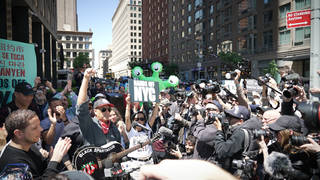
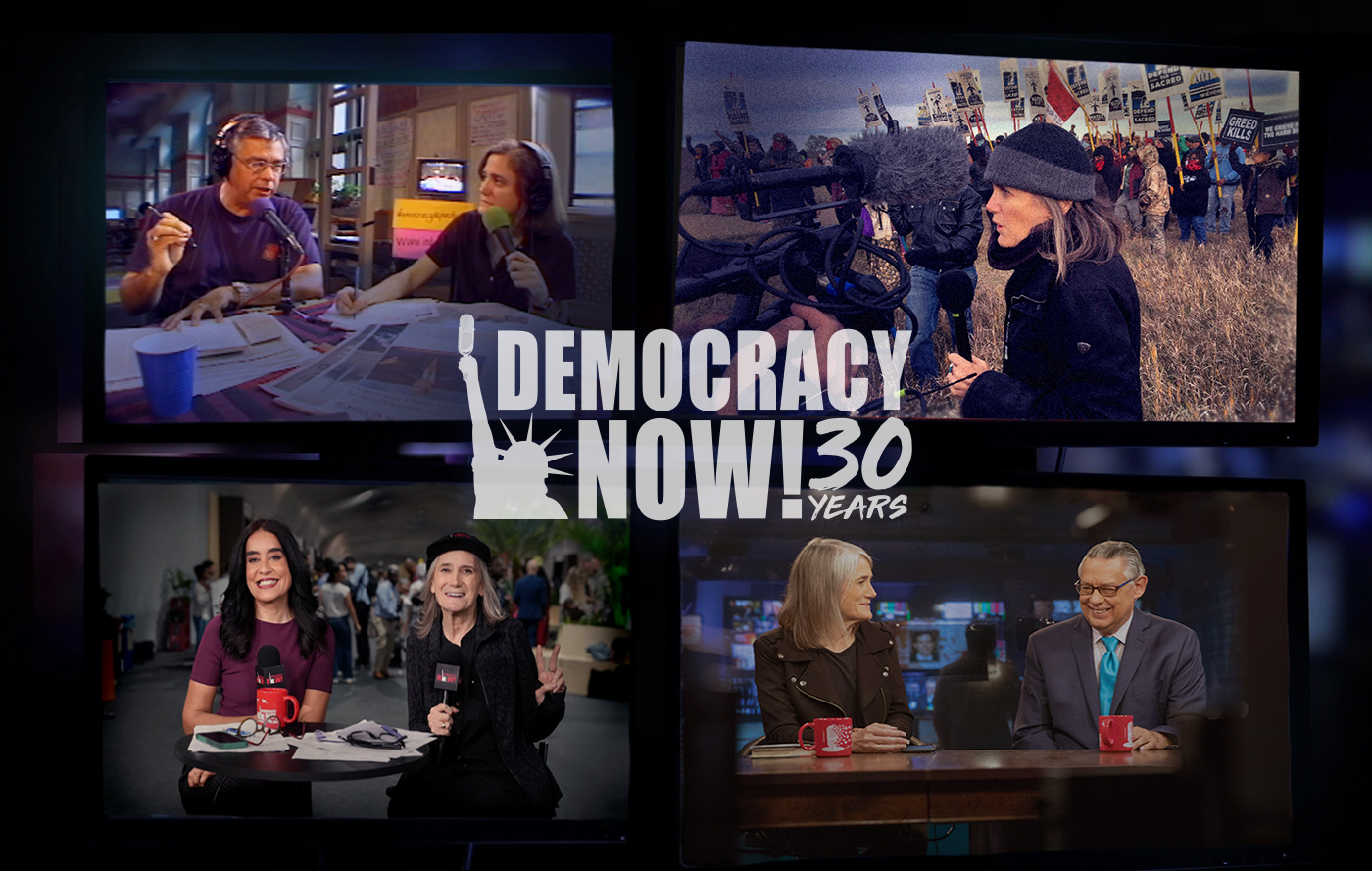
That does it for our show. I’ll be in Atlanta, Georgia, on Friday night. We’ll be celebrating WRFG, also showing the film about Democracy Now!. It will be screening. That screening will take place in Atlanta. On Saturday, we’ll be in Austin, Texas, and we’ll also be in Houston, Texas, this weekend, celebrating KPFK [sic], as well as KOOP Radio in Austin. You can check our website — KPFT in Houston, which was blown up by the Ku Klux Klan when it first was founded in 1970. To see the travel plan for this weekend and showing of Steal This Story, Please!, go to democracynow.org. I’m Amy Goodman, with Nermeen Shaikh.



 Top
Top
Media Options