










 Watch Full Show

Amnesty International’s 2025 report on the global use of the death penalty finds that executions have surged to their highest recorded number in over 40 years, driven largely by the expanded use of political executions in Iran to “create a climate of fear and intimidation in the society and deter dissent.” Amnesty recorded 2,707 executions in 2025. But the data excludes China, believed to be the world’s top executioner, because its government does not release any public data on executions. While the majority of countries around the world have banned the use of the death penalty, Raha Bahreini, who contributed to the report, says the 17 countries that carried out executions last year “keep insisting on the use of the death penalty as a tool of control and repression.”
Related Story
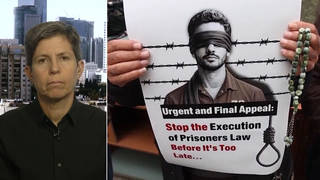
 StoryApr 02, 2026Israel’s Death-by-Hanging Law Marks Further “Dehumanization of Palestinians”: B’Tselem
Transcript
AMY GOODMAN: This is Democracy Now! I’m Amy Goodman.
We end today’s show looking at the death penalty. Amnesty International has found global executions surged to a 44-year high last year, the spike in executions driven by Iran, where 2,100 people were executed, more than double the number there in 2024.
We’re joined now by Raha Bahreini, human rights lawyer and researcher on Iran for Amnesty International, contributed to the new Amnesty International Global Report on death sentences and executions in 2025.
Raha, talk about what happened in Iran in the last year.
RAHA BAHREINI: Hello, Amy. Thank you for having me.
Iran has been the second executioner in the world for decades. However, even by the authorities’ own grim record, 2025 was a horrific year. We have recorded the highest number of executions carried out in Iran since the early 1980s. And this is in a context where the Iranian authorities had intensified the use of the death penalty as a tool of political repression to create a climate of fear and intimidation in the society and deter dissent. We documented the execution of over 2,100 people in 2025. Around half of them are for drug-related offenses, which affect the most impoverished sectors of the Iranian society. We also documented an increased use of the death penalty against protesters, dissidents and those accused of espionage, who face grossly unfair trials before revolutionary courts in Iran.
AMY GOODMAN: You mentioned Iran is number two. Let’s talk about number one. Amnesty notes that 2025 death penalty count doesn’t include thousands of executions in China that the organization believes have been carried out, remaining the world’s top executioner, Raha.
RAHA BAHREINI: China has kept the number of executions that it carries out every year a state secret. And as a result, even though Amnesty believes that thousands of executions take place in China every year, we are unable to provide a minimum credible figure. A number of states in the world, including China, Saudi Arabia, the U.S., are the largest executioners in the world year after year. And they, along with Vietnam, North Korea and 15 other countries — so, all in all, 17 countries — constitute a small minority in the world that keep insisting on the use of the death penalty as a tool of control and repression, against this global trend toward the abolition of the death penalty.
So, the report, on the one hand, is grim, because it shows this escalating use of the death penalty by a minority of the states in the world, but it also shows that the global effort for the abolition of the death penalty has succeeded, as two-thirds of the countries in the world now have stopped using the death penalty in law or practice.
AMY GOODMAN: Finally, Raha Bahreini, what is the effect of the U.S. and Israel bombing Iran, when it comes to repression of Iranians?
RAHA BAHREINI: People in Iran now are caught between unlawful Israeli and U.S. armed attacks, on the one hand, and deadly cycles of repression at the hands of Iran’s own authorities. The attacks caused major civilian harm and intensified the economic hardship that people have faced in Iran for decades. And they just started weeks after people in Iran were in a state of collective shock, grief and trauma following the unprecedented January protest massacres.
In the context of the armed conflict, the Iranian authorities have intensified the climate of repression and have used national security and armed conflict as a pretext to carry out further mass arbitrary arrests. Thousands of people have now been arrested. And they have also intensified the use of politically motivated death penalty cases. So, since the armed conflict began in late February, there has been at least 32 politically motivated executions. They included young protesters who had been arrested just weeks earlier, in January 2026, dissidents and those accused of espionage or collaboration with foreign governments, who usually face charges such as enmity against God or corruption on Earth, that are very vague and broad, and they fall under the jurisdiction of revolutionary courts that are fundamentally unfair and rely on torture-tainted confessions.
AMY GOODMAN: Raha —
RAHA BAHREINI: So, the situation now has become very dire, and people in Iran face dual-atrocity risk —
AMY GOODMAN: We have to leave it there. Raha —
RAHA BAHREINI: — potential war crimes and crimes against —
AMY GOODMAN: Raha Bahreini, we thank you so much for being with us, with Amnesty International. We’ll link to the new Amnesty report.
That does it for our show. I’ll be at the IFC Center tonight for Steal This Story, Please! with Nermeen Shaikh.




 Top
Top
Media Options