







 Watch Full Show

Topics
Guests
- Jimmy Munguriekcountry director for the Democratic Republic of Congo at Resource Matters.
- Matthew Kavanaghdirector of the Center for Global Health Policy and Politics at Georgetown University.
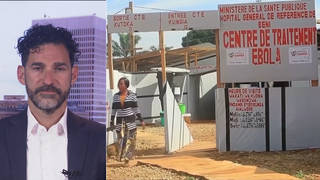
The deadly Ebola outbreak spreading across the eastern Democratic Republic of the Congo has killed at least 177 people, with more than 750 suspected cases reported in the DRC and neighboring Uganda, according to the World Health Organization. Health officials believe the virus may have been spreading undetected for months before the outbreak was identified, raising concerns that the scale of transmission could be far greater than initially understood. The epidemic has spread hundreds of miles away to South Kivu province, now under the control of the Alliance Fleuve Congo, which includes the Rwanda-backed M23 rebels.
Jimmy Munguriek, country director for the Democratic Republic of Congo at Resource Matters, tells Democracy Now! that poor road access, insufficient medical facilities and local stigma about the disease are making it hard to respond to the crisis. “Ebola outbreak is really, really a very urgent issue in the Mongbwalu region,” he says from Kinshasa.
We also speak with Matthew Kavanagh, director of the Center for Global Health Policy and Politics at Georgetown University, who says U.S. international aid cuts and the Trump administration’s withdrawal from the World Health Organization have hampered the response to Ebola. “This is not just an outbreak of a virus. This really is a politically driven … epidemic.”
Related Story
 StoryMay 18, 2026As WHO Declares Ebola Outbreak a Global Health Emergency, Did USAID Cuts Worsen the Crisis?
Transcript
AMY GOODMAN: The deadly outbreak of Ebola in the eastern Democratic Republic of the Congo has caused 177 suspected deaths out of 750 suspected cases in the DRC and neighboring Uganda. That’s according to the World Health Organization. But officials believe the virus may have been spreading undetected for around two months, making the likely death toll much higher.
On Thursday, officials of Alliance Fleuve Congo, which includes the Rwanda-based M23 rebels who seized control of parts of the eastern DRC last year, confirmed a case of Ebola had been found in South Kivu province, which is hundreds of miles away from the epicenter. Authorities believe the first cases originated in Mongbwalu, a region known for artisanal gold mining in the eastern Ituri province. Instability and weak health and infrastructure have made treating patients and containing the spread of the virus more difficult.
On Thursday, protesters set fire to Ebola isolation tents at a hospital in the town of Rwampara after a dispute erupted over the burial of a man suspected of dying of Ebola. A witness says the family had wanted to take the body for family burial at home, which can be dangerous.
WITNESS: [translated] I’m in Rwampara. At the Rwampara Hospital, we’re locked down. Look at the angry protesters. They’re setting fire to the tents of the sick because they want to recover their bodies. And there are a few police officers, who can’t even contain the situation. A significant intervention is really needed.
AMY GOODMAN: We go now to Kinshasa, the capital of the DRC, where we’re joined Jimmy Munguriek. He is country director for Resource Matters in the DRC, an NGO that works on natural resource governance issues to ensure mineral and energy wealth generates benefits locally. He’s also from Bunia, the capital city of the Ituri province.
Jimmy, welcome to Democracy Now! Thank you so much for being with us. You’re right near the epicenter of the Ebola outbreak. You’re from that area, which you visited frequently in your work. If you can talk about the extent of the crisis? And talk about the gold mining region there and why you see that as intimately connected, the conditions, with the Ebola outbreak.
JIMMY MUNGURIEK: Thank you very much. Thank you for that question.
Yeah, as you say, today, Ebola outbreak is really, really a very urgent issue in Mongbwalu region. And what makes it be more urgent, because, as you already said that, it was discovered after, like, two months since it started. That is one thing, which makes now the response to be not very easy in the area. But that area has some characteristics that is likely to make that the Ebola outbreak to be spread very, very quickly. I can mention some of them.
Firstly, the access to the region is very, very difficult because of the poor road condition, and also in some areas there is not even the roads, because it is a mining area, but more artisanal mining. And that brings to another issue or challenge that can make the outbreak, Ebola outbreak, to spread very quick, is their behavior, the behavior of artisanal miners in the area. In their behavior, they trivialize everything almost. And even now when the Ebola case is very real, some of those artisanal mining still think that Ebola does not exist, that it is a kind of curse in the region because of the gold, gold in the area. So, that one also makes now the response to be not very, very effective in the area, because that behavior, since they believe that Ebola — they think that Ebola is not real Ebola, but it is some kind of disease which was thrown on the populations, and that comes also with those African culture, the way they consider things, and it makes it now difficult for Ebola to be — to have a very strong response.
And another challenge is that, you know, the area is really — as I mentioned, there is poor road conditions, but there is also not enough healthcare facilities compared now to how — the number of cases now. For example, now all the hospitals are populated with those who are sick. And now those who are sick at home, they fear to go to the hospital, because think that when they reach the hospital, they will be — it will be told that they have Ebola. And no one need to die, say that “I’m dead of Ebola,” because if someone dies from Ebola, can’t easily, when they — you know, in the African culture, they still have, example, a kind of consideration to the dead body. And when they manipulate the dead body, it is spreading again the Ebola, the Ebola outbreak.
So, those are some challenges. And another one is the insecurity in the zone. You know, the eastern part of the Congo have been in insecurity for many years. And now also where there is — where the Ebola started, in Mongbwalu region, as I mentioned, that region is divided between two army groups. They are not rebels, but they are militias groups. And then, to move from another side to one side, from one side to another side of the area, maybe they need to go through those insecurity zones. And that means that those who are maybe affected at their home, they have now difficulties to reach the health facilities where it is. And that one also complicates a lot, a lot the response which can be given to Ebola spread.
The government has taken some decisions just today to limit the — I mean, the gathering of people to a maximum of 50 people, but that decision has been taken this morning. But for those areas, as I said, in Mongbwalu region, and also the area around Mongbwalu, it will not be easy to applicate those decisions from the government, from the provincial government, because they have their way of thinking, as I say, their behavior of trivializing everything. They will even trivialize that, the decision from the government. And that is very, very dangerous for the area. And I think what the government should do is to see that, how they deploy a lot of — now, beyond such decisions, I think it needs even some police accompaniment to make sure that the communities are obeying those rules edicted by the provincial government. Other way, it is really very, very difficult.
You are hearing about the statistic. Those are the official statistic. But on the ground, the statistic is very higher than what is official, because when we talk about the death case for today, about more than 180 persons have already died of Ebola since it started. That is the official statistic, but it doesn’t include those who are dying at home and buried in their own way, fearing that their relatives to be declare of dying of this.
JUAN GONZÁLEZ: Jimmy — Jimmy Munguriek, I wanted — I wanted to ask you, in terms — because the Mongbwalu area is so close to Uganda, is it your sense that many of the miners are migrant laborers? Or are they local folks? In other words, to what degree can the actual people working on the mines who contract the disease spread it to other areas, especially to Uganda, and as well as other areas of the Congo?
JIMMY MUNGURIEK: Yeah. Thank you. You know, you know that Kinshasa is very, very far from Uganda. And from all that region of Mongbwalu and Bunia, Uganda, especially Kampala, is considered to be like a capital for those who are in Mongbwalu and in Bunia and all those areas, even in North Kivu. So, they consider Uganda to be very closer. Even economically, all these areas is depending on Uganda. So, I mean, the Ebola outbreak is likely to be spread very quickly, because there is a very high level of movement of people and goods between Uganda and Congo.
But yesterday at night, the Uganda government also took some decisions. And among those decisions is to not admit for the public transport used in the borders between Uganda and Congo. Now there might not be a public transport. So, it is prohibited to have the public transport, and that decision was taken by Uganda. And it is a way of limiting, to limit the Ebola to be spread to Uganda side. And also among those decisions is that the companies or the flights from Uganda to Congo will be closed after 48 hours. That means since tomorrow, all the flights from Uganda to Congo, or from Congo to Uganda, will not be operated. So, that is some decisions taken by Uganda just to limit the Ebola in the area.
AMY GOODMAN: Jimmy — Jimmy Munguriek, we have to leave it there, but, of course, we’re going to continue to cover this, country director for the DRC, an NGO that works on natural resource governance to ensure DRC mineral and energy wealth generates benefits locally and contributes to a fair and inclusive energy transition.
There is currently no vaccine for the Bundibugyo strain of the Ebola virus. The Coalition for Epidemic Preparedness Innovations, which funds the development of new vaccines, said at a press briefing in Geneva Thursday that it could be hard to meet their goal of developing a safe, effective vaccine within three months. This is CEPI Board Chair Jane Halton.
We thought we had that clip. But some experts are saying the U.S. has been noticeably absent from the global health response, following the withdrawal of the U.S. from the World Health Organization earlier this year and massive and abrupt funding cuts to global and domestic public health efforts and research.
For more, we’re joined by Matthew Kavanagh, who is director of the Center for Global Health Policy and Politics at Georgetown University.
Professor Kavanaugh, we just have a few minutes, but if you can talk about both the travel bans that the Trump administration is now imposing on foreigners who have traveled in the DRC, Uganda and South Sudan, and the slashing of U.S. aid around the world, how that connects to what we’re seeing with this surging Ebola virus?
MATTHEW KAVANAGH: Amy, thanks so much for covering this issue.
The Trump administration came into office and slashed USAID, slashed all sorts of programs internationally, and many of us were very worried at the time that exactly this was going to happen. The Congolese epidemiologists and doctors and nurses who are confronting this are the best in the world. These are the global experts in how you stop an Ebola outbreak. But what we’re seeing is that they’re trying to do it without the tools that they need. You know, in 2022, there was an outbreak, and they were able to stop it, detect it in a few days and stop it quite quickly. This time we’ve seen a really different course, because it’s been so slow to be detected and so slow to respond. Now we’re hearing that there are folks who are trying to respond on the frontlines without gloves, without masks. This is in large part because hundreds of millions of dollars were cut by DOGE. The Democratic Republic of Congo used to be one of the biggest recipients of USAID funding, not just for surveillance activities that were happening, like trying to actually detect when there were spillovers like this that we’re seeing right now, but also to fight AIDS, to fight malaria. Thousands of health workers were laid off because the Trump administration issued this stop-work order.
And so, what we’re seeing now is folks without the tools to be able to respond, and instead what we’re seeing, the major, major push is a travel ban, which is theater. It’s not public health response. And I think it’s part and parcel of a racist immigration policy that, front and center, tries to, you know, say that we can somehow protect Americans by keeping people out and keeping viruses out. And we just — we know that that’s a failed strategy, right? We’ve seen it in AIDS. We’ve seen it in COVID. We’ve seen it again and again and again. Travel bans are not public health. They’re simply theater that make it look like they’re doing something, when what we know is needed is building those isolation facilities, getting people the PPE they need. That’s the actual response. And unfortunately, the U.S. has now cut hundreds of millions of dollars, huge disruptions to the DRC’s health system, which means people are really struggling to respond.
JUAN GONZÁLEZ: And, Matt, what about this whole issue of the U.S. withdrawing from the World Health Organization, how that affects the situation, a crisis like this, and the importance of community healthcare workers on the frontlines when an epidemic like this erupts?
MATTHEW KAVANAGH: That’s right. The World Health Organization is the global responder to all sorts of things, and the global platform for pandemic preparedness and response. When the United States withdrew from the World Health Organization — we have been the biggest funder, the biggest supporter since its founding — it means that WHO last year had to lay off 2,000 people worldwide, especially in Africa and at headquarters. That’s had a major impact on their capacity to be able to respond to things.
And the bigger picture here is that it’s not just the United States, right? We’ve seen that not only did the World Health Organization — you know, did the United States withdraw from the WHO, but so, too, did Argentina, at the urging of the Trump administration. But we’re seeing this kind of rising attacks on WHO from right-wing forces in the U.K., in Italy, around the world, who are trying to dismantle these international institutions, because they stand in the way of a bigger project that’s a right-wing project. But what we need right now is to invest in these global public goods. And my huge concern is that at this point we’re not seeing countries of the world that want to actually respond, want to support WHO, actually rallying in the way that they need to. Ministers of health are meeting right now in Geneva at the World Health Assembly, and what we should be seeing is massive influx of funding to WHO and a strong political support, but we’re not seeing that. And so, I’m really worried that the kind of right-wing project is actually achieving what it’s trying to do, which is dismantling these international institutions.
And they are, as you were saying, deeply linked to these local folks on the ground, because it is getting them the resources that they need, getting them the protective equipment, because these community health workers that were — thousands of which were laid off by the DOGE cuts, they might be doing malaria care, but it’s somebody that walks into the clinic with a fever, that they then detect might be Ebola and then respond. It’s these frontline health workers who were trying to mobilize to be able to go do the contact tracing, so that you find every single person that somebody with Ebola has been in contact with, and yet organizations have had to lay them off. And so, we really are in a geopolitically driven pandemic. This is not just an outbreak of a virus. This really is a politically driven pandemic — or, epidemic. It’s not a pandemic at this point, I should be very clear.
AMY GOODMAN: And if you, Professor Kavanagh, can talk more about the travel bans and how efficient, effective they are?
MATTHEW KAVANAGH: When we are responding to an outbreak, the way that you do it is to fight it at the source. You need to be able to get supplies in, supplies out, have people move around the world. A travel ban simply says that Ugandans and Congolese people and people from South Sudan are no longer allowed to come to the United States. This only encourages people to simply lie, right? The travel ban, we’ve seen it again and again and again. They simply don’t work. Obviously, we’re in a globalization era. How hard is it for someone to take a flight from one place to another to another and then say on the form, “No, I haven’t been in that place.” That’s simple. Public health is based on trust. And all travel bans do is they tell people not only do you — you know, are you not trusted, but also, by the way, somebody’s out to get you, trying to cripple the economy of these countries. These are countries with millions and millions of people who are far, as you heard Jimmy saying, hundreds of miles away from the outbreak zone. And yet you’re going to try to shut down transport to and from there. That actually undermines the response rather than supporting it, at a time when we need to be actually getting people what they need.
AMY GOODMAN: I want to thank you for being with us, Matthew Kavanagh, director of the Center for Global Health Policy and Politics at Georgetown University, speaking to us from Washington, D.C.
Stephen Colbert signed off last night for the final time as host of The Late Show on CBS. What does that have to do with the massive mega media mergers that are taking place? Back in a minute.
[break]
AMY GOODMAN: Fatoumata Diawara performing “Fenfo,” which means “Something to Say,” here on Democracy Now!




 Top
Top
Media Options