







 Watch Full Show

Topics
Guests
- Augusto ZegarraPeruvian film director.
- Fernando ValenciaPeruvian voice actor and Indigenous activist.
- Dylan Valenciason of Fernando Valencia.
Experts estimate that a language is lost every two weeks — and that half of the world’s 7,000 spoken languages could be lost by the end of the century. Quechua is the most widely spoken Indigenous language in the Americas, with approximately 7 to 10 million speakers living primarily in Peru, Bolivia and Ecuador. But like so many Indigenous languages, Qechua is vulnerable due to cultural pressures and discrimination.
The new documentary Runa Simi — “our language” in Quechua — follows Fernando Valencia, a Peruvian voice actor, Indigenous activist, radio host and single father, who has dubbed many online clips of animated movies into Quechua from his home in Cusco, Peru. In the film, Fernando pursues his most ambitious goal yet: to fully dub Disney’s animated classic The Lion King into Quechua, with the help of his 8-year-old son, Dylan.
“I am sharing our culture to the worldwide culture,” says Fernando Valencia, who started dubbing films after noticing that Quechua-speaking Indigenous children were watching movies dubbed into Spanish that they couldn’t understand.
“There’s like one hour a week of Quechua [in school], so it is very hard to actually learn it,” says Fernando’s son Dylan, who is now 14 years old.
“Indigenous people in Peru are fighting for basic rights, like having water, electricity, healthcare, education in their own language,” says Augusto Zegarra, the director of Runa Simi. “But they also have the right to access entertainment in their own language.”
Related Story
 Web ExclusiveOct 10, 202250 Years After Sacheen Littlefeather’s Oscars Protest, “Prejudice & Racism” Persist in Film Industry
Transcript
AMY GOODMAN: This is Democracy Now!, democracynow.org. I’m Amy Goodman.
Half of the world’s 7,000 spoken languages could be lost by the end of the century. Experts estimate a language is lost every two weeks. Quechua is the most widely spoken Indigenous language in the Americas, with approximately 7 to 10 million speakers, primarily in Peru, Bolivia and Ecuador. But as with so many Indigenous languages, Quechua is still vulnerable due to broader cultural pressures and discrimination.
We turn now to the documentary film Runa Simi. The film follows Fernando Valencia, a Peruvian voice actor, Indigenous activist, radio host and single dad, who’s dubbed many online clips of animated movies into Quechua from his home in Cusco, Peru. The film follows as Fernando pursues his most ambitious goal yet: to fully dub Disney’s animated classic The Lion King into Quechua, with the help of his 8-year-old son, Dylan. This is the trailer for the film.
DISNEY OPERATOR: Thank you for calling the Walt Disney Company. How may I assist you?
FERNANDO VALENCIA: Hi, my name is Fernando Valencia, and I’m calling from Cusco, Peru, in South America. And I have a project that consists of dubbing a Disney film to a language that has never had a dubbed version. The language I am referring to is Quechua, which is the second official language here in Peru. I know this is a random request, but I was wondering if you can please contact me with the right person, or maybe it’s the legal department that I could approach first.
DISNEY OPERATOR: Yes, sir. I’ll be happy to assist you, and I’ll gladly connect you to our legal department. All right, I’m connecting you now. You have a magical day.
FERNANDO VALENCIA: [translated] There are 10 million Quechua speakers that have never seen a blockbuster movie in their own language. My dream is to show the movie in different communities.
DYLAN VALENCIA: [translated] And this will all be mine?
FERNANDO VALENCIA: [translated] That’s good, but you sound like a teenage Simba.
There are so many great movies we’ve all enjoyed, so why the hell can’t the Quechua children enjoy them, too?
Just don’t do it like this. Let me show you. “And this will all be mine?” Like that.
I will never let this language die. It’s more than a language; it’s a worldview.
He is my motivation. He pushes me to do this. I think that if it wasn’t for him, I probably wouldn’t be here, and none of this would have happened.
Ñoqa means “I.” It comes from the heart.
I’ve been playing around with my voice since I was a kid, and now I want to use it for this.
DYLAN VALENCIA: [translated] And this will all be mine?
FERNANDO VALENCIA: [translated] Exactly!
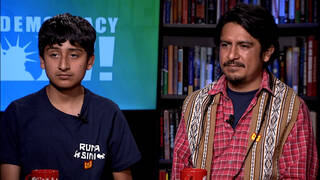
AMY GOODMAN: That’s the trailer for the documentary film Runa Simi, which will be playing in New York this weekend at the Firehouse Cinema downtown. I had the chance to sit down with the film’s director, Augusto Zegarra, and the film’s subjects, Fernando Valencia and his son Dylan Valencia, in New York this year. I began by asking Augusto about the making of the film, specifically about the meaning of the title, Runa Simi.
AUGUSTO ZEGARRA: Runa Simi means “language of the people” in Quechua. So, that’s how Quechua people would refer to the language themselves.
And yeah, it’s been an amazing journey to work on this film next to Fernando and Dylan and our whole team for the last eight years and half, almost nine years, in the making of this film. And I won’t lie: It took us a little bit longer than we expected. But I wouldn’t change anything of how we’ve done this.
And on the question of why this film is important, this is a film about Quechua. Quechua is a language spoken by 10 million people. It’s the most spoken Indigenous language in all of South American region. Four of them live in Peru. And a lot of people don’t know about this language. So, to me, it was important to shine a light in Fernando’s project, because I feel like, through his project, we use that anecdote to explore bigger themes, such as language discrimination, and we also see the story of Fernando passing his cultural heritage to his son. I think this is an urgent story because people right now in Peru, Indigenous people, they are not, I think, treated fairly in general in Peru. And —
AMY GOODMAN: You yourself are Peruvian, Peruvian American.
AUGUSTO ZEGARRA: I am Peruvian. I am Peruvian. My mother is from Cusco, but I am from Lima. I am not Quechua, and I am not Indigenous. But I’ve had the honor, you know, to be able to tell Fernando’s story. Fernando himself is Quechua.
And I think this story is important and urgent because Indigenous people in Peru are fighting for basic rights, too, you know, like having water, electricity, healthcare, education in their own language. And so, somebody could think that this is not important, but they also have the right to access of entertainment in their own language. So, to me, it was important to shine a light on Fernando’s story and just be able to emphasize the power of film as a medium for oral language and to try to maintain it alive.
AMY GOODMAN: If you, Fernando, can talk about why it’s so important to translate, what you do, these films from Western culture? And not always, because you’re doing things, translating from Spanish into Quechua, as well, in Peru. Talk about where you grew up and why you do what you do.
FERNANDO VALENCIA: Thank you so much. First of all, I want to say ¿Allillanchu, panay? ¿Imaynallan kashanki? Ñoqayku anchakusiskhan kashayku tarikuiku kay Mosoj Yorkniymanchay. It’s like New York but in Quechua. Mosoj York kay llaqtapi, hinaspam willasayki. I am going to tell you my story.
I was born in Cusco city, but I passed my first years with my mother in the countryside. She was a teacher. She is retired. And so, that’s where I learned Quechua, because in the '90s, most kids in the countryside just speak — spoke in Quechua. So, now they speak Spanish, as well. And that's how I learned to speak Quechua.
And then, when I was around 25, I guess, I saw kids watching movies in the countryside, because most of them, they don’t have TV. They don’t have internet. Actually, they just have the TV, the device, and the DVD reproducer. And then they go to the city, sell some stuff, food, potatoes or whatever they harvest, and then the parents bring them — they can’t afford toys or things like that for their entertainment, and they just buy discs of movies. And this is the entertainment. But what I saw, it’s that they saw the movies in Spanish, in Spain-dubbed movies, and then they even don’t understand what was going on in the movie.
AMY GOODMAN: So, they just watch.
FERNANDO VALENCIA: They just watch and laugh with some physical jokes, you know, but they didn’t understand. And then, I asked them, “Hey, what’s going on in the movie?” And they say, “Oh, I don’t know.” Right?
And that’s why I decided to, “Hey, why if I try do the same voices and create the dubbing process for this in a short clip?” And the response of those kids was really, really amazing, because they finally understood, but just a short clip. That’s why we decided to, “Hey, why if we dub a full movie?” Right?
And here is why. Because most of the Indigenous language hasn’t a written; they don’t have the way to write. And Quechua is the same. And then, most of the communication is oral. Right? And then, how I can figure out to preserve the language without writing? It’s — we have this device, the phones, the audiovisual, the media now. And I said, “OK, this is the way how I can preserve the language,” because it’s losing.
AMY GOODMAN: I want to go to clip number two. It’s you describing why, speaking in Quechua, preserving this language is so important.
FERNANDO VALENCIA: [translated] Our language, Quechua, to me, it’s like life itself. In Spanish, I can say many things, but in Quechua, I can say what I really feel, what truly comes from my heart.
There’s the bull!
Quechua speakers have always been treated like second-class citizens. In the past, people would have to speak it in secret. To this day, when you speak Quechua, people will look at you like you are worth less. That’s why people won’t speak it. That’s why we are losing it.
AMY GOODMAN: That’s another clip from Runa Simi, translated into English from Quechua means “the language of the people.” And we’re speaking to Augusto Zegarra, who is the director, but also the voice you just heard, Fernando Valencia, who this film is about. And now we’re also joined by his son Dylan. He was very young at the time. He’s a few years older. It’s hard to recognize him at 14. But, Fernando, before I ask Dylan a question, it is so beautiful the way you describe your Indigenous language being your heart expressing your soul. Talk about how it’s threatened.
FERNANDO VALENCIA: Yes, so each language in the world, especially the Indigenous language, are very attached to the human relationships and also the relationship with the nature. And in Quechua, the most important thing, it’s think in the other before think about yourself. It’s why when you say “hello,” let’s say, “hello” or “good morning” — right? — you say ¿Allillanchu?, which means “Is everything all right?” because I am aware, I am care of you, right? And then, yeah, that’s why the language comes from the heart. And it’s a beautiful thing.
And most people ask me, “Why should I learn Quechua, Runa Simi?” And I say, “Because you will discover yourself.” That’s why I made. I learned Spanish to communicate in my country, because each document is in Spanish. I learned English to communicate with the world, because English is splitted around the world. And I, fortunately, learned Quechua to talk with myself, with my most basic feelings.
AMY GOODMAN: Dylan, you’re 14 years old now.
DYLAN VALENCIA: Yeah.
AMY GOODMAN: Did you learn Quechua in school?
DYLAN VALENCIA: I didn’t. I didn’t learn Quechua. But they teach it in a very basic way. There’s like one hour a week of Quechua, so it is very hard to actually learn it and not just memorize some, a couple of words.
AMY GOODMAN: So, you learn it from your father?
DYLAN VALENCIA: Yeah, I learned some words, some greetings, yeah. But I have a very good way to pronounce the Quechua, I think, because of this trainments with dubbing —
AMY GOODMAN: Because of your dad training you?
DYLAN VALENCIA: Yeah, like Ñoqa, I can say it a little bit better. Yeah, this was like when I was maybe 7 or 6.
AMY GOODMAN: Well, it’s now preserved for all time.
DYLAN VALENCIA: Yeah.
AMY GOODMAN: Are you concerned about cultural imperialism, bringing it to the Quechua people, the idea of bringing this movie, as opposed to bringing out the voices of the Quechua people to the world?
FERNANDO VALENCIA: Yeah. Most people ask me the same question, is “Why you are bringing imperialism into Quechua, a peaceful country and a peaceful culture?” And I say, “But I’m not bringing them here. I am bringing the Quechua outside. I’m doing the opposite thing. And they don’t even are noticing about this.” What I’m doing is, in the peaceful way, to share the worldwide culture into small culture. And when I translate it, I am sharing our culture to the worldwide culture, taking something very iconic as The Lion King into a Native language, which is not small thing. It’s 10 million people speaking Quechua. And I say, “Why not?”
AMY GOODMAN: I want to go to the final clip we have of Runa Simi. We see Fernando teaching Dylan, a young, young Dylan — he’s already 14 — to jump into a haystack. But really, it’s so much more.
FERNANDO VALENCIA: [translated] OK, Dylan, you have to fly high.
DYLAN VALENCIA: [translated] Dude!
FERNANDO VALENCIA: [translated] You have to fly!
DYLAN VALENCIA: [translated] I don’t know if I want to do this anymore.
FERNANDO VALENCIA: Come on! You can do this! Yeah? Ready? You can jump this high. On three! One, two — ready? Come on! Come on! Come on! Fly! Fly!
DYLAN VALENCIA: [translated] That was intense.
AMY GOODMAN: That’s a clip from Runa Simi. Augusto Zegarra, you’re the director. You filmed him for so many years. Why did you choose this clip?
AUGUSTO ZEGARRA: To me, that clip was always really magical and really special, you know. And that scene means more. It’s more about Fernando teaching Dylan to overcome a fear, just through a game. It’s like something that Fernando used to do when he was a kid, and he’s pushing Dylan, and he’s pushing him, and he’s pushing him, and finally he does it. So, I think it has a lot to do with what Fernando is trying to teach Dylan, in general, throughout the film.
AMY GOODMAN: As we begin to wrap up, Fernando, that scene — the radio audience can’t see it, but you can imagine it — reminds me of the scene where you show the full Lion King to the community in the mountains. Describe where you chose your open-air theater.
FERNANDO VALENCIA: It was an incredible experience to see the final result and the people, because nothing of this could have sense if the Quechuan people don’t enjoy the final movie dubbed into their own language.
AMY GOODMAN: And it was particularly touching to see you with your parents. Describe that experience.
FERNANDO VALENCIA: Oh, my parents, yeah. I think about the kids for the dubbing, but in the way, I discovered the old people liked more, because most of them just saw the cartoons as something very far from them. But when they realized, my father came to me and told me to my ear, “Hey, this movie moves your heart and makes you cry.”
AMY GOODMAN: That was Fernando Valencia and his son Dylan and Augusto Zegarra, the director of the new documentary, Runa Simi, playing in New York this weekend at the Firehouse Cinema at DCTV. I’ll be moderating the Q&A on Monday at 3:30 there.
Tonight, I’ll be in Middlebury, Vermont, for a screening of the documentary Steal This Story, Please! at the Dana theater at 7:15 with Tia Lessin and Carl Deal, the directors. It’s great to be back. I’m Amy Goodman, with Juan González.




 Top
Top
Media Options