








 Watch Full Show

Award-winning Danish Afghan journalist and filmmaker Nagieb Khaja’s most recent documentary, Winning Heart and Minds, is an investigation into what went wrong in the U.S.-led war in Afghanistan. In the film, Khaja travels to Musa Qala, the capital of the southern Helmand province. Danish and British troops had been deployed to Musa Qala in 2006 to defend their allies, the local police, against Taliban insurgents.
While urban areas benefited from U.S. occupation during the war, “Western forces allied themselves with forces that in rural Afghanistan were considered worse than the Taliban,” says Khaja. “The police forces and the warlords that were fighting side by side with American, Danish and British forces, they were drug cartels, they were ruthless criminals, they were rapists.”
Related Story
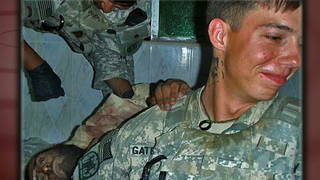
 StoryApr 19, 2012Photos of Soldiers Posing with Afghan Corpses the Latest Outrage of U.S. Occupation of Afghanistan
Transcript
AMY GOODMAN: This is Democracy Now!, democracynow.org, The War and Peace Report. I’m Amy Goodman. We’re broadcasting from Copenhagen, Denmark.
Next week marks the 25th anniversary of the U.S. invasion of Afghanistan, which began October 7, 2001. The war and occupation would go on for nearly 20 years. Following the withdrawal of international troops in 2021, the Taliban quickly returned to power.
We end today’s show with the award-winning Danish Afghan journalist and documentary filmmaker Nagieb Khaja. His most recent documentary is an investigation into what went wrong in the war — a question with many answers. In the film, titled Winning Hearts and Minds, Khaja returns to the capital of Helmand province with fellow filmmaker, former Danish soldier, Martin Tamm Andersen. Danish and British troops had been deployed to Musa Qala in 2006 to defend their allies, the local police, against Taliban insurgents. What they didn’t understand at the time is the police were a ruthless drug cartel. The film was released in 2023 and featured on the BBC’s Storyville series.
This is the trailer for Winning Hearts and Minds.
SOLDIER: [translated] Go inside. Take cover.
ON-SCREEN TEXT: Helmand Province, Afghanistan.
LARS ULSLEV JOHANNESEN: [translated] My first impression of the police was positive. I got it through Chief of Police Koka.
CHRIS DARBY: He was the most effective man in dealing with Afghan police officers that I had met.
MIKE MARTIN: But actually, we know that you’re probably a murdering, raping drug trafficker.
UNIDENTIFIED: [translated] Koka and Issa Khan are synonymous with tyranny.
“ARIF”: Be careful about Issa Khan. If he gets angry, you can’t escape.
RAPE VICTIM: [translated] They took off my clothes and raped me.
SHARIF POPAL: [translated] There were 14 or 15 boys there who were used as sex slaves.
LARS ULSLEV JOHANNESEN: [translated] I’m aghast this is taking place.
ANIKA TRONIER: [translated] We might all be ambushed. They could turn on us at any time.
ISSA KHAN: [translated] [bleep] the Danes! Did they make these claims against me? Can’t you stop the film from coming out?
I’d sacrifice myself for your head. Things haven’t been the same since you left.
AMY GOODMAN: That’s the trailer for Winning Hearts and Minds.
We’re joined now here in Copenhagen by Nagieb Khaja, the award-winning Danish Afghan journalist, war correspondent, filmmaker, kidnapped by the Taliban in 2008, held hostage for a week before escaping. We’ll talk about that in a minute.
But it’s great to have you with us. I think the last time we spoke to you was when the Taliban fell. You were in Kabul. We were interviewing you there.
NAGIEB KHAJA: Yeah.
AMY GOODMAN: But right now, why did you call this film Winning Hearts and Minds?
NAGIEB KHAJA: Because, you know, that was like the headline when the foreign forces went into Afghanistan, that the whole purpose, you know, the whole — the whole strategy was to win hearts and minds. But what happened was exactly the opposite, actually. They lost the hearts and minds. And the reason why they lost them was that they allied themselves with forces that in rural Afghanistan were considered worse than the Taliban. You know, so, for the rural Afghans — I’m talking specifically about southern and eastern Afghanistan — the police forces and the warlords that were fighting side by side with American, Danish and British forces, they were drug cartels, they were ruthless criminals, they were rapists.
So, basically, you know, the film that we did, Martin Tamm Andersen and me, is about one of these cartels in Musa Qala, in Helmand. It was the first big city in rural Afghanistan that fell to the Taliban in 2006. And it started like a — it was a snowball that started back then, and it developed into a very big snowball that took the rest of the country and ending with Taliban taking back power in ’21.
AMY GOODMAN: You profile Issa Khan and Abdul Wali Koka. You talk about the West’s favorite leaders there and who they actually were.
NAGIEB KHAJA: Yeah. Yeah, we do. What happened was that Martin and I, we embedded ourselves with their forces. They didn’t know that we were doing an investigative documentary actually revealing their atrocities. They thought that we were going to do kind of a propaganda film about how — you know, how the friends of the West, they worked in southern Afghanistan. But, you know, the parallel process while we were embedded with them was also finding their victims, interviewing them, checking up, checking the sources, trying to verify the facts that people were telling us.
AMY GOODMAN: Like the chai boys, the tea boys, that they raped.
NAGIEB KHAJA: Yes, and also kidnapping random boys from poor families, exploiting them, sexually abusing them, and also demanding big ransoms, killing innocent people, collective punishment of villages.
AMY GOODMAN: These were, to be clear, not Taliban. These were the forces that the U.S., that the West was working on.
NAGIEB KHAJA: Yes, and these were the forces, Issa Khan and Koka’s forces. They were in Musa Qala. And the forces, their forces, cooperated with American forces, British forces and Danish forces.
AMY GOODMAN: How did you get kidnapped in 2008?
NAGIEB KHAJA: I tried to do an embed with the Taliban, and I was set up by the person. The so-called fixer was supposed to give me the access, and he sold me.
AMY GOODMAN: And how did you — how did you escape?
NAGIEB KHAJA: I managed to escape together with my photographer. We convinced one of the guards to flee together with us. We bribed him, basically.
AMY GOODMAN: It’s 25 years later, Nagieb, after the U.S. bombed, invaded Afghanistan. What do you think is the most important lesson?
NAGIEB KHAJA: The important lesson is that the Afghans, they’ve been the victims under the previous rule, but also under the current rule. You know, the Afghans, they’ve been — you know, they’ve been — what can you call it? Like, it’s like a chessboard, and they’re just being thrown around by the different — different power brokers in the country. And first, under the previous government, it was the rural Afghans who suffered most, and now it’s, you know, the more progressive Afghans living in the cities who are suffering under the totalitarian rule of the Taliban. So, ultimately, what we learned is that the Afghans, they are always — you know, the average Afghans are the losers every time.
AMY GOODMAN: And the Taliban, you feel, coming to power were a response to the brutality of the warlords, the drug lords, the rapists that the West worked with?
NAGIEB KHAJA: That’s one of the answers. A lot of answers to this question. A lot of other things also went wrong. But one of the reasons, one of the big reasons, is that, you know, it was a reaction. And I have to emphasize that they were the lesser evil in some of the rural areas. They were not the lesser evil in the cities, in areas like Kabul and Mazar, a lot of people were benefiting from the foreign presence. Women, they had rights, and, you know, they were going to universities and working as journalists.
AMY GOODMAN: And we’re going to talk more about that in Part 2 of our discussion. Nagieb Khaja, award-winning Danish Afghan journalist, covered the wars in Afghanistan and Syria. His latest film, Winning Hearts and Minds.
I want to thank our crew here in Copenhagen: Peter Thorsøe, Casper Thorsøe, Charlotte Petersen, Michael Bernth. Happy birthday to Paul Powell! We’ll be at the Grand Theater tonight at seven for the screening of Steal This Story, Please! I’ll be speaking after with director Carl Deal. Special thanks to Denis Moynihan. We’re in Copenhagen.





 Top
Top
Media Options