






 Watch Full Show


Guests
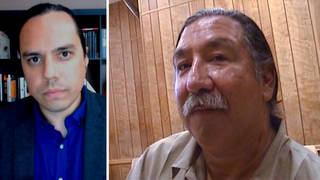
- Leonard PeltierIndigenous activist and longtime political prisoner who spent nearly 50 years behind bars over his involvement with the American Indian Movement.
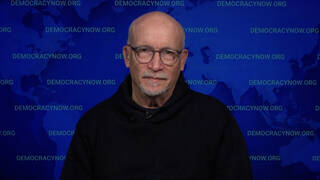
- David Franceinvestigative reporter and Oscar-nominated filmmaker.
On Indigenous Peoples’ Day, we feature a conversation with one of the world’s most prominent champions for Indigenous rights, Leonard Peltier. “Indigenous Day is a day that’s been long overdue for any type of recognition,” says Peltier. “I am not going to give up, because we are not free yet. We are in danger. Trump and these organizations, they’re talking about doing away with our reservations and our treaties and everything else. … We’re going to stay here. You’re not going to get rid of us.”
Peltier is a longtime political prisoner who spent nearly half a century behind bars for a crime he says he did not commit — the 1975 fatal shooting of two FBI agents. In the final hours of his administration last year, President Biden commuted Peltier’s sentence, but his conviction has not been overturned, and he remains under home confinement on the Turtle Mountain Band of Chippewa Reservation in Belcourt, North Dakota.
“It was one crime against the justice system after another in order to frame Leonard for the assassination of these two federal agents,” says David France, co-director of the new documentary Free Leonard Peltier. “And although he and his team were able to prove over and over that every bit of evidence used against him in his conviction was brought into question, he was never able to get a retrial.”
Related Story
 StoryMay 13, 2022Nick Estes: Leonard Peltier’s Continued Imprisonment Is an “Open Wound for Indian Country”
Transcript
AMY GOODMAN: This is Democracy Now!, democracynow.org. I’m Amy Goodman, with Anjali Kamat.
ANJALI KAMAT: Today is Indigenous Peoples’ Day, a day to honor Indigenous people, their history, their cultures, their ongoing struggles for justice and sovereignty.
We turn now to Leonard Peltier, one of the world’s most prominent champions for Indigenous rights. He’s a longtime political prisoner who spent nearly half a century behind bars for a crime he says he did not commit. Last year, in the final hours of his administration, President Biden commuted Leonard Peltier’s sentence. Leonard is now home, but his conviction has not been overturned, and he remains under home confinement. His story is the subject of a remarkable new documentary called Free Leonard Peltier. The film draws on decades of archival footage to examine Leonard Peltier’s case and the half-century-long movement to free him. This is the film’s trailer.
KEVIN McKIERNAN: There’s some firing now.
UNIDENTIFIED: What do you remember about the shootout?
LEONARD PELTIER: I felt the bullets going by my head.
KEVIN McKIERNAN: At this rate, there’s surely going to be some blood spilled here.
I want to ask you about the dead agents. Did you kill them?
LEONARD PELTIER: No, I did not kill them.
HOLLY COOK MACARRO: Leonard turned 80 last week. In a couple of months, he’ll begin his 50th year of incarceration.
REPORTER 1: Native activist Leonard Peltier …
REPORTER 2: … is an American Indian accused of murdering two FBI agents.
KEVIN McKIERNAN: Do you think that you’ll ever be released from prison?
LEONARD PELTIER: If enough people look at the evidence, yes.
LAKOTA ACTIVIST: They say we don’t have no civil rights. They’re terrorizing these people on the reservation.
REPORTER 2: The American Indian Movement.
RUSSELL MEANS: We have found it necessary to force the white man to listen.
MADONNA THUNDER HAWK: We had to kick the door open.
LEONARD PELTIER: We found documents where the government had tried to illegally buy Indian lands.
MADONNA THUNDER HAWK: It’s always because of the land.
BRUCE ELLISON: The government said that they were going to use paramilitary forces, and they wanted to be able to shoot to kill.
BOB ROBIDEAU: As a result of that firefight, two FBI agents died.
JOHN PRIVITERA: They needed to get a man. The government did so many things wrong.
PELTIER SUPPORTER: We want to wake up the little people, expose U.S. government and FBI conspiracy.
JOHN PRIVITERA: I came across a teletype that contradicted the primary piece of evidence.
JOHN TRUDELL: We want to talk about what this FBI has been doing, and we want to discuss cause and reason.
RUSSELL MEANS: We only want the white man to live up to his own laws.
WILMA BLACKSMITH: The feds were saying, “Shoot to kill.”
JAMES REYNOLDS: That alone ought to be enough to make the authorities hang their head in shame.
NICK TILSEN: We’re continuing on this battle because we want to bring Leonard home.
LEONARD PELTIER: I am someone that’s trying to make a better life for my people.
AMY GOODMAN: That’s the trailer for the new documentary Free Leonard Peltier. The film’s being released today, Indigenous Peoples’ Day, co-directed by Jesse Short Bull and David France.
On Friday, I spoke to France and Leonard Peltier, who joined from his home on the Turtle Mountain Band of Chippewa Reservation in Belcourt, North Dakota. I began by asking Leonard Peltier what Indigenous Peoples’ Day means to him.
LEONARD PELTIER: First of all, I would like to thank everybody for allowing me to be here and to make my presentation, let you know how I still feel, as I did 50 years ago, or longer. I’m still an activist and a warrior for the people, and I will continue 'til I die. But Indigenous Day is a day that's long been long overdue for any type of recognition or any type of appreciation that the Natives of this country, this continent, had to offer to humanity. …
Some people became greedy and selfish and murderous, and they tried to exterminate us because they wanted it all for themselves. Well, 500 years later, we’re still here, and I’m still talking, and I’m going to talk 'til I die. I am not going to give up, because we are not free yet. We are in danger. They're — Trump and these organizations, they’re talking about doing away with our reservations and our treaties and everything else. That’s it. That’s it for us. If we lose those, we’re done. We’re — it’s over with. We’re vanished, as they called us in the '50s and ’60s, the vanishing Americans. And we have a right, as much as anybody in the world, on Earth, to defend themselves. And that's what we do. We defend ourselves. We weren’t out looking for — to go to war or hurt anybody or kill anybody. That’s not a — that’s not what we were about. We want our freedom. Indigenous Day is another day for us — excuse me — to express these feelings, to let the world know that we’re still here, and we’re going to stay here. You’re not going to get rid of us. … I’m here on this day to say thanks to all of you who support us.
AMY GOODMAN: And, Leonard, if you can talk about what happened in the last hours of the Biden administration? In fact, I believe it was announced when he was getting in the car with Trump to go to Trump’s inauguration, that you heard that you would be released from prison.
LEONARD PELTIER: I actually didn’t hear 'til — for certain, was until Biden only had a couple days or a few hours, whatever, left. Whatever it was wasn't — he didn’t have much time left. And that’s when I actually heard that I had been — I was getting commutation under home confinement. At least it was out of a prison cell, but I’m still basically under jurisdiction of an illegal conviction. I was never legally convictioned. I was never legally indicted. So, everything they — when they put up evidence that’s false, that’s not a hearing. And that’s been proven over and over, that the grand jury hearing was fake. The trial had an admitted racist on the jury. The judge was overturned numerous times for making racial statements against Native people. So, I never did get a trial. That’s — that was all fake. But I spent — I still spent all the — they wanted me to die in prison.
So, thanks to you, the people, you’re the ones that helped get me out here.
AMY GOODMAN: I want to go to two clips of the new film Free Leonard Peltier and then talk to the co-director. This clip features Leonard Peltier and three other AIM activists — that’s American Indian Movement activists — arrested in connection with the shootout at Pine Ridge in 1975. They discuss how the fighting began.
DINO BUTLER: “Come on, you guys, time to be warriors. Get your guns and go up there and protect the elders.”
BOB ROBIDEAU: We responded, and we ran towards Jumping Bull. We were met by individuals that were firing upon the houses. We had no idea who these individuals were.
LEONARD PELTIER: We figured it was an attack by some of the GOONs.
DINO BUTLER: I don’t know really how the gunfight started. My main concern was the safety of our people.
LEONARD PELTIER: I ran into the houses, because there was little babies there, women and children, got them out of there.
NORMAN BROWN: It just happened so fast.
AMY GOODMAN: That was Dino Butler, Bob Robideau and Leonard Peltier, and then Norman Brown.
This clip goes back to November 14th, 1975. Oregon State Police stopped a motor home. Leonard Peltier was inside. This is another clip from Free Leonard Peltier.
DENNIS BANKS: And just as he’s getting on, here goes this mobile home. He decided to stop us, claim the glory. The deputy sheriff says that he heard two shots. So he fires at the vehicle. Leonard saw that, went running into the fields. The deputy sheriff fired at him. He escaped.
AMY GOODMAN: And that was the voice of the AIM leader, American Indian Movement leader, Dennis Banks, all in Free Leonard Peltier. David France is the co-director with Jesse Short Bull. David, talk about the making of this film.
DAVID FRANCE: The making, I guess, really, for me, goes back almost 50 years, because, as you said, I was a witness to the news reports around the events of 1975, and then the efforts to find Leonard, which was and remains, I think, the largest and longest FBI manhunt in history. It’s a story that galvanized my understanding of justice, social justice.
And when I realized that Leonard was approaching his 50th anniversary, I visited him in Coleman in central Florida and asked him for permission to tell his story. And it was a conversation that took some time before he agreed that we could do it. And one of those conditions was that we put together an Indigenous team of filmmakers to lead in the making of the film.
AMY GOODMAN: And when you talk about the longest manhunt in FBI history, Leonard had escaped to Canada. Meanwhile, Bob Robideau and Dino Butler were put on trial.
DAVID FRANCE: Correct.
AMY GOODMAN: And they were acquitted.
DAVID FRANCE: They were found not guilty by reason of self-defense.
AMY GOODMAN: And so, the search by the state was for another jury, another court.
DAVID FRANCE: What’s really clear from the record is that after they lost that case against those two men, those co-defendants, they were — they were prepared to do anything to convict Leonard Peltier. That included falsifying evidence, covering up exculpatory evidence, coercing people into giving false testimony. And it was one crime against the justice system after another in order to frame Leonard for the assassination of these two federal agents. And although he and his team were able to prove over and over that every bit of evidence used against him in his conviction was brought into question, he was never able to get a retrial. He was never able to get a hearing before the Supreme Court. And it had become for him, and for anybody watching it, one of the most Kafkaesque experiences in American history,
AMY GOODMAN: Leonard Peltier, there was a moment when President Biden — this is before he commuted your sentence — when President Biden apologized for the residential schools that people like you, Indigenous children, were put in. Can you talk about growing up as a Native American in this country and what happened to you as a child?
LEONARD PELTIER: I was just — I grew up in an era when it was — we were just coming out of the times when this was actually a concentration camp. We couldn’t leave the reservation without a pass, and that’s even to go to shopping for groceries on the border towns of our nation. We’re a nation. We’re not reservations. We’re nations. And we had to pay for that pass. I never got to go to town 'til I was about 6 years old, I think, somewhere there, because we had to pay for it. We didn't have money to pay for stuff like that.
So, the racism was just so out. It was so out, and, I mean, it was just so obvious. It was not even trying to — they didn’t even try to hide it. Of course, to us younger people, they started — they would — they wouldn’t be so vocal about it, because they’d get their goddamn [bleep] kicked, and because we’d start fighting back. My generation started fighting back real strong.
AMY GOODMAN: Do you remember the first day you were taken to a residential school and what these residential schools were, where you were taken, where you were living?
LEONARD PELTIER: My grandfather died in 1952, who was my hero. He was a very cultural person. He was very, very popular. And he passed. And my grandmother went up to the agency to see if they can get — my grandfather and grandmother was raising myself, my sister Betty and my cousin Pauline. And she went up to the agency to try to get some help, because she had no way to support us and feed us and everything. And so, in retaliation, they took us to the boarding school in Wahpeton, North Dakota. I mean, I tried to escape there, from there, at 10 years old. I fell in the Red River and almost drowned. So, that was the type of conditions we had.
When we got there, they took us to the barber room, the barber shop, and they buzz cut all our hair off. And then they took — they stripped us of all of our clothes, took our — what clothes we had, and poured DDT over us. Some people said that they had — in their generation, they poured kerosene over them. But DDT is poison. And then we went to the shower and took a shower after that. But the brutality was — it was so open, for the least violation of any kind of rule. And that’s what we — and all we were being taught was that we were saved by the white man who came to our shores, because we were a bunch of savages here and we didn’t know nothing and we didn’t — I mean, it was just outright racism.
AMY GOODMAN: Leonard, I wanted to go to the year 2000. It was Election Day, when President Clinton called into our station, WBAI, to talk about getting out the vote. Because the president of the United States was on the phone and you were in prison — yours was a case we had been covering for years — I got to ask him this question.
AMY GOODMAN: President Clinton, since it’s rare to get you on the phone, let me ask you another question. And that is: What is your position on granting Leonard Peltier, the Native American activist, executive clemency?
PRESIDENT BILL CLINTON: Well, I don’t — I don’t have a position I can announce yet. I think if — I believe there is a new application for him in there. And when I have time, after the election is over, I’m going to review all the remaining executive clemency applications and, you know, see what the merits dictate. I will try to do what I think the right thing to do is based on the evidence.
AMY GOODMAN: That was part of President Clinton’s response a quarter of a century ago, when I asked him about whether he would free you from prison, Leonard Peltier. It would take another quarter of a century. At that time, the FBI staged a major demonstration. Talk about how rare that demonstration was.
LEONARD PELTIER: It was not only rare; that was illegal. … They cannot march in the streets with weapons. This is against the Constitution and the laws of the United States of America. And this is what we got to tell people. They were marching in the streets armed.
DAVID FRANCE: It’s absolutely true. It was the first and only time that the FBI has staged a demonstration ever in public. And there were 500 people, FBI agents, former FBI agents, armed agents, who circled the White House in silent protest to warn the president of their position on any movement to free Leonard Peltier. And it was really a shocking display of the agency that had committed these crimes against Leonard, demanding that the civil government not overturn their campaign. And it was threatening, and it was certainly very effective.
AMY GOODMAN: I thought it was very interesting, the part of the film that deals with James Reynolds. And I wanted to ask, Leonard, you about this. James Reynolds was the prosecutor in charge of the district that tried and convicted you, but he would go on to remove his name from the case, and he went on to sign a petition for your release —
LEONARD PELTIER: Yes.
AMY GOODMAN: — based on FBI, judicial and prosecutorial misconduct.
LEONARD PELTIER: Yes.
AMY GOODMAN: He would campaign for your freedom.
LEONARD PELTIER: Yes.
AMY GOODMAN: Talk about that.
LEONARD PELTIER: Well, he wasn’t the only one. The regional director of the FBI, Don Edwards, he was the third in line to be the director of the FBI. He was a committed supporter. They asked him how come he was supporting me, and he said, “Well, I work there. I know what they did to Leonard.” And there’s other FBI agents also that came forward and supported, I mean, and judges. Reynolds is just one of the latest ones that in the last 10 years came forward and mentioned about the illegal things. He said, “Leonard never committed no crimes on that reservation,” which is true. …
Judge Heaney, he was the main judge in the 8th Circuit Court of Appeals on the murder weapon. He was sitting there, was going to overturn the case because the murder weapon was false, and all of a sudden he denied it. And so, we find a document later on where an FBI agent made a phone call to Washington, D.C., and he said, “I just left Judge Heaney’s office, and it went very well for us in that Peltier case. I will make a full report as soon as I get back to Washington.” I want that report. That belongs to me. That belongs to my case. Why can’t I get that? Why is this stuff being withheld from me to this day, over 50 years later?
AMY GOODMAN: Can you talk about getting documents under FOIA, David France?
DAVID FRANCE: There was a huge number of documents that have been released over the decades, but there are still tens of thousands of pages that have not been released, and won’t be released, despite litigation around them, on the basis of national security. That’s the explanation that’s been given to the courts. National security is keeping those documents from public view, including the ones that Leonard is seeking.
You have to ask yourself what possible national security issue could be involved in this FBI campaign against Leonard and campaign against the American Indian Movement. And I can think of none, except what we discovered, that the United States declared that it was in the national interest, strategic national interest, to claim access to the minerals at Pine Ridge, including the minerals necessary for making atomic bombs. And that might be their explanation. It certainly wouldn’t hold up today, but — and yet, they still maintain that they should not be released to the public.
AMY GOODMAN: When I did the question-and-answer after the film here in New York, talking to Holly Cook Macarro, who was a lobbyist with the NDN Collective fighting for your freedom, she talked about the importance of Deb Haaland, who’s now running for governor of New Mexico, and Xavier Becerra. At the time, he was health secretary under Biden, and he is now running for governor of California. The two of them working to have you freed, what did that mean to you, Leonard Peltier?
LEONARD PELTIER: Well, it was kind of, I would say, soothing to know that we did have some victories. We are having some victories. It isn’t total loss, like it seemed to be for so many years that we were not getting — we were not making any gains. We were still living in the worst poverties, in the danger. They just passed a law here six months ago, where — maybe a little bit longer — where if a Native woman is killed, they have to investigate immediately. Just think of that, too. I mean, you know, they didn’t have to investigate when an Indian woman was killed. And this is 2025. They just tried to pass a law where we can’t buy back our own land. I mean, we beat the law; we defeated it. But nevertheless, this is what we’re still facing today — today, Indigenous Day, the day that’s supposed to be honoring us. And, you know, at least — at least leave us alone. Let us lead our own lives. Let us do our own thing. We’re not — we’re not here to overthrow the United States government. That’s not what we’re here for. We just want to be left alone. Let us live our own lives. Let us have our own society we’ve had for thousands of years. What the hell? I mean, we don’t want to be part of a government that’s killing women, children, babies, and bombing every damn thing that they can, and talking about annihilating a race of people.
AMY GOODMAN: You’re talking about the war in Iran.
LEONARD PELTIER: That’s right. Right. Who wants to be part of that? I don’t. We don’t. We don’t want to be part of that [bleep]. That’s what happened to us. So, you know, this is — we’re supposed to celebrate Indigenous Day when we see this stuff still going on and still happening to us?
AMY GOODMAN: Leonard, I was hoping you’d be sitting here at the table. I was hoping that when the film came out in New York City, that you’d be there addressing the audience. There was a display of your artwork. We haven’t even talked about the fact that you are an artist at the Friends Academy here in New York City.
LEONARD PELTIER: Yeah.
AMY GOODMAN: Can you talk about what the conditions of your confinement are, though you are not in Coleman Prison or, before that, in Leavenworth?
LEONARD PELTIER: Well, the conditions I’m in is a million times better than that prison cell, I mean, you know, six-by-nine feet, with another person, living with another person, and that’s not very much room. That’s three feet of space. I now have a couple acres here, and I got a nice little house Native people bought for me, not the government.
AMY GOODMAN: And, David France, what are you hoping to do with this film, Free Leonard Peltier?
DAVID FRANCE: Bringing Leonard’s story to the public again, because I think many years ago his story was very well known, to remind people that the history, the horrible history, genocidal history, of the United States government against Indigenous people is not a thing of the distant past. The stories that Leonard tells about being confined to his reservation as a child, being taken away from his home to strip him of his culture and his connection to his people and spirituality, that idea that in Leonard’s lifetime it was illegal for Indigenous people to practice their own religious ceremonies. This happened within Leonard’s lifetime, and it’s still happening in very important ways. And that’s one of the reasons why he’s still being repressed by the government. And telling his story, as he is constantly aware of, is a way to demand that kind of reckoning from the U.S. government and the American people.
AMY GOODMAN: That’s David France, co-director, with Jesse Short Bull, of the new Netflix documentary Free Leonard Peltier, and longtime Indigenous activist Leonard Peltier himself, his sentence commuted last year in the final hours of the Biden administration after almost 50 years in prison. Leonard spoke to us from his home on the Turtle Mountain Band of Chippewa Reservation in Belcourt, North Dakota.
This breaking news: Federal officials have just carried out a dawn raid of Congressmember Ilhan Omar’s house.
And that does it for this show. Steal This Story, Please!, the documentary about Democracy Now!, will be viewable online for the first time, an exclusive special event, starting Tuesday, October 13th at 8 p.m. Eastern Time, if you live in U.S. and Canada. Check out StealthThisStory.org. I’m Amy Goodman, with Anjali Kamat.




 Top
Media Options