



 Watch Full Show


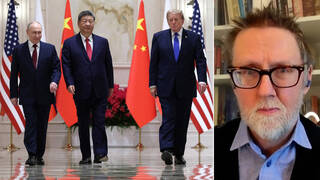
Chinese President Xi Jinping hosted his U.S. and Russian counterparts for a historic trilateral summit on Thursday, with the leaders of the three biggest nuclear superpowers meeting for about 90 minutes in Shenzhen. Afterward, the countries published a “peace declaration” that affirmed “nuclear war cannot be won and must never be fought.” The declaration also announced a commitment to increase petroleum production, called for reforms at the United Nations and urged the International Criminal Court and similar bodies to “not abuse their jurisdiction.”
While in China, President Donald Trump also had a separate meeting with President Vladimir Putin to discuss the war in Ukraine, though it’s unclear if they made any progress.
“It’s a significant post-1945 moment, which was the last time that we had great summits,” says Scott Lucas, professor of international politics at University College Dublin. “What is the most important takeaway … is an ascendant China. It was China that really set the terms of what was said.”
Related Story
 StorySep 16, 2026A Russian Oligarch Secretly Funded Donald Trump Jr.’s Bahamas Wedding; Democrats Demand Probe
Transcript
NERMEEN SHAIKH: We begin today’s show looking at today’s historic trilateral summit in China between Chinese President Xi Jinping, President Donald Trump and Russian President Vladimir Putin. The three leaders met for about 90 minutes.
After the meeting, Chinese state media issued what it described as a, quote, “peace declaration” by the Chinese, Russian and U.S. leaders. The four-point declaration called for reforms at the United Nations and said the three leaders, quote, “concurred that the International Criminal Court and other similar bodies must not abuse their jurisdiction.” The three countries are not signatories to the ICC. The ICC has issued an arrest warrant for Putin for war crimes committed in Ukraine.
The declaration also states, quote, “The three countries plan to increase the production and supply of refined petroleum products for the benefit of all nations.”
In addition, the declaration states, quote, “The three countries will engage in dialogue on reducing nuclear risks and preventing nuclear proliferation.”
AMY GOODMAN: Prior to the closed-door meeting, the three leaders shared brief remarks. This is Chinese President Xi Jinping.
PRESIDENT XI JINPING: [translated] This is the first time the leaders of our three countries have come together. It is a historic meeting. We will discuss how to safeguard world peace and promote strategic stability and relations among major powers. …
The world is undergoing rapid changes unseen in a century. The world is not peaceful, and challenges reveal true leadership. As major world powers and permanent members of the United Nations Security Council, our three nations should lead by example, collaborate to address global challenges, jointly safeguard world peace and stability, and make more significant contributions to the progress of humanity.
AMY GOODMAN: Russian President Vladimir Putin also spoke before the trilateral meeting in China.
PRESIDENT VLADIMIR PUTIN: [translated] For my part, I am convinced that Russia, China and the United States, and our respective peoples, are capable of making a significant contribution to strengthening global security and stability, provided they engage in constructive, partnership-based cooperation rooted in mutual respect, equality and a balance of interests.
NERMEEN SHAIKH: And this is President Trump speaking in China before the trilateral meeting.
PRESIDENT DONALD TRUMP: As presidents of three of the world’s largest countries, we have a special responsibility to maintain open, respectful and productive dialogue on issues impacting not just our people, but the entire planet. Too often past leaders avoided talking to nations with whom they had disagreements. And we feel the opposite, and we think that we are sure about that. No problems were ever solved under the old school refusing to talk about them, so no peace was ever forged by declining opportunities for engagement and speech.
AMY GOODMAN: Well, we’re joined right now by Scott Lucas. He’s a professor of international politics at University College Dublin’s Clinton Institute.
Professor Lucas, thanks so much for being with us. First, if you can just talk about the significance of this moment, of these three world leaders coming together for the first time ever in China, President Trump, the Russian President Vladimir Putin, as well as the Chinese President Xi Jinping?
SCOTT LUCAS: Well, Amy, I think it’s a significant post-1945 moment, which was, you know, the last time that we had great summits, including discussing the future of China, in part because you’re looking at a changed international order. You’re looking at a United States which is no longer the leader of that post-1945 system. You’re looking at a Russia having succeeded the Soviet Union, which is very much tied down by this struggling invasion of Ukraine, now in its fifth year, isolated, in some part, economically and politically because of that invasion, struggling to escape that isolation. And you’re looking at, I think, what is the most important takeaway, both symbolically and in real terms, from the summit, which is an ascendant China.
It was China that really set the terms of what was said throughout this, beyond Ukraine, talking more about the global situation in a couple of ways. They did that symbolically by putting Xi right at the center, as you saw at that table, between Putin and Trump. China now is a great power. But they also did it with the specific terms that they put forward: strategic stability, unity, technology and innovation, and perhaps most striking, free trade — given that, of course, the United States had premised its post-1945 position on precisely that, but you have a Trump administration doing something much differently.
There’s a lot of specific takeaways, especially because Donald — because Putin’s priority was Ukraine, but this was a summit where you had Trump coming there for ego and the photo opportunity, Putin because of the problems with his invasion and trying to get an alliance with Trump to force Ukraine’s surrender, and China there for strategy, a political, economic and military free hand in pursuing its alternative system.
NERMEEN SHAIKH: Well, Professor Lucas, could you comment specifically on some of the remarks that were made by these leaders, what we mentioned in our introduction on the International Criminal Court, as well as — you know, we’re speaking to you — we’re here at COP31 at the U.N. climate summit in Antalya, Turkey — this pledge that they would all increase petroleum production?
SCOTT LUCAS: So, one of the features where we are now, with the post-1945 system breaking, perhaps broken, is the dismissal of international law. And that is what you saw, on camera, before that closed-door meeting.
Vladimir Putin is wanted on war crimes charges, specifically the deportation of Ukrainian children, by the International Criminal Court. He does not want to face those charges. Donald Trump, who wants a friendship with Vladimir Putin, who will be shown in that vivid embrace of Putin — “He is my friend” — was there to carry out Putin’s wishes by saying the International Criminal Court should have no credibility — not even that its decisions can be questioned, it has no credibility. So, that is where we are, between two of the three leading powers, that there is no regard for the International Criminal Court. And the Chinese, of course, have sort of a different approach, because they’re looking for a different type of international system.
I think whether you’re at COP31 dealing with specific questions of climate change, or you’re dealing with specific questions of war crimes or broader questions of justice, this is a crisis moment for international law and for the ICC.
NERMEEN SHAIKH: And could you comment also on the fact that this meeting comes so soon after Jensen Huang, the chief of Nvidia, was forced to step down after reports of his affair with an alleged Chinese spy, in addition to two others in his company? Do you think that’s significant at all? And would it have come up?
SCOTT LUCAS: I don’t think it would have come up directly, but I think it’s part of the important backdrop at work here, which is, on the one hand, China is working from a position of leverage — of course, we’ve known this for quite some time — with its possession of rare earth minerals, with its dominance in terms of magnets. But, of course, it needs chips.
On the other side, you have a Trump administration which is almost in chaos right now for two very important reasons. First of all, American companies, in this case Nvidia, allegedly, was taking 20% of its revenue from China, despite saying that none of it came from there. Now, that’s a specific gap regarding where you are in terms of AI and technology in the U.S.-versus-China relationship. And that is magnified by the revelation that the Commerce Department did not enforce more than 100 recommended export controls on China-linked firms.
So, on the one hand, you have China, which has a very clear policy where it wants to go with tech and AI and with innovation and with control of resources, and you have a Trump administration that’s scrambling and divided over where exactly its position is right now in terms of the relationship with China. Open supply of chips? Export controls? Something in between? Where does it go next?
AMY GOODMAN: I also wanted to ask you — at the same time that they’re meeting in Shenzhen in China, Putin and Xi and Trump, you have Jared Kushner and Witkoff meeting with President Zelensky, with other European representatives. The significance of this and what this means?
SCOTT LUCAS: There are two different agendas right now in terms of where we go next regarding that invasion of Ukraine. The Russian agenda is to push Ukraine to the side — don’t discuss a ceasefire, don’t discuss security guarantees for Kyiv, don’t discuss freezing the frontlines; instead, call for a Europe-wide security architecture, by which the Russians mean security guarantees for us, and NATO withdrawing to its 1997 position, which not only means, of course, that Ukraine is exposed. It means that there’s no NATO, effectively, in the Baltic states or in Poland.
On the other hand, you have Ukraine and Europe that are saying, “No. Before you discuss a European-wide security arrangement, you need to have a specific commitment to a ceasefire on the current frontlines. You need to have an agreement that Russia will not get more territory. And you need to have security guarantees for Kyiv, so we don’t have a repeat of this aggression.”
The problem that we have right now is, is that the Russians are trying to impose their agenda by putting Donald Trump in their pocket. How are they doing that? You saw part of it today from Putin’s rhetoric, and from Trump supporting that rhetoric. But perhaps more seriously, you have it through the Russians putting tens of billions of dollars of proposed economic deals on the table, including some deals that would benefit friends and family of Donald Trump and his envoys, Steve Witkoff and Jared Kushner, and saying, “You can get all these deals, provided this invasion is halted on our terms.”
AMY GOODMAN: Let me ask you something, and this last question: On the one hand, you have President Trump announcing there shouldn’t be regulation of SI, what he calls superintelligence, but also, will this set a new template for the international order, major powers meeting amongst themselves, ignoring the U.N. Security Council and other forums? We just have a minute, Professor Lucas.
SCOTT LUCAS: First of all, Trump’s statement, supported by some of the people in the technological industry, is: “Look, don’t restrict us. Don’t do anything to restrict what we’re doing with AI.” More broadly, what you’re seeing here is this isn’t a question of international order. International order has broken down because certain countries and certain leaders don’t believe in international order. I think that’s true of Vladimir Putin. And with regret, I think that’s also true of Donald Trump and his inner circle. But I think the country that benefits from that lack of respect for international order, and we saw it today, is China.
AMY GOODMAN: Professor Scott Lucas teaches international politics at the Clinton Institute, University College Dublin.
Coming up, we’re going to go here to Turkey to summarize what’s happening at the U.N. climate summit, in the plenaries, but also outside, where all sorts of groups are protesting all the issues that are being discussed here. Stay with us.
[break]
AMY GOODMAN: “The Fire of Antalya,” performed at the COP31 opening ceremony.




 Top
Media Options