











 Watch Full Show

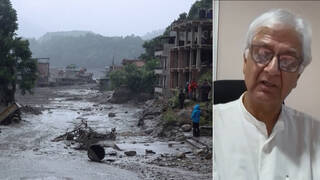
We get a report from Nepal, where at least 547 people are confirmed to have died and over 1,500 are still missing after a glacial collapse on Wednesday sent a wall of ice, mud and rock into a Himalayan river, triggering catastrophic flooding in the Nepal-Tibet border region that swept away entire communities. Nepali authorities say they have rescued more than 3,700 people so far. Geologists say the flash floods were set off by a landslide and glacial avalanche so powerful it set off its own seismic signal. Climate scientists warn the region is warming much faster than the global average, leading to the rapid retreat of glaciers.
“Scientists and civil society have been warning about the very fact that these kind of events might happen in the Himalayas,” says Sunil Acharya, a climate and public policy specialist reporting from Kathmandu, Nepal. “This is the result of the delayed global action to deal with climate change.”
“The number of people being killed, the number of properties being damaged has been way beyond what we can adapt to,” says Acharya. The floods have “[washed] away hundreds of villages, a huge number of bridges and road infrastructure and also hydropower stations.”
Related Story
 StoryAug 31, 2026“Catastrophe of Unimaginable Proportions”: Nepal Flood Death Toll Tops 900; Near 5,000 Still Missing
Transcript
AMY GOODMAN: This is Democracy Now!, democracynow.org. I’m Amy Goodman, with Juan González.
We turn now to Nepal, where at least 547 people are confirmed dead, over 1,300 people are still missing, after a glacial collapse sent a wall of ice, mud and rock into a Himalayan river, which triggered catastrophic flooding in the Nepal-Tibet border region, sweeping away entire communities. Water levels along the river at one point rose by as much as 27 feet over half an hour.
As the desperate search for survivors continues, heavy rain and risk of secondary flooding have complicated rescue operations. Chinese authorities warned Friday a lake formed by the landslide could breach its banks and cause another flood downstream in Nepal.
This is David Fisher, who leads the Red Cross in Nepal.
DAVID FISHER: And so, we are operating on still very, very estimated figures, but we believe that at least 93,000 people are — have been affected and are in great need. We’re, of course, very, very concerned about the secondary flood.
AMY GOODMAN: Nepali authorities say they’ve rescued over 3,700 people so far. The bodies of the dead swept away by the floods are being found far downstream. Meanwhile, local morgues are running out of space to store the bodies until they’re identified.
Among the missing are hundreds of foreign tourists, many of whom were on their way to a popular pilgrimage site sacred to Hindus, Buddhists and Jains. There are up to a hundred tourists from the United States missing. This is an evacuated Indian tourist describing her escape from the flood.
ANJANA RAJA: You know, we saw the gush of water all the way, dirty mud, you know, rising all the way, four-story high. We ran for our life. We ran 500 steps all the way up the mountain to be safe.
REPORTER: Did you hear something before —
ANJANA RAJA: Yes.
REPORTER: — you saw the mudslide? What was it? Please explain.
ANJANA RAJA: Like waterfall. It felt like a boulder falling down. Like, when a boulder hits water, what happens? That’s what it was. A big, big rock, when it hits water, what happens? It comes up all in. So, we were thinking it’s an earthquake, right? But we still don’t know, because I was also told that, you know, this is more like a glacier burst. That’s what I think the army folks told us. So, we have to go with what they say, so I don’t know.
AMY GOODMAN: Geologists say the flash floods were set off by a landslide and glacial avalanche so powerful it set off its own seismic signal. Climate scientists warn the region is warming much faster than the global average, leading to the rapid retreat of glaciers.
For the latest on how this catastrophic flooding relates to climate change, we go now to Kathmandu, Nepal, where we’re joined by climate expert Sunil Acharya, the just transition lead at the nonprofit Recourse.
Thank you so much, Sunil, for joining us. I know you’re outside a hospital. If you can describe the scene there and also talk about how all of this relates to climate change? At this point, we have numbers up to 2,000, between the dead and the missing.
SUNIL ACHARYA: So, I’m standing right in front of a government hospital here in Kathmandu, where they are bringing hordes of people who have died or who are severely injured. This is an unprecedented situation in here. The devastation caused by the flood that happened on Wednesday is unimaginable, in the sense that the scale of devastation it has done is huge.
The exact, you know, cause of this flooding, scientists have now started to tell, was because a huge ice mass fell off, and that triggered the flooding, because it carried the huge amount of water, the rocks and debris along the way, washing away hundreds of villages, huge number of bridges and road infrastructure, and also hydropower stations.
Though it seems like it’s unimaginable when we see the footages coming in, however, scientists and civil society have been warning about the very fact that these kind of events might happen in the Himalayas is no news. The scientists and civil society have been telling to the global community that these kind of events can happen because of the climate crisis, and this is the result of the delayed global action to deal with climate change.
JUAN GONZÁLEZ: And Nepal has lost nearly a third of its total ice volume over the last three decades. Could you explain?
SUNIL ACHARYA: Yeah, that’s true. The Nepal Himalaya are, you know, warming at the rate that is higher than the global average. The ice caps in the mountains and the glacier in there are melting in a rapid scale that’s leading to a number of flood disasters every year. For example, this particular flooding event is the third in the row in the same catchment area. There are several other glacial lakes which are on the verge of explosion or melting.
That means we are living in a situation wherein we can say that we — there’s a time bomb attached to Nepal, wherein the communities who didn’t cause anything to cause climate crisis are bearing the brunt of this crisis, wherein the number of people being killed, the number of properties being damaged has been, you know, way beyond what we can adapt to. This also shows that the climate crisis has reached a stage wherein there is a very hard limit to adaptation, and the loss and damage is resulting.
But again, the global community, or the developed countries, which have historically contributed to the climate crisis, are complacent in this, causing the situation like this. They are still, you know, trying to not act upon and deal with the crisis in acting to reduce the greenhouse gas emissions urgently.
JUAN GONZÁLEZ: And given how quickly this unfolded, Nepal has an early flood warning system that relies on a network of river gauges. How well did that work?
SUNIL ACHARYA: So, see, the suddenness of this event was so quick that the ice mass fell off — usually the early warning system that Nepal has are used to monitor the slow surge of water flow. But this was an explosion that happened in a very quick succession. And then, the river, you know, surge that happened was so fast that even the monitoring stations were swept away before they were able to send the early warning situation. That also means that the early warning system that has been installed, despite the fact that Nepal also lacks, you know, sufficient resources to put in place the early warning system, put in place the monitoring system, that’s one fact. But again, another fact is what we’ve witnessed is that these monitoring systems, which were supposed to work at the usual time, no longer work. Because of the climate change, the hazard profile had changed. The behavior of the hazard had changed. That’s why it is very difficult for the existing early warning system to work.
AMY GOODMAN: Our last question to you, Sunil. The U.S. is historically the largest greenhouse gas emitter, China currently the largest greenhouse gas emitter. Nepal, to say the least, contributes almost not at all to greenhouse gases, which lead to the warming of the planet. If you can comment on this and where we go from here, as you face possibly another flood in Nepal?
SUNIL ACHARYA: As you say, it’s a glaring example of climate injustice. Nepal contributes less than 0.1% of — to the global greenhouse gas emissions. However, the number and magnitude of, you know, disasters we are facing is rising day by day. And also the fact that the country, which is already having to force, to shift the very scarce resources it has from health and education to deal with disasters that, you know, come year after year is very bleak. But also, the fact that there’s already a warning up there, the water level has already risen, and there might be another, you know, flooding event that can happen right away as we speak.
But as the crisis is unfolding, we can see that there will be a number of such events that will happen. That also means that people and communities will be left in a situation wherein there is no way to deal with this crisis. And this also reflects the fact that there is loss and damage that is happening, and it is reality. And it also shows to the fact that the historically responsible countries, such as the U.S., need to urgently compensate for the damage that has created because of this crisis.
AMY GOODMAN: Sunil Acharya, our deepest condolences on what has happened to your country on the border with Nepal and Tibet. And, of course, we’ll continue to follow this issue. Climate and public policy specialist, speaking to us from Kathmandu. He’s the just transition lead at the nonprofit Recourse.





 Top
Top
Media Options