









 Watch Full Show

Topics
Guests
- Susan Neimanauthor, philosopher and director emerita of the Einstein Forum in Potsdam, Germany.
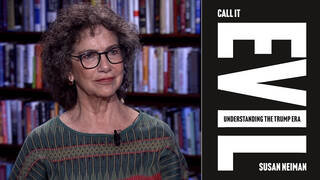
We speak with moral philosopher Susan Neiman, author of the new book Call It Evil: Understanding the Trump Era. Neiman argues that evil — far from being an outdated religious concept — is a vital way to understand how injustice works in the world. The Trump administration’s abusive policies have been aided by a general reluctance to call them out as evil, part of how people are “brainwashed … by the idea that morality is for losers, suckers, fools,” she says.
“People worry that it’s polarizing, that it’s demonizing, and by that worry, we leave the strongest weapons we have in the language in the hands of people who are least responsible in using them,” says Neiman.
Related Story
 StoryJun 29, 2026“America, U.S.A.”: Eddie Glaude on the 250th Anniv., Race & “The Madness at the Heart of the Country”
Transcript
AMY GOODMAN: This is Democracy Now!, Democracynow.org, the War and Peace Report. I’m Amy Goodman with Nermeen Shaikh.
NERMEEN SHAIKH: We end today’s show with the philosopher Susan Neiman. In recent years, she has written extensively on politics in Germany and the United States. In 2019, she published the book Learning from the Germans: Race and the Memory of Evil. The book examines how Germany has confronted the evils of Nazism.
AMY GOODMAN: Susan Neiman’s latest book is also about the concept of evil. It’s titled Call it Evil: Understanding the Trump Era. Susan Neiman is the director emerita of the Einstein Forum in Potsdam, Germany, but she is joining us here in New York. Before we talk about your new book, I want to ask about what’s happening in Germany, where you just left coming here. You’re going to be teaching at New York University, NYU. You lived in Germany for 30 years.
SUSAN NEIMAN: More than 30 years, yes.
AMY GOODMAN: The German far-right party, AfD, recently won nearly 44% of the vote in the east German state of Saxony-Anhalt. It was the strongest showing by a far-right party in the German elections since the Nazi era. Can you talk about the significance of this? Many in Germany are reeling at this point but it’s not known—as you know, we’re very insulated in the United States when it comes to getting news from outside the United States. What has actually happened?
SUSAN NEIMAN: I don’t know yet. In fact, I was just asked yesterday to write a piece for Le Monde on exactly that question, and I said, “I’m not going to say anything for another week.” Because we have two other big state elections coming on Sunday which actually represent many more people than Saxony-Anhalt. In particular, the Berlin election where it looks as if we may get a Turkish woman whose parents went into exile from Turkey because they were socialists, who has tried as much as possible to base her campaign on Zohran Mamdani’s. In fact, Die Linke, the Left Party, has quoted Leonard Cohen, saying, “First we take Manhattan, then we take Berlin.” So it would be a completely different result, also representing a much larger state of people. Berlin has about 3.5 million people. It’s also the capital. Saxony-Anhalt has about two million. I don’t want to play it down; It’s deeply concerning that the AfD got so many voters.
AMY GOODMAN: What has changed in this last half century? I mean, way beyond that.
SUSAN NEIMAN: Look, part of it is the other parties are just awful. They are incapable. In fact, the almost funny thing—I mentioned Mamdani at a book talk I gave just before I left Germany. Somebody said to me, “Well, you’ve confirmed our worst fears about America. Is there any hope?” I said, “Yeah, we have a fantastic mayor of New York who has inspired a lot of other candidates.” And the man said to me, “You know, we Germans are very afraid of charisma.” [laughs] That’s true. And that’s one of the wrong lessons they learned from their history.
What has changed is that the other parties don’t—possibly the Left—have a real program that they’re able to communicate. What has changed is also—one has to understand, Saxony-Anhalt is a state in East Germany. Now, one of the West German myths about East Germany is, oh, well, the reason why there are proportionally larger numbers of people voting for far-right parties is they never learned anything about democracy because they lived in a totalitarian system. This is just not true. In fact, the oldest people, the oldest population of Saxony-Anhalt, were the people who were voting against the AfD, not the younger people who were born in East Germany.
What’s true is that West Germans have been contemptuous of East Germans for a very long time. 1.8% of leadership jobs, and that’s leadership in the media, in the government, in universities, in corporations—1.8% of leadership inside East Germany is East German. The rest of it are West Germans who have come to East Germany. So there’s a lot of resentment, understandably, and a lot of desire for change. There is racism. You know, there’s racism everywhere. But I’m not convinced yet that it’s a sign of where Germany is going.
NERMEEN SHAIKH: Lets go from what you said about the left in Germany taking inspiration from Zohran Mamdani and then go to your book, these extremes of the political spectrum that are now in evidence in the U.S. Unfortunately, one of them is more powerful than the other. So talk about this book, why you wrote it—_Call it Evil: Understanding the Trump Era_.
SUSAN NEIMAN: I wrote it because, first of all, I was astonished by the number of people, who didn’t need to, who have quickly capitulated in the second Trump administration. I always thought the point of having more money than any family could possibly spend on luxury in a lifetime—I thought the point of having that kind of money was being able to say, “No.” [laughs] And it’s apparently not. I mean, that Google changed its maps to “Lake America” was for me [laughs]—thank you!
AMY GOODMAN: From “Lake Ontario.”
SUSAN NEIMAN: Yeah! And thank you for your—that expression. It’s a trivial kowtow but it’s fairly unbelievable, I think. But what struck me that may explain both the capitulation and the election of the second Trump administration is the uneasiness that so many people on the left have with moral language. People worry that it’s religiously tinged if they’re secular. It’s not. This is something I know something about, having written a—
AMY GOODMAN: As a moral philosopher.
SUSAN NEIMAN: Yeah, and having written a book 25 years ago called Evil in Modern Thought, so I know something about the history. Moral concepts come before religious concepts in every culture. Religion is a way to express certain moral concepts. It’s an attempt to solve certain moral problems. But the initial feeling of evil—you can call it a sense of injustice—is something that children have in every culture—and according to some researchers, even primates and other higher animals like elephants. So, it’s not a religious term although religious people tend to feel comfortable with moral language. People worry that it’s polarizing, that it’s demonizing. And, by that worry, we leave the strongest weapons we have in the language in the hands of people who are least responsible in using them.
NERMEEN SHAIKH: Let’s go actually to senior White House aide Stephen Miller speaking to CNN earlier this year.
STEPHEN MILLER: We live in a world in which you can talk all you want about international niceties and everything else, but we live in a world, in the real world, Jake, that is governed by strength, that is governed by force, that is governed by power. These are the iron laws of the world.
NERMEEN SHAIKH: That’s Stephen Miller. Susan Neiman, your response to that and what that shows about the entire political conversation here under in the Trump administration?
SUSAN NEIMAN: Stephen Miller is echoing two sources; I don’t know if he knows it. One is the Nazi legal theorist Carl Schmitt but the other is something that goes back to the ancient Greeks, and it’s about the Athenians defending a genocide. The Athenians committed a genocide, the island of Melos, because the Melitians [sic] would not bow to their superior power. So that’s the first time you see that argument in history. I have no idea whether Stephen Miller knows that. What’s more disturbing is the fact that he is stating that as the iron law of the world.
And unfortunately, that is what many people today believe—that self-interest and interest in power is the only thing that motivates human beings to action, and we’d better just face it. Now, this is a philosophical idea. People treat it as a fact; it’s a philosophical idea. It’s a piece of ideology. And it’s a piece of ideology that we have been trained for a good century—or bad century, if you like—a good century to accept as fact. What my book does is talk about the ways in which, through misinterpretations of both Adam Smith and Charles Darwin—mixed in the late 20th century with a little but of Michel Foucault—how those ideas got into the water stream. You don’t have to have read any of those people to read them in the media, to hear them on television. But they are ideologies that are every bit as strong as any other totalitarian ideology.
NERMEEN SHAIKH: I just want to ask you, because you do talk about this in the book—what do you think explains the fact that a large portion, a significant portion of the American population, electorate, voted for Trump in the second term?
SUSAN NEIMAN: Because although we could see the immorality in the first term and the tendencies towards fascism—I don’t think that’s too strong an expression—we’re so convinced that moral concepts are for suckers, as he would say, or as Stephen Miller would say—you know, they’re niceties that don’t actually make a difference in the world—that people threw up their hands and were unable to condemn what was actually going on in a shocking kind of way. Many of us have been shocked.
We talk about the contempt for the rule of law that we already saw to some extent in the first administration and we’re seeing even more blatantly now. What we forget is the rule of law depends on people having a commitment to abide by the rule of law even when a legal decision goes against you. That is a moral commitment. James Madison knew that. He said the best Constitution in the—well, he didn’t put it that way—he said, “No Constitution can protect a people without any virtue.”
Now, the founding fathers were less anxious about using moral language than we have become. We need to get more comfortable with it if we’re going to understand exactly how we have been affected—maybe “brainwashed” is the appropriate term—by the idea that morality is for losers, suckers, fools. Or, it’s a form of hype that is attempting to convince people, fool people, into accepting forms of power that—and we saw that, frankly, in the George W. Bush administration. His use of words like “moral clarity” for a war that was neither moral nor clear is I think something that prepared us to think that when politicians use moral language, they are trying to pull the wool over our faces.
AMY GOODMAN: Well, the book is fascinating. It’s called Call it Evil: Understanding the Trump Era. It’s by Susan Neiman, Director Emerita of the Einstein Forum in Potsdam, Germany. Philosopher and author of many books. Fascinating book.
That does it for our show. Tonight I will be back in Bay Shore, New York, where I grew up and went to high school. They will be showing Steal This Story, Please! at the Boulton Center. I’ll be there with the director of the film Tia Lessin and producer Caryn Sproul. You can go to our website for more details. Then next Tuesday, here in New York at the IFC Center. Then to Copenhagen, London and Berlin. I’m Amy Goodman with Nermeen Shaikh.





 Top
Top
Media Options