












 Watch Full Show

Guests
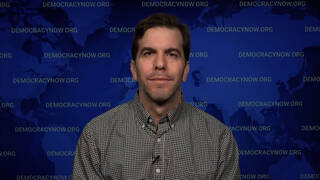
- Sharon Weinbergerveteran national security journalist, currently editor-in-chief of the Bulletin of the Atomic Scientists.
Longtime national security reporter Sharon Weinberger’s new book, Valley of Death: How Big Tech Is Fueling the Future of War, follows the rise of the military-industrial complex in Silicon Valley, where defense technology companies, like Palantir, Anduril and SpaceX, and their billionaire founders, are increasingly shaping U.S. foreign policy. Weinberger explains that because “the government doesn’t own the underlying technology” peddled by “this new class of entrepreneurs,” these companies have upended the traditional procurement relationship between the U.S. government and older defense firms, and now unilaterally control access to the new weapons and systems — including drones and artificial intelligence — used in modern warfare.
Transcript
AMY GOODMAN: This is Democracy Now!, democracynow.org, The War and Peace Report. I’m Amy Goodman. Today we’re broadcasting from London. Tonight, the film about Democracy Now! called Steal This Story, Please! will be showing in Lewes at the Lewes Depot outside Brighton at 8:00, and I’ll be there with the film’s director, Carl Deal, for Q&A afterwards.
We end today’s show with a remarkable new book about the growing ties between Silicon Valley and U.S. military and intelligence agencies. It’s called Valley of Death: How Big Tech Is Fueling the Future of War. The author, longtime national security reporter Sharon Weinberger, traces the roots of Silicon Valley’s relationship with the Pentagon back to the Cold War, when government funding helped fuel the development of the tech industry. But today, she writes, the relationship has fundamentally changed. Companies like SpaceX, Palantir and Anduril are no longer simply supplying technology to the U.S. military intelligence agencies, but also developing powerful technologies that, in some cases, they maintain control over themselves. Weinberger argues the stakes are enormous.
Take a listen to Axios reporter Colin Demarest questioning the co-founder of the military tech company Anduril Industries, Palmer Luckey, about whether there’s any red line on what he would build.
COLIN DEMAREST: What won’t you build? What’s your red line?
PALMER LUCKEY: What wouldn’t I build? That’s an interesting one. Well, you know, I’ve been pretty public that how our weapons are used are — you know, that’s a matter for the DOD. But you’re right, I have control over what I can build. There’s things that I could say, for example, you know, “That’s a power too great for any man.”
COLIN DEMAREST: Nuclear weapons?
PALMER LUCKEY: I would definitely build nuclear weapons. I would — I would build fission weapons. I would build fusion weapons. I think that nuclear weapons have been one of the most stabilizing forces in history ever.
AMY GOODMAN: In her new book, Valley of Death: How Big Tech Is Fueling the Future of War, journalist Sharon Weinberger examines the extraordinary rise of tech billionaires like Luckey, as well as Elon Musk, Peter Thiel, Alex Karp, who, she writes, are playing an increasingly central role in U.S. military and intelligence decisions, but with no oversight or accountability.
Sharon Weinberger, welcome to Democracy Now! Before we get to these tech billionaires building nuclear weapons themselves, I want to turn to your recent article, based on your book, this in The Wall Street Journal, headlined “The Hidden Debt That Apple Owes to the CIA.” Talk about Steve Jobs being rehabilitated, kind of, when he went back to Apple, and what that relationship was with the CIA.
SHARON WEINBERGER: Sure. So, about 10 years ago, when I was thinking of working on this book, when Silicon Valley was starting to move back into Pentagon work, I was told a story, that I thought was perhaps apocryphal, about how the National Security Agency had given a large contract to Steve Jobs’ company NeXt. This was the company he formed in the 1980s after he was initially exiled from Apple. Company built beautiful, very expensive computers, wasn’t doing well. It was essentially failing. And I was told the National Security Agency had bought a whole bunch of computers, and it had, in effect, saved the company.
So, it took me years to track down the story, and when I eventually did, it turned out it wasn’t the NSA. That was actually cover for a CIA contract that was buying NeXT computers for satellite analysts to go through imagery. And the story was really fascinating, not just because it was Steve Jobs, but — we think of him as almost a counterculture figure — but the idea that in the late 1980s, early 1990s, he was not only doing work for the CIA, but that it essentially saved his company. The argument was, was that that gave him years — a few years of extra runway to prove himself at NeXT. He leapfrogged back to Apple, took over Apple again, and the operating system from NeXT became the operating system for modern Apple products. So, the argument I would hear from people both inside that company and inside the intelligence community was the CIA effectively saved Jobs and saved Apple.
AMY GOODMAN: So, I want to go to the start of your book, beginning with a Zurich-based company that has the sole secret mission to build and sell nuclear weapons. You write, quote, “The entrepreneur’s goal essentially was to break the government monopoly over the production of nuclear weapons. It turned out to be an exercise sponsored by a secretive division of the Pentagon.” You write, “The idea that the Pentagon had sponsored a secret study to see if a rogue billionaire could develop a nuclear weapon fascinated me.” Take it from there.
SHARON WEINBERGER: Yeah, so, in 2013, this division of the Pentagon funded this study to look at whether a rogue billionaire could build nuclear weapons — I mean, essentially, a little bit like what Palmer Luckey was talking about in the clip you played. And I was given a copy of this study around 2017, 2018, and then eventually went back and interviewed the participants. And it doesn’t mention specific billionaires, but when I interviewed the people who took part in it, sort of like a tabletop war game, they’re like, “Oh yeah, absolutely, we were thinking of an Elon Musk figure.” And that’s sort of amazing. In 2013, Elon Musk was certainly up and coming, but he wasn’t the figure he is today. And the point they made was what they saw coming down the pike when they did this study in 2013 was that technologies, whether for nuclear weapons, for space travel, for other weaponry, was — it was no longer simply in government hands. It was now feasible for an entrepreneur, for a billionaire, for private capital to build these weapons.
And sure enough, here we are in 2026. Elon Musk has his SpaceX-built Starlink, a satellite internet communication system, which was critical for Ukraine in the early days of the war. We have Palmer Luckey, the founder of Anduril, talking about building nuclear weapons. What differentiates this new class of entrepreneurs from the defense-industrial complex of old was the Pentagon never had to call the CEO of Lockheed Martin and say, “Can we use your F-35?” Many of these technologies developed in the private sector now, to include AI, are done with private money, with venture capital, with private capital. The government doesn’t own the underlying technology, which is why you’re starting to see these disputes now, as you’ve seen, for example, between Anthropic and the Pentagon, because the Pentagon doesn’t own the technology. They don’t control it.
AMY GOODMAN: So, in this part of the interview — we’re going to do a Part 2 — but what did Trump’s presidency mean for the relationship between Silicon Valley and the U.S. military industry? You write in The New York Times, “For tech companies, the personality … of the person occupying the White House are less important than that person’s willingness to buy what Silicon Valley is offering.”
SHARON WEINBERGER: So, what I mean by that is that, you know, it’s not that people don’t have real beliefs, real ideas and real ideals. I don’t want to discount sort of individual agency. But Silicon Valley, as a whole — you know, we’re all determined by our economic and operating environment. And that was the point of the Steve Jobs story. Like, yes, he was in some ways a figure of the counterculture, but when it meant the survival of his company, he was perfectly willing to work with the CIA. He gave lectures at the CIA. He was willing to work with national security.
And it’s the same thing with tech billionaires now. They may have their own political beliefs, left or right, but they know that it’s more about what is the administration going to do for them. President Obama was very good in many ways for Silicon Valley. He was supportive of Silicon Valley. There were a lot of personal links between people going in and out of the administration. He was supportive of privatized space travel. Biden administration less good for Silicon Valley.
So, Trump has done two things. He’s sort of supercharged this relationship between government and Silicon Valley, but he’s also demonstrated — when you saw how in 2016 Peter Thiel was this outlier supporting Trump, and then you get to the current administration, and you have these tech leaders showing up for dinner, praising Trump for his leadership, sort of going like supplicants, saying what they’re going to do for the U.S. economy. You know, it’s hard to say what they believe or don’t believe, but at the end of the day, they’re going to do what’s good for their businesses, and that’s what they’re demonstrating.
AMY GOODMAN: Sharon Weinberger, we want to thank you for being with us. We’re going to continue this interview, post it online at Democracy Now! We’re going to talk about how artificial intelligence is transforming warfare from targeting software to autonomous drones. That does it for our show. Sharon Weinberger is author of Valley of Death: How Big Tech Is Fueling the Future of War.
I’ll see folks in Lewes, outside Brighton, tonight at 8:00, the tomorrow in Copenhagen at the Grand Theater, and then in Berlin at Spore. Check our website at democracynow.org. I’m Amy Goodman, from London.




 Top
Top
Media Options