







 Watch Full Show

Eight decades after the Nuremberg trials against Nazi war criminals, the Trump administration has launched an all-out assault on the International Criminal Court, primarily over the tribunal’s pursuit of Israeli leaders for war crimes committed in Gaza. In his recent address to the United Nations, President Donald Trump called the ICC a “rogue institution” and urged other states to abandon it, and his administration has vowed to dismantle it through sanctions and other pressure tactics.
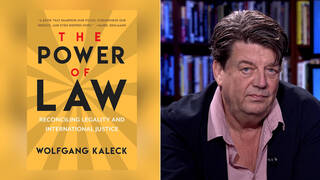
“It’s so sad to remember that the core group behind the Nuremberg trials were Robert Jackson, Telford Taylor and Benjamin Ferencz, the U.S. prosecutors,” says Wolfgang Kaleck, lawyer and founder of the European Center for Constitutional and Human Rights. His new book is The Power of Law: Reconciling Legality and International Justice.
Transcript
AMY GOODMAN: This is Democracy Now!, democracynow.org, The War and Peace Report. I’m Amy Goodman in Berlin, Germany, where Steal This Story, Please! is screening at the Spore on Thursday night. You can check our website at democracynow.org. Anjali Kamat is in New York.
As we broadcast from Berlin, we end today’s show with a discussion on the state of international law. Tomorrow, Thursday, is the 80th anniversary of the end of the Nuremberg trials following World War II, in which leaders of Nazi Germany were successfully prosecuted for war crimes and crimes against humanity. The Nuremberg trials ended October 1st, 1946. They’re widely seen as a precursor to modern courts of international justice, like the ICC, the International Criminal Court.
ANJALI KAMAT: Well, today, the ICC is under immense pressure from the United States over its issuance of arrest warrants for Israeli leaders for war crimes committed in Gaza. This is President Trump attacking the ICC at the U.N. General Assembly in New York last week.
PRESIDENT DONALD TRUMP: The United States is equally opposed to the out-of-control institution known as the International Criminal Court. We will never allow U.S. service members or anyone else to be investigated or given show trials by an anti-American tribunal with no jurisdiction over us. They’re an evil group of people. I call on all nations that are members of the ICC to officially resign from this rogue institution immediately.
ANJALI KAMAT: The U.S. has sanctioned members of the ICC, including prosecutors, judges and staff, and is reportedly preparing to issue sanctions against the court itself.
On Monday, the German foreign minister visited the ICC in The Hague in a show of support for the court. Germany is the ICC’s second-largest financial contributor. Nevertheless, German Chancellor Friedrich Merz said last year that Israeli Prime Minister Benjamin Netanyahu would be able to visit Germany without arrest, in contravention of German law.
AMY GOODMAN: In a statement ahead of his visit, the German foreign minister, Johann Wadephul, said, quote, “Germany is mindful of its own history and knows what the outcome can be when state power overrides the rule of law and humanity. Therefore, for Germany, support for the ICC is not only a foreign policy issue. It is a part of our historical responsibility,” he said.
For more, we’re joined now by Wolfgang Kaleck, founder of the European Center for Constitutional and Human Rights, ECCHR. Usually, he is based here in Berlin, Germany, where I am, but he’s joining us from New York and has a new book. It’s titled The Power of Law: Reconciling Legality and International Justice.
Wolfgang, we’re going to do this conversation in two parts. And in this part, if you can start off by talking about Germany’s position on the International Criminal Court, the all-out frontal assault that President Trump is waging on the court, from the massive sanctions and beyond, and why you feel, on this 80th anniversary of the end of the Nuremberg trials, you feel international law is so important?
WOLFGANG KALECK: So, hello, Amy, from New York. I’m so sorry to miss you in Berlin.
It’s a very good take to start with the 80th anniversary of the Nuremberg trials. And it’s so sad to remember that the core group behind the Nuremberg trials were Robert Jackson, Telford Taylor and Benjamin Ferencz, the U.S. prosecutors. And what they had in mind — and Robert Jackson said it explicitly, and later on, Telford Taylor wrote this book, From Nuremberg to Vietnam — it was very clear: This is not only about the Nazi crimes; it is about — to establish a universal rule that crimes against humanity, genocides and war crimes shouldn’t get — shouldn’t be left impune.
And so, it was so important that in 2002 the International Criminal Court was established. It’s a pity that many of the most important military powers, such as the U.S., but also China, Russia and others, Israel, Iran, didn’t join the statute. But still, the court needed its time to get off the ground. But now they have an ongoing series of important trials.
And we have to be clear: It’s not about only about Palestine. The sanctions against the court are, first of all, a big stroke against the international criminal justice, internal justice as such, because the ICC is one of the light towers, one of the most important international institutions. So they want to destroy the institutions of the international justice system. But the sanctions would also deprive not only the Palestinian victims, but also the Ukrainian victims, the Rohingya victims, the sub-Saharan refugees and many others of their rights, the rights which we have been fighting for for many decades right now.
ANJALI KAMAT: And, Wolfgang, I mean, we’re living in a moment where international law is under assault on so many different fronts, whether we look at, you know, the war in Iran, what’s been happening in Gaza for the past few years, Ukraine, so many other — Venezuela, so many places. You know, how do you retain faith in the possibility of international law in this context?
WOLFGANG KALECK: I mean, when you look at Nuremberg 80 years ago, when you look at the Eichmann trial in the ’60s, when you even look in the ’90s, the Rwanda and Yugoslavia tribunal, the survivors of state violence, the families and the civil society actors had not a real stand in these trials. But over the last decades, we entered the stage of international criminal justice, and it is so important. I mean, we just listened to Nicolás Jaar from Chile. The Pinochet arrest, 1998, was a wake-up call for all of us. And there is a — there is a constant row of important trials initiated by civil society actors, and that is a progress of the last couple of years, despite the ongoing attack against international law, the ongoing ignorance and, in particular, the ongoing double standards of the West.
AMY GOODMAN: You know, Wolfgang Kaleck, you are representing Patrice Lumumba’s family — for example, his grandchildren. He was assassinated in the Congo, in the Democratic Republic of Congo, in what? 1961. In these last minutes we have together, especially for — you know, in the world, when people are so isolated when it comes to having global information, not to mention going back in time, can you tell us Patrice Lumumba’s story and what his family is demanding now? Who assassinated him?
WOLFGANG KALECK: A lot of people are lamenting that the postwar, liberal, West-dominated international order is eroding. And, of course, we are facing a change. But we don’t have — we have to be very clear: The liberal order was also the history of disorder in many parts of the world: 1953, overthrow of Mosaddegh; 1954, overthrow of Jacobo Árbenz — Iran, Guatemala; and then '61, the first democratically elected leader of Congo, Patrice Lumumba, kidnapped, tortured, assassinated and then dumped in acid. Before that, the civilized, you know, Belgian soldiers who were at the spot break out his teeth and took them as souvenirs to Belgium. This is — this is a story of the West preventing democratically elected leaders in the Global South from distributing the goods of their country to the peoples of the country. That's the one side of the story. So, this goes impune for more than 60 years.
But then, as I said, we entered the stage of international criminal justice. So, the Lumumba family, more than 10 years ago, went to a Belgian lawyer, and the Belgian law firm started a criminal case against 10 of the surviving Belgian participants in the murder and in the abduction. One of them was indicted last year, and this is incredibly important. This will stay. This is a historical document. The indictment of a federal prosecutor in Belgium says that Patrice Lumumba’s assassination and his kidnapping constitutes a war crime.
ANJALI KAMAT: Wolfgang, we have 30 seconds.
WOLFGANG KALECK: The only accused died, but we are going to prepare a civil reparation case against the state of Belgium in the near future. You will hear from us.
AMY GOODMAN: And we’re going to do Part 2 of this conversation, hear more about this. Wolfgang Kaleck, founder of the European Center for Constitutional and Human Rights. His new book is titled The Power of Law: Reconciling Legality and International Justice. He’s speaking to us from New York. He usually is right here in Berlin, Germany.
I’m here because the film about Democracy Now!, Steal This Story, Please!, will be screening at Spore in Berlin. You can check our website at democracynow.org. That’s October 1st, Thursday, at 7 p.m. Afterwards, I’ll be doing the Q&A with the director Carl Deal. I’m Amy Goodman, with Anjali Kamat.



 Top
Top
Media Options