








 Watch Full Show

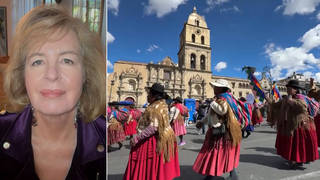
Protests in Bolivia are demanding the resignation of Rodrigo Paz, the country’s first right-wing president in decades. Since Paz took office in November 2025, the country has been placed under austerity measures that have led to a surge in poverty rates for much of Bolivia’s rural and working-class population. We speak to Kathryn Ledebur, director of the Andean Information Network in Cochabamba, Bolivia, about the monthlong protests. “Bolivia is a country where, for 19 years, Indigenous people and social movements enjoyed equal rights and political inclusion,” she explains. “There’s a huge break between what Paz promised and what he’s done in practice, which is select a white, upper-middle-class Cabinet with only two women, reject any genuine dialogue, reject interaction with the Bolivian social movements, or even have any empathy for people and what they’re going through day to day.”
Ledebur also discusses the Paz administration’s growing ties with the Trump administration as the U.S. seeks to expand its so-called war on drugs throughout Latin America.
Related Story
 StoryAug 13, 2020General Strike & Blockade in Bolivia Enter Day 11 as Protesters Condemn Delayed Vote by Coup Gov’t
Transcript
AMY GOODMAN: This is Democracy Now!, democracynow.org. I’m Amy Goodman, with Juan González.
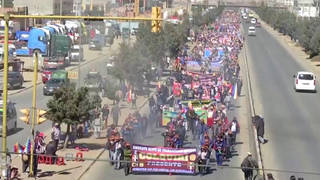
Mass protests in Bolivia have marked one month as thousands continue to take to the streets of La Paz and other cities demanding the resignation of President Rodrigo Paz, a Trump ally who’s aligned himself with Latin America’s right-wing leaders. Labor and Indigenous groups, other protesters are calling on Paz’s government to roll back austerity measures amid soaring costs of food, fuel and medicine.
ANGELA AGUIRRE: [translated] We want the government to solve this problem, to fix it once and for all, and to do so wholeheartedly. The babies are starving. We can’t afford to buy food. We seniors no longer have the money to buy food, and I have my granddaughters, who are orphans. I’m asking for a solution.
AMY GOODMAN: Earlier this week, Bolivia’s Congress approved the possible deployment of armed forces to suppress the mobilizations, a move that would also help President Paz declare a state of emergency in Bolivia.
For more, we go to Cochabamba, Bolivia, where we’re joined by Kathryn Ledebur, director of Andean Information Network.
We thank you so much for being with us. Lay out the escalating protests, why people are in the streets demanding President Paz’s resignation.
KATHRYN LEDEBUR: Thanks so much for having me.
I think that you summed it up nicely when you said it’s about people feeding their families and a political exclusion, a racial exclusion. Remember that Bolivia is a country where, for 19 years, Indigenous people and social movements enjoyed equal rights and political inclusion. With the election of right-wing government Rodrigo Paz, even though he was elected as a last-ditch alternative by many of the protesting sectors, what we see is a return to the neoliberal policy, to these austerity shock measures, and the removal of fuel subsidies, and it’s generated a great deal of poverty, especially for Bolivian working class and subsistence farmers.
JUAN GONZÁLEZ: And from what I can tell, during the last few weeks, this uprising in Bolivia is perhaps the most important people’s uprising in the world right now. Could you talk about how the movement grew so quickly, given the fact that this president’s only been in office for six months?
KATHRYN LEDEBUR: Yes, of course. You know, social movements in Bolivia have always been very well organized, Indigenous communities. We’re talking about a country that was colonized, but that colonization was never able to break down those strong social ties, cultural ties or a union movement that eventually helped the first Indigenous president come to power. It’s something that’s been brewing for a very long time.
But there’s a huge break between what Paz promised and what he’s done in practice, which is elect — you know, select a white, upper-middle-class Cabinet with only two women, reject any genuine dialogue, reject interaction with the Bolivian social movements, or even have any empathy for people and what they’re going through day to day as they try to feed their families. You know, it’s not enough to put on a poncho for your campaign and then forget about your electorate.
JUAN GONZÁLEZ: And what about Paz’s claims that former President Evo Morales is behind this uprising or these protests?
KATHRYN LEDEBUR: Well, I think they’re infuriating. I think that, you know, Evo Morales has had a long career as a social movement leader and as former president. He definitely opposes the actions of Rodrigo Paz. But the sectors in protest are not directly affiliated with Morales. You have a — you had a small group of coca growers from Morales’s base in La Paz for only five days. But it’s a convenient — one, there’s the right-wing political class in Bolivia, that’s never developed governance strategies, that find it convenient to blame Morales. They want to target him. They speak frequently his arrest. And it dovetails nicely with a very close and strong alignment with the Trump administration, because, as we know, the U.S. Drug Enforcement Administration and consecutive right-wing U.S. administrations have targeted and scapegoated Morales. This is not about him. And it infuriates protesters further, because it’s a way to not address meaningful demands.
AMY GOODMAN: And very quickly, you’re in Cochabamba, where Democracy Now! was. We interviewed at the time President Evo Morales at the People’s Climate Summit there. But if you can address the allegations that the government is making that this is an attempted coup? And also talk about Paz’s alignment with Trump, with Marco Rubio recently saying on social media, “Let there be no mistake: the United States stands squarely in support of Bolivia’s legitimate constitutional government. We will not allow criminals and drug traffickers to overthrow democratically elected leaders.” The words of Marco Rubio.
KATHRYN LEDEBUR: Right. I think that that explosive and that toxic narrative is very helpful to the Paz administration, but it’s in lieu of any meaningful attempt for dialogue. I don’t think we found any ties — the U.S. has looked for decades of ties to Evo Morales for drug trafficking. Certainly, these protesters have no ties to drug trafficking. It’s absurd that people would suggest that drug — the drug business in Bolivia, or in anywhere in the world, has the need to direct any protest.
You know, this stigmatization, this focus on Morales is toxic, and it’s really aggravating the conflict. I think that the vision on the part of the Paz administration and on the United States and on the far right and the Operation Southern Shield, that very corrosive international alliance through Trump, is that this was going to somehow scare the protesters into retreating. And what it’s done is it’s infuriating them. You know, this is a group of people that’s protesting because they don’t have anything to eat tomorrow or the year after that, and people in La Paz are complaining that they don’t have anything to eat. And everyone needs to be able to have a sustainable source of life. And that is not being addressed here, as it’s not being addressed in so many other places.
JUAN GONZÁLEZ: We have only about a minute left, but I wanted to ask you about the Trump administration and the U.S. interest in Bolivia. What does the U.S. want from Bolivia?
KATHRYN LEDEBUR: Well, the U.S., on very different, you know, many levels, was very unhappy with the expulsion of the U.S. ambassador, the expulsion of the DEA in 2008 and the end of all U.S. funding in 2013. And their claim was that Bolivia would become a narco-state, that things would fall apart. And what we saw is that actually things in Bolivia got better. It’s the threat of a good example. And, you know, it’s very clear, and you can — when you speak to U.S. diplomats, they highlight that there’s a strong desire for revenge on the part of the DEA, on the part of the Trump administration, which criminalizes protests in the United States and elsewhere, and there’s an obsessive focus on punishing the left instead of engaging with them or governing responsibly.
AMY GOODMAN: We’re going to leave it there. We’re going to do an interview in Spanish, and you can check it out at democracynow.org. Kathryn Ledebur, director of Andean Information Network at Cochabamba, Bolivia.
And a very happy birthday to Angie Karran! That does it for our show. I’m headed to Tucson, Arizona, today and Saturday to the Loft Cinema. We’ll be doing a fundraiser for KXCI in Tucson as the screening of Steal This Story, Please!, about Democracy Now!, begins in Tucson, then headed to Phoenix on Saturday night. You can check our website at democracynow.org. On Sunday, I’ll be here in New York doing a Q&A after the screening at the IFC of Steal This Story, Please!, next weekend in Tampa and in Miami. And the following weekend, we’ll be going through Vermont, from Montpelier to Burlington to Brattleboro and beyond, then to Sheffield, England, and to the Belfast Film Festival. You can check our website at democracynow.org for all details and StealThisStory.org, where it is screening in your area. I’m Amy Goodman, with Juan González.



 Top
Top
Media Options