





 Watch Full Show


Guests
- Rashid KhalidiEdward Said professor emeritus of modern Arab studies at Columbia University.
- Tariq AliPakistani British historian, activist and filmmaker.
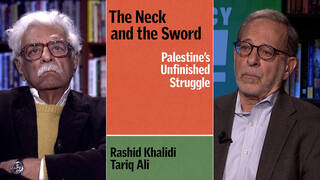
We get analysis of the Israeli elections, the upcoming U.S. midterms, the pro-Palestine movement and more from Palestinian American scholar Rashid Khalidi and Pakistani British writer Tariq Ali. They are co-authors of the new book The Neck and the Sword: Palestine’s Unfinished Struggle. The book, an extended conversation between Khalidi and Ali over two years, offers an overview of Palestinian intellectual and political history, drawing its title from a famous phrase used by the renowned Palestinian writer Ghassan Kanafani to describe the futility of “peace talks” between occupier and occupied, saying it was akin to a “conversation between the sword and the neck.”
Kanafani was assassinated by Israel in 1972, “murdered simply because his words were too dangerous for Israel to tolerate,” says Khalidi.
Public opinion about Israel has grown increasingly negative in the United States and across much of the world in the wake of the genocide in Gaza, and it’s “not going to shift back,” says Khalidi. “People have seen something that cannot be unseen. They’ve seen genocide. They’ve seen slaughter. And Israel has no defense.”
“Even in countries with no history of a Palestine solidarity movement, suddenly the Palestine flag emerges,” says Ali. “Why? Because their governments are trying to stop dissent on this issue, so they are defying their governments.”
Related Story
 StoryJul 24, 2026“America First or Israel First?” Ex-Israeli Negotiator Daniel Levy on Saudi Nuclear Deal, Iran & More
Transcript
ANJALI KAMAT: Israel is facing possible political gridlock after neither Prime Minister Benjamin Netanyahu nor his chief challenger, Gadi Eisenkot, won enough seats to form a new government in Tuesday’s election. The final tally could take days. The election marked the first time Israelis went to the polls since the October 7th, 2023, attack and the ensuing wars on Gaza, Lebanon and Iran. The vote drew record turnout.
With over 70% of the vote counted, Israeli — Netanyahu’s Likud party leads with the 27 seats, ahead of former military chief Gadi Eisenkot’s Yashar party at 22. According to Haaretz, a possible pro-Netanyahu coalition currently has 54 seats, while a possible pro-Eisenkot bloc has 49 seats.
Palestinian-led parties — the Joint list and Ra’am — have won 17 seats, their strongest showing ever. But both Netanyahu and Eisenkot have ruled out governing with the Arab parties. Millions of Palestinians living under Israeli occupation in East Jerusalem, the West Bank and the Gaza Strip are ineligible to vote.
This is Netanyahu speaking on Tuesday.
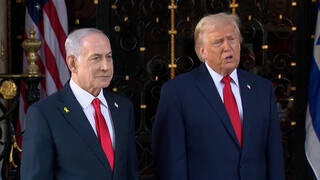
PRIME MINISTER BENJAMIN NETANYAHU: [translated] We must form a right-wing, national, strong government. That is what must be done. We must not — must not — endanger Israel and establish a government that is backed by anti-Zionist Arab parties. … Israel faces a singular historical opportunity, together with our partner, President Trump, to remove the existential threat of Iran once and for all.
AMY GOODMAN: Meanwhile, former General Gadi Eisenkot said the election results are a vote against the continued leadership of Netanyahu.
GADI EISENKOT: [translated] I stand before you thrilled. This morning, the people of Israel went to a referendum on the leadership that will guide Israel in the coming years. Tonight, we received an answer. The public has decided in favor of change.
AMY GOODMAN: Eisenkot also accused Netanyahu of using Israel’s security for his political needs. And this is Yousef Jabareen, Palestinian citizen of Israel and head of the Joint List, speaking Tuesday.
YOUSEF JABAREEN: [translated] We are the people who sent Ben-Gvir home. It’s us, our people, our nation. … The exit polls indicate that we have achieved our goal. The Joint List is a strong force that will bring change and make a difference.
AMY GOODMAN: For more about the election, Palestine and beyond, we’re joined in studio by two guests. They’ve just co-authored a new book. It’s titled The Neck and the Sword: Palestine’s Unfinished Struggle. Rashid Khalidi is a Palestinian American historian and Edward Said professor emeritus of modern Arab studies at Columbia University. His books include The Hundred Years’ War on Palestine. And Tariq Ali is a Pakistani British historian, activist, filmmaker and longtime associate of the New Left Review. His books include You Can’t Please All: Memoirs 1980-2024.
We welcome you both back to Democracy Now! Rashid Khalidi, let’s begin with you. The results are not final right now in Israel, but it does look like Netanyahu has pulled ahead, and it looks like the Joint List has garnered more votes than they ever have in history. Can you talk about the significance of these elections and what it means for either of the men to become prime minister?
RASHID KHALIDI: Well, the so-called Arab parties, the Palestinian parties, have done better than they ever did before. The problem is that the rest of the parties in the Israeli political spectrum refuse to govern with Arabs. This is — there’s a deeply seated racism. You heard Netanyahu talking about we’ve — “we’re going to deal with the danger of these Arab parties, these anti-Zionist Arab parties.”
So, neither party, neither coalition has won. There’s a very good question as to what difference there is between the two coalitions when you’re talking about anything that deals with Arabs, Palestinians, Israel’s aggression throughout the region. Both seem committed to continuation of the war on Gaza. Both seem committed to hostility to Iran.
And neither coalition seems willing to change anything fundamental about Israel, except things that deal with, essentially, Jewish citizens. So, one group wants the judicial reform to stop; the other — that is to say, Netanyahu — wants to move towards authoritarianism. Well, that’s fine as far as Jewish citizens are concerned. But the discrimination against Arabs within Israel and Israel’s wars do not seem to be on the table for either of the two major coalitions, and they refuse to govern with the Arab parties, which actually hold the balance right now.
ANJALI KAMAT: And, Rashid and Tariq, you both talk quite a bit about how the genocide in Gaza has dramatically changed public opinion in this country, particularly among young people. You also acknowledge there can be quite a gap between that change in public opinion —
RASHID KHALIDI: Right.
ANJALI KAMAT: — translating to an actual change in the material conditions on the grounds for Palestinians in particular. We’ve got the midterms coming up next week. It’s the middle of this unpopular war in Iran, soaring gas prices, inflation. And we’re also seeing resistance to AIPAC —
RASHID KHALIDI: Right.
ANJALI KAMAT: — in many of the campaigns. Are you hopeful that the results of this election, or even just this campaign, might help shift U.S. policy towards Israel?
RASHID KHALIDI: Well, public opinion has shifted. The people have voted with their feet, as it were, against not just AIPAC, but against this war. Everybody’s against this war — right, left, center. It’s very, very clear that the suffering in terms of gas prices and inflation, and so on and so forth, is a direct result of Trump’s stupid war on Iran.
The question is: Will people be able to overcome the resistance of the elites in this country, which seem still totally committed to support of Israel? And that actually is most true of the Republican Party, but it’s true also of the Democratic Party. So, the question is: Will the voters on Tuesday be able to force the parties, especially the Democratic Party, to actually do something to change American policy, stop arms to Israel, force the president to stop his war? That’s not going to be a — that’s going to be a tall order. So, public opinion has shifted. The politicians, the elites, not so much.
ANJALI KAMAT: And, Tariq Ali, I want to bring you into the conversation. Your read on the midterms coming up, and also the results of the Israeli elections?
TARIQ ALI: Well, the result of the Israeli elections, I concur totally with what Rashid has said. Quite honestly, it’s not going to make any difference for the, you know, Palestinian population inside Israel. And what is quite staggering is this decision to treat the Palestinians, the Arab Palestinians of Israel, as an invisible people carries on. You know, they’ve just won 17 seats, their largest number in the Knesset, and they’re being told, “You don’t really exist. We just pretend that you exist for international reasons. Ideally, we’d quite like to wipe you out, but let’s start by wiping you out politically.” That is the only reason why they’re not treated as a political party and allowed to function and make coalitions with whoever they want to. Were they allowed to do so, well, Netanyahu would be out of power, because whatever the similarities between the two coalitions, I think a defeat for — Netanyahu’s removal, on its own, would mean something, saying that the archcriminal, wanted by the International Criminal Court, has at least been removed from office. It looks as if even that might — it might not happen.
The effect on the midterms, we shall see. I mean, you know, the Democrats have been incredibly slow, to put it at its mildest, in realizing that the bulk of the country is opposed to them on this question. And the victory of Mamdani in New York and the winning of primary seats by DSA candidates is an indication of public opinion — a small indication, but an important one. So, if we have a few Senate seats in Michigan or from Florida, which would be a miracle, going to the DSA Democrats, then, you know, some change is on the way. The monolithic impression which one gets of Congress and Senate on key security issues would be pierced a tiny bit. The big question is: Are the Democrats going to win the Senate? That is what Trump is fighting for: “OK, let them have the House, but the Senate, we must keep.” But if they lose the majority in the Senate, it is a, you know, serious setback for MAGA and for that faction in American politics.
AMY GOODMAN: Tariq Ali, you live in London. Rashid, you live here in New York. President Trump just put on social media — he refers to himself in the third person. He said, “When President Trump endorsed Bibi Netanyahu, the whole tide turned, and now, rather than a decisive defeat for a Great Prime Minister, it looks like a big come-from-behind stalemate, or even a WIN for Netanyahu. It all took place AFTER the Endorsement by President Trump, who only wants what is good for the Middle East, Israel, and the United States of America!” But can you talk about, Rashid Khalidi, the role of the United States in these elections, but also in the course Israel is taking right now?
RASHID KHALIDI: I mean, Israel for three years has been fighting a war side by side with the United States. Nothing that they do would be possible without the fact that every single combat aircraft is American; the 2,000-pound bombs are American; the vetoes in the Security Council, multiple vetoes preventing a ceasefire, were American. And one could go on. Tens of billions of dollars came from the United States to fund this war. So this was an American-Israeli war — or, if you prefer, Israeli-American war. That’s the American role.
Israel has now occupied extraordinary amounts of extra territory, in Lebanon, in Syria and in the Gaza Strip, and is ravaging the West Bank. And that’s the Israeli government and its settlers and its army that are doing it. This is not a bunch of crazy settlers. This is the Israeli government, led by two of the most intensely right-wing ministers in Israeli history, which is saying a lot given Israeli history.
So, a change in the United States will force a change in Israeli behavior. The question is, as Tariq said: Is it going to be a minor change, or is it going to be a big one? And I’m not enormously optimistic about this midterm. But public opinion is not going to shift back. People have seen something that cannot be unseen. They’ve seen genocide. They’ve seen slaughter. And Israel has no defense. You have to call people who say anything about Israel antisemitic, because you can’t answer 20,000 dead children. How do you speak to that? Burning olive groves, beating up journalists. You cannot justify anything Israel does, so you resort to the lowest of possible epithets, saying that someone is antisemitic, simply because they’re criticizing Israel. And that’s the situation that they’re in. They’re really in a corner. And were it not for Trump and were it not for American support, Israel would have lost. We can see Europe, even Europe, moving slowly toward sanctions.
So, I think that that trajectory is clear. But the question is: How quickly? How much suffering will be inflicted by Israel and the United States in Lebanon, Syria, and especially in Gaza and the West Bank, before this monolithic offensive of these two powers — it is the United States and Israel; it’s not just Israel — is stopped? And I don’t see that coming out of our midterms, unfortunately. I hope — I hope there’ll be a change, but I don’t see — I don’t see this bulldozer stopped.
ANJALI KAMAT: You know, speaking of Europe, Tariq, talk about — you know, we’ve seen this massive number of protests on the continent going on right now, about the cost of living, critiques of the government. But you’ve also had massive pro-Palestinian demonstrations across the continent and in the U.K., but you’ve also had a doubling down in some of these countries, particularly the U.K., France and Germany, on any sort of pro-Palestinian speech and action. Can you talk about the latest with what’s happening in the U.K. with the crackdown on Palestine Action?
TARIQ ALI: Well, the crackdown on Palestine Action, which is a group of nonviolent peace activists determined to do their best to help the Palestinians in a more concrete way than simply marching on the streets, who’ve targeted Israeli arms factories and people collaborating with them in the United States — attempts to stop them failed, because juries acquitted them when they explained what they were doing. Then there was a big move: Let’s abolish juries. That’s the problem. The problem is not what Israel is doing, but what the juries are doing, acquitting activists. So, that didn’t work, either. There was a lot of anger about that. So, then, what to do?
I’m told that what happened was that the Palestine Action people, to show their anger against Trump and American collaboration with the Israelis, damaged some tiny bit of Trump’s golf course in Scotland. And this, you know, very sort of trivial act, really, angered the great leader of the United States, and he demanded that they be dealt with, that this is how the question of even banning them arose. No Cabinet minister can explain this.
The head of security in 10 Downing Street, Jonathan Powell, has made it clear he thinks this is a foolish measure. Jonathan Powell’s wife has supported Palestine Action. You know, this is the equivalent of the head of the FBI, or whatever, supporting something that is happening against the government. She said, “I visited Palestine 20 years ago as a journalist. I saw what they do on the West Bank. And Palestine Action has my support.” Were they going to now charge her for aiding terrorism? They drew back. So, once you draw back because an important person has said it, then your case falls. So, we’ll see what happens.
AMY GOODMAN: In September, the British Labour Party held its annual conference in Liverpool. We were in London, and just as we were going to air, the British Foreign Minister Ed Miliband took the stage. This is an excerpt of what he said.
ED MILIBAND: And I want to say to the millions of people in this country, and indeed elsewhere, who have been moved and outraged by the plight of the Palestinian people: We hear you. You were right. … We call out ethnic cleansing by the settler terrorists in the West Bank. We call out the evidence of war crimes in Gaza. We call out Israel’s illegal occupation of Palestine. And we match words with action. We will ban the import of goods from illegal settlements. We will disrupt the supply lines of British finance, British construction and British services for illegal settlements. And when it comes to the attempt to destroy the two-state solution, this party, this movement, this government says: We will not let you succeed.
AMY GOODMAN: So, that was British Foreign Minister Ed Miliband standing in front of a sign that said “Hope Again.” It got some of the largest applause we had seen. Interestingly, Ed Milliband, formerly an intern at The Nation magazine. But if you can talk, Tariq Ali, about the significance of what he said versus what U.K. is doing?
TARIQ ALI: I think he meant it. His mother died recently, and she was a Palestinian activist. She had lost her — you know, large chunks of her family during the Judeocide of the Second World War. And she said, “I cannot bear to see what Israel is doing. They’re doing a version of what was done to us.” And she marched on every single demonstration with the Jewish bloc, which is part of the Palestinian solidarity movement. And Edward used to listen to her every day.
And at at her funeral, which I attended, Edward said very openly, he said, “You know, sometimes I’d look at my mother, and she had her hands on her head like this and would say, 'Why, oh why?' And I would say, 'Mum, why are you saying, “Why, oh why?”' She’s saying, 'Why both my sons joined this wretched Labour Party?'” So, he said, “She had many 'Why, oh why?' moments, so I will never forget her stand on Palestine.” And it was very moving.
But I think underneath it was also — because, obviously, it had been approved by the new leader — to win back Muslim votes. I think there was a cynical calculation there. I’m sure Edward believes all that he said, but it’s had nil impact.
AMY GOODMAN: And by the way, Miliband’s speech came a day after police arrested more than 50 people outside the Labour Party conference, with demonstrators nonviolently urging that the banned direct action group Palestine Action be supported. Among them, Robert Del Naja, frontman for the British trip-hop group Massive Attack, arrested for holding some homemade banners reading “I oppose genocide. I support Palestine Action.”
TARIQ ALI: You know, this campaign against Palestine Action, I have sort of referred to it as a campaign against elderly people, because they’ve arrested more old-age pensioners who’ve come out and demonstrated, of all nationalities, of all ethnicities, picked up, put in buses, one woman on wheelchair. I mean, the whole thing makes the British government a laughingstock.
And if they were clever, they would just give a nod and a wink to the Supreme Court, which is listening to the case, and say, “OK, lose it.” They’re saying, “We’re waiting for the judges.” But that’s not true, because the previous judges acquitted them. Government took the case to the Supreme Court. They could easily withdraw the case, and that would be that. But that would be a huge defeat for what has become, stupidly, a central plank of their policy.
So, there’s no basic difference between the new prime minister and his predecessor, Keir Starmer, in my opinion, very little difference at all on Palestine. They’ve made this slight move, but have done nothing. And we always judge people by what they do, not by what they say.
ANJALI KAMAT: Let’s talk about the title of your new book, The Neck and the Sword. It’s a reference to a phrase used by the great Palestinian writer and journalist Ghassan Kanafani. He was a spokesperson for the Popular Front for the Liberation of Palestine, the PFLP, and founding editor of its weekly magazine, Al-Hadaf. He also wrote some of the most iconic novels in Palestinian literature, including Men in the Sun and Returning to Haifa, among others. Ghassan Kanafani was assassinated by Israel in a 1972 car bombing. Two years before, he spoke to Richard Carleton from the Australian Broadcasting Corporation. They spoke in Beirut. Here’s a clip from that interview.
RICHARD CARLETON: Why won’t your organization engage in peace talks with the Israelis?
GHASSAN KANAFANI: You don’t mean exactly peace talks. You mean capitulation, surrendering.
RICHARD CARLETON: Why not just talk?
GHASSAN KANAFANI: Talk to whom?
RICHARD CARLETON: Talk to the Israeli leaders.
GHASSAN KANAFANI: That’s kind of conversation between the sword and the neck, you mean.
RICHARD CARLETON: Well, if there were no swords and no guns in the room, you could still talk.
GHASSAN KANAFANI: No. I haven’t been — I have never seen any talk between a colonialist case and a national liberation movement.
RICHARD CARLETON: But despite this, why not talk?
GHASSAN KANAFANI: Talk about what?
RICHARD CARLETON: Talk about the possibility of not fighting.
GHASSAN KANAFANI: Not fighting for what?
RICHARD CARLETON: Not fighting at all, no matter what for.
GHASSAN KANAFANI: Ya’ni, people usually fight for something, and they stop fighting for something. So, you can’t tell me even why should we speak about what.
RICHARD CARLETON: Well, stop fighting.
GHASSAN KANAFANI: Fight for what, or talk about stop fighting — why?
RICHARD CARLETON: Talk to stop fighting to stop the death and the misery, the destruction, the pain.
GHASSAN KANAFANI: The misery and the destruction and the pain and the death of whom?
RICHARD CARLETON: Of Palestinians, of Israelis, of Arabs.
GHASSAN KANAFANI: Of the Palestinian people who are uprooted, thrown in the camps, living in starvation, killed for 20 years and forbidden to use even the name Palestinians.
RICHARD CARLETON: They’re better that way than dead, though.
GHASSAN KANAFANI: Maybe to you. But to us, it’s not. To us, to liberate our country, to have dignity, to have respect, to have our mere human rights, is something as essential as life itself.
ANJALI KAMAT: Ghassan Kanafani talking to Richard Carleton from the Australian Broadcasting Corporation in 1970. Rashid Khalidi, why did you decide to call this set of conversations between you and Tariq Ali The Neck and the Sword?
RASHID KHALIDI: Well, many reasons. First of all, it was a reference to this wonderful, charismatic and extraordinarily intelligent Palestinian intellectual, murdered simply because his words were too dangerous for Israel to tolerate.
AMY GOODMAN: And how was he murdered?
RASHID KHALIDI: He was blown up with his 17-year-old niece in his car as he was about to drive her away from his home in 1972. And it was — it has been intolerable for Israel that people like him or Kamal Nasser or many, many, many other Palestinian writers and intellectuals make a case that Israel basically cannot answer, so they kill them. I mean, the number of Palestinian leaders and intellectuals who’ve been assassinated by Israel is extraordinarily long.
The other reason was that he and I, Tariq and I, had done several sessions, one of which was previously published, of conversations, in which we went over this genocidal war and we talked about deeper roots than just, you know, what started on the 7th of October. One of the worst things about the way in which this has been treated is as if history started on the 7th of October. Well, we have the Nakba in 1948. We have things — in fact, we started talking about the '30s and Britain destroying Palestinian society in order to help the creation of and establishment of Israel. That's the beginning of, in fact, our discussion.
ANJALI KAMAT: And the colonial techniques and the training they gave the Israelis.
RASHID KHALIDI: Exactly. We went into the fact that everything the Israeli army does, its attacks on civilians, are a result of British counterinsurgency doctrine, that was passed on to the Israeli army by the British during the 1930s. So, we went deeper than not just October 7th, before October 7th. And somehow, Ghassan was central to much of what we talked about. Verso and the Institute for Palestine Studies has also published a book by Ghassan Kanafani.
ANJALI KAMAT: And you have an introduction to that.
RASHID KHALIDI: To which I wrote —
ANJALI KAMAT: And you talk about the different forms of resistance.
RASHID KHALIDI: Right.
ANJALI KAMAT: What is your sense of the state of Palestinian resistance today? I mean, we’re into the fourth year of this ongoing genocide.
RASHID KHALIDI: Right.
ANJALI KAMAT: The U.N. commission of inquiry just said that what’s happening in the West Bank is also crimes against humanity.
RASHID KHALIDI: Well, I think that the most effective forms of resistance right now, in many cases, are the kinds of things that people are doing in the U.K., Palestine Action, BDS. This upheaval on American campuses, I think, woke American — the American public up. That was not Palestinian resistance, but that was inspired by the fact that the Palestinians are still standing tall in spite of everything Israel has done to them. People saw that genocide, and they were moved, especially young people. But that’s affected American public opinion and global public opinion.
AMY GOODMAN: I mean, Zohran Mamdani has become mayor. And what did he campaign on? Gasoline prices and Gaza.
RASHID KHALIDI: Exactly.
AMY GOODMAN: And you were a professor at Columbia, now professor emeritus, with his father, Mahmood Mamdani —
RASHID KHALIDI: Right.
AMY GOODMAN: — also a very powerful voice on the issue of Palestine.
RASHID KHALIDI: I mean, they are trying to silence these voices, student voices. The repression on campus is extraordinary. And I don’t just talk about Columbia. Every single American campus, the elites that control these campuses will not allow criticism of Israel. The things that have been done to pro-Palestine demonstrators on American campuses were never done in the anti-apartheid movement, in the movement for climate change, in the movement even against the Vietnam War. I’m going back to my youth, my student days. Nothing like what has been done on American campuses was done to students, because they are terrified at the fact that the students have a case. What Israel is doing is abominable, and people are increasingly understanding that. So you shut it down.
And I think that there is resistance simply on the ground. People staying in their homes are, in fact, resisting. That’s another enormously important form of resistance. But in international law, resistance, armed resistance and multiple other forms, are legal. What Kanafani was saying in this book is writing, culture, literature are enormously important forms of resistance. And he was talking about specific writers — Mahmoud Darwish, Tawfiq Ziad and so on. And he was the first to talk about them. This is a book published in 1968. And I think that that’s true to this day. I think that what people are saying, what people are writing, the books that are being published today are an enormously important form of resistance.
AMY GOODMAN: We’re going to break, and we also want to talk about Iran and much more with Rashid Khalidi and Tariq Ali, co-authors of the new book The Neck and the Sword: Palestine’s Unfinished Struggle. We’ll return to them after a short break.
[break]
AMY GOODMAN: Sonny Singh in our Democracy Now! studio. This is Democracy Now!, democracynow.org, The War and Peace Report. I’m Amy Goodman, with Anjali Kamat.
ANJALI KAMAT: We’re speaking to Rashid Khalidi and Tariq Ali, co-authors of the new book The Neck and the Sword: Palestine’s Unfinished Struggle. Let’s talk about the U.S.-Israeli war on Iran and Iran’s response, and how that’s changing the balance of forces in the region. We’re seeing a flurry of reports that the U.S. and Israel are drawing up plans to attack Iran after the midterms. Meanwhile, a Reuters investigation this month found that Iran created far more damage in the Gulf than the Gulf states had previously admitted. And you’ve got Ansar Allah in Yemen also blocking shipping routes, attacking strategic sites in Saudi Arabia. And you have the so-called Mecca Defense Alliance, which is Saudi Arabia, Pakistan and Turkey, who were all in Iran this week. And now Egypt has agreed to provide military support for Saudi Arabia in its fight against Ansar Allah. And Drop Site News reports that the UAE is backing Ansar Allah in Yemen. What is the regional picture, Tariq Ali, and why do you think the Trump administration keeps trying to fight what many are calling an unwinnable war with Iran?
TARIQ ALI: Well, I think the Trump administration made a huge mistake, and some of the people within the administration are aware of it, as is virtually the entire American military elite. It was a disaster for them to do this. There was debate before, and Trump overrode them under pressure from the war criminal Netanyahu. That is effectively what took place, and now they are paying the price. They thought Iran would crumble. Trump said it’d be — “We thought it’d be like Venezuela. We’d have our own person in there.” Well, it wasn’t like that. They misjudged Iran. They misjudged the support for Palestine and for Iranian national sovereignty.
And then, the Iranians did something that took the world by surprise: They hit back. You’re not meant to hit back when the world’s largest imperial power is attacking you. You’re meant to sit still and do nothing. Well, the Iranians did what any self-respecting nation would do: They hit back. And when they hit back, they targeted first all the U.S. bases in the region. They virtually destroyed the naval base in Bahrain. They attacked bases in Kuwait. They bombed the Gulf states, unheard of. And I’m told — I was told by friends, Palestinian friends in Jordan, that many Jordanians came out onto the streets as they saw these missiles and drones flying, and said, “Please don’t forget us. A few bombs here would help, too, get rid of the monarchy.” So, effectively, the Iranians transformed the situation. And that is why the crisis is now exacerbated. And there’s very little they can do except do a deal.
So, you ask about the Ansar Allah, the Yemeni nationalists, attacking Saudi Arabia. Saudi Arabia has occupied them for years, with the support of the West, imposed a corrupt puppet government on them, which they are now getting rid of systematically, from town after town after town. And then they’ve attacked Saudi Arabia itself. So, Saudi Arabia has money, so they’re offering Pakistan and Turkey $8 billion each. The Egyptians are greedier, because the Americans have spoiled them, so their army will probably demand more than $8 billion. The Egyptians should be wary, because even their most gifted leader tried the intervention in Yemen under — you know, during Gamal Abdel Nasser’s reign, to attack people who were pro-imperialist, but they suffered.
There is this instinct in the Yemenis: They don’t like being occupied. It’s quite nice to have one country where its people feel that, you know, occupation is a debased thing. So they are fighting back. This is what’s created the crisis. And I think the Americans are buying time by using the Mecca Three in order to delay the process. Pakistan, Turkey will not — and leave alone Saudi Arabia — will not do anything against the will of the United States, in my opinion. They’ve never done so.
AMY GOODMAN: This is Egyptian President Abdel Fattah el-Sisi last week during the Egypt Forum 2026 in Cairo, saying that Egypt will provide military support for Saudi Arabia as the Ansar Allah movement, the Houthis, continue to strike crucial refinery infrastructure within the kingdom.
PRESIDENT ABDEL FATTAH EL-SISI: [translated] Standing with our brothers in the Gulf is an extension of the mutual Arab national security between us and all our efforts. And by the way, so people can understand, because I have heard a lot of talk over the past few days saying that we are going to launch an attack on Yemen and things of that nature, absolutely not. We have never cooperated to fight beyond the borders. We are talking about defending the kingdom’s territory and its borders, defending the lands of the kingdom’s and its borders, the lands of any other Arab country and its borders, if we have been asked to do so by the country itself. But we do not extend our military efforts beyond the borders of Egypt or any other brotherly country who care about its security and stability.
AMY GOODMAN: So, that is the Egyptian President Abdel Fattah el-Sisi. I’m wondering if you can address this, Rashid Khalidi, and also now knowing that the UAE is supporting the Houthis and this different alignments of power.
RASHID KHALIDI: Well, just starting from what Tariq said, the Iranians have shown themselves to be enormously resilient. They have closed the Straits of Hormuz. Their allies in Yemen are basically winning a civil war and fighting off Saudi Arabia. Countries in the region, including countries that are completely aligned with the United States, are beginning to wonder, “Who can protect us — not just from Iran, but also from Israel?” Remember, Israel attacked Qatar. Israel has attacked, in addition to invading south Lebanon, has attacked Syria. And it is something that has changed the face of this entire region.
The United States’ mistaken, foolish attack on Iran has unleashed forces that were totally contained previously, or seemed to be contained. And I think that you have governments that are, as Tariq exactly said, aligned completely with Washington, wondering, “Will these people protect us? Do they care about anybody in this region besides Israel?” And the answer is obviously no and no.
And so, the United Arab Emirates, which has been at odds with Saudi Arabia for many years, and that’s come to a head recently, are now playing an extraordinarily dubious, dangerous game, not just in Yemen. They are the main supporters of the Rapid Support Forces, so-called, in Sudan, carrying on a war that is genocidal in nature. They are the supporters of one faction in Libya. They are involved in the Horn of Africa in ways that actually counter the interests of other regional powers. So I think everything has been turned upside down in a way.
ANJALI KAMAT: And the UAE is a close ally of Israel, as well.
TARIQ ALI: Yes.
RASHID KHALIDI: It is the closest ally of Israel. It is the only real ally of Israel in the region. So, you have some very strange things happening as a result, essentially, of the American-Israeli decision to attack Iran. They have unleashed a hornet’s nest, if you want. And it’s not — you cannot put that genie back in the bottle. The world oil prices are not going to go back down very soon.
The fears that have been aroused in Gulf countries about the vulnerability of their desalination plants, of their oil refineries, of their entire infrastructure, to $25,000 drones fired only 20 or 30 miles across the Gulf, those fears are not going to go away. The vulnerability of those countries is now laid bare, and the idiocy of American bases being placed in proximity to Iran, that have been, as Tariq said, systematically destroyed. The entire logistical base of the U.S. Navy in Bahrain was destroyed. The logistical base of the American Air Force and Army in Kuwait and in other parts of the Gulf was destroyed in a matter of a few days by the Iranians, with cheap weapons, leading the United States to use up huge stocks of enormously expensive weapons, which actually were not able to stop the Iranians.
So, regional balances have been changed. And what the UAE is doing here or what Egypt may do there is a function of, I think, their having lost a sense of how to deal with Iran and with Israel. They’re as scared, I think, now of Israel as they are of Iran. It has shown itself to be uncontrollable. And —
AMY GOODMAN: So, I’m just wondering, as we begin to wrap up this show — Tariq Ali, we’re in this moment of rising fascism in the world, but you also have these youth-led movements across Europe and India. And now we see what’s happened in Brazil with the reelection of President Lula, and Bolsonaro, his opponent, the son of the previous president, who’s now under house arrest for a failed coup attempt in Brazil — Flávio Bolsonaro flees to the United States with his family. If you can talk about your hope for the future?
TARIQ ALI: Well, it’s a bit difficult to talk about hope in these awful conditions. The movements are, of course, great. But even in the case of Lula’s triumph, which is fantastic — and, you know, I’m delighted and thrilled — but the PT, as a political party, was smashed in the Brazilian elections, which means it will be very difficult for Lula to do too much. That’s the problem. Even the student movement, which has won in Serbia, as it did in Nepal a few years ago —
AMY GOODMAN: Knocked out Vučić.
TARIQ ALI: Yeah. They change — they form a government, then they don’t know what to do, because neoliberalism has gone so deep that there are problems. We’ll see what happens in France, where there is a real danger that someone whose party is linearly of fascist descent, in Marine Le Pen, will probably be backed by liberals to defeat the left candidate, Jean-Luc Mélenchon. If you look at how they are normalizing in the Financial Times and The Economist, it’s quite frightening. So, they’re going for the far right, feeling these are the only people who can deal with protests.
But the interesting thing about these protests also is, whereas in the ’60s and ’70s Vietnam triggered these mega-protests, including in the U.S., today the anti-imperial issue is Palestine. Even in countries with no history of a Palestine solidarity movement, suddenly the Palestine flag emerges. Why? Because their governments are trying to stop dissent on this issue, so they are defying their governments.
And in Albania, when the students and others found out that the Supreme Court had decided to not accept —
AMY GOODMAN: We have 10 seconds.
TARIQ ALI: — the removal of Kushner, they burned the Supreme Court down. So, that’s a sort of strange situation we’re in. There’s absolutely no confidence in the ruling elites, so people are, you know, burning down buildings. I mean, Albania was a total puppet state of the United States after the collapse of communism. This is what’s happening there now. So, it’s a deep crisis. How it will be resolved, we shall see.
AMY GOODMAN: Well, we’re going to leave it there for now, Tariq Ali and Rashid Khalidi, co-authors of the new book The Neck and the Sword: Palestine’s Unfinished Struggle. Thank you so much for joining us.
That does it for today’s show. Coming up tomorrow, we’ll speak to a research engineer for Google’s AI unit DeepMind, who’s just resigned over Google’s work with the U.S. and Israeli militaries. And tune in on election night, Tuesday, November 3rd, for Democracy Now!'s four-hour live election night special starting 8 p.m. Eastern. That's Tuesday, November 3rd. I’m Amy Goodman, with Anjali Kamat. Thanks.




 Top
Media Options