








 Watch Full Show


Guests
- Aakaluk Adrienne BlatchfordInupiaq and Yup’ik activist from Unalakleet, Alaska, who is a geoengineering outreach organizer with the Indigenous Environmental Network.
Democrat Mary Peltola was declared the winner this week of Alaska’s closely watched race for U.S. Senate, making her the first Alaska Native lawmaker elected to the upper chamber of Congress.
At the COP31 climate conference in Turkey, we speak with Aakaluk Adrienne Blatchford, an Inupiaq and Yup’ik organizer from Unalakleet, Alaska. She says Peltola’s win is a significant milestone for Indigenous peoples in Alaska.
“Having somebody represent us in such a large capacity with such a big weight on her shoulders, but still carrying that struggle with her as she continues to advocate for our people and our way of life, is monumental,” says Blatchford.
Related Story
 StoryNov 19, 2026Russian Indigenous Activist Daria Egereva Remains Jailed; Arrested After 2025 U.N. Climate Talks
Transcript
AMY GOODMAN: This is Democracy Now!, democracynow.org. We’re broadcasting from the U.N. climate summit, known as COP31. I’m Amy Goodman, with Nermeen Shaikh.
NERMEEN SHAIKH: In Alaska, voters have just elected Congresswoman Mary Peltola as the next senator from Alaska, bringing the incoming Democratic majority to 56 seats. Peltola is Yup’ik Alaskan and will be the first Indigenous woman from Alaska elected to the U.S. Senate. This is Mary Peltola thanking supporters on Tuesday.
SEN.-ELECT MARY PELTOLA: Alaskans have voted for change, and I’m so honored to be your next U.S. senator. Together, we’re going to put an end to the era of self-serving politicians lining their own pockets at your expense. And together, we’re going to put Alaska first. I’ll work relentlessly to serve the interests of Alaska, and I’ll be guided by your voices every step of the way.
AMY GOODMAN: Mary Peltola campaigned in many difficult situations and places to reach communities across Alaska that are often overlooked in elections. One in five Alaska voters are Indigenous.
Well, we’re here at the U.N. climate conference in Antalya, Turkey. The Arctic is warming faster than anywhere else on the planet, and shifts in sea ice and temperatures in the Arctic influence weather patterns globally. This has led some researchers in the Arctic to begin experimenting with marine geoengineering.
We’re joined right now by an Inupiaq and Yup’ik organizer from Unalakleet, Alaska. Aakaluk Adrienne Blatchford is a geoengineering outreach organizer with the Indigenous Environmental Network, joining us here.
We welcome you to Democracy Now! You have tears in your eyes, Aakaluk. And I wanted to ask you, before we talk about what’s happening here at the summit — the second draft has just been released of the final document. But I wanted to ask you about this huge news this week in the United States: The first Native Alaskan is elected to the U.S. Senate, Mary Peltola. People have heard about her, but not in that way. You are weeping.
AAKALUK ADRIENNE BLATCHFORD: Yeah. To hear that out loud, it was heartfelt, knowing that somebody that has been born into our communities, that’s been raised alongside us, that faced these struggles, you know, in our motherlands, the place that remembers our bones — the reality of that, having somebody represent us in such a large capacity with such a big weight on her shoulders, but still carrying that struggle with her as she, you know, continues to advocate for our people and our way of life, is monumental.
AMY GOODMAN: How large is the Indigenous community in Alaska? You know, I think of the only — I think of another famous Alaskan, the woman who ran for vice president — right? — under John McCain, Sarah Palin. We’re about to talk about Russia and an imprisoned Indigenous activist there. But Sarah Palin famously said, “You can see Russia from here.” But now Mary Peltola is making history in a very different way. What does she represent? And when it comes to the U.N. climate summit, are you confident that she stands where you do on the elimination, for example, of fossil fuels, something Alaska is very dependent on?
AAKALUK ADRIENNE BLATCHFORD: You know, there’s a lot of different layers to politics in Alaska, but we’re going to hold her feet to the fire when it comes to divestment from this fossil fuel industry, and the introduction of false solutions in Alaska that follow alongside that, that destruction of Mother Earth. And when it comes to having a Yup’ik representative, a woman, in that office, you know, it really resonates with us as Indigenous people, because they’re our matriarchs. They’re the people that hold that responsibility to defend the sacred when it comes to our lands and our waters and our resources. So, I have confidence in Mary and in what she’s going to bring.
AMY GOODMAN: Do you know her personally?
AAKALUK ADRIENNE BLATCHFORD: I’ve met her. I don’t know her personally, though, no.
NERMEEN SHAIKH: And could you talk about the climate impacts in Alaska already, the devastating decline — there are reports of this — of the catch of Chinook salmon, and how central that is to Alaska’s both economy, but also it is the food of the Indigenous peoples that have been there for centuries?
AAKALUK ADRIENNE BLATCHFORD: Like water, salmon brings us life. It’s something that is a — you know, a deep part of our culture, our cultural survival, our food security, our sovereignty. When we talk about the salmon and the waters that carry them, we also talk about ourselves, because we have a deep relationship with the land and what it provides. And without that salmon, you know, our people are threatened to no longer be in those lands.
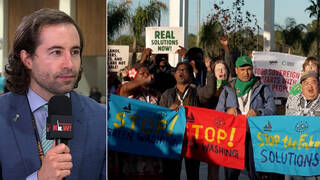
AMY GOODMAN: And the Arctic melting faster than anywhere on Earth, and you are wearing, with your necklaces, a little sign that says “Decolonize Climate Policy.” What does that mean?
AAKALUK ADRIENNE BLATCHFORD: We have the answers as Indigenous people. We know that with our way of life and our traditions carried on into these spaces, that decolonizing this space and implementing what we know, our traditional ecological knowledge, our value systems, into these policy spaces is what’s going to move forward to help bring regenerative economies and a just transition that’s equitable and that’s going to give opportunities for Indigenous peoples to not only live in our lands, but thrive in our lands.
AMY GOODMAN: And geoengineering, what you’re most concerned about when it comes to the issue of geoengineering and experiments in Alaska?
AAKALUK ADRIENNE BLATCHFORD: You know, when we look at geoengineering, it’s a false solution, and it only perpetuates what we’re seeing when it comes to the dependence on this fossil fuel industry. And we need real climate solutions, not technology for climate mitigation. There’s a lot to be said when these projects are funded and operated by these industries that are bringing forward destruction to Mother Earth.
AMY GOODMAN: We want to thank you so much, Aakaluk, for joining us. We have seen you out there protesting, being part of news conferences, holding up signs. We’re here at the U.N. climate summit. This is Aakaluk Adrienne Blatchford with the Indigenous Environmental Network. She is Inupiaq and Yup’ik from Unalakleet. And why don’t you say it yourself, so I say it right?
AAKALUK ADRIENNE BLATCHFORD: You got it. You got it down. Unalakleet, Alaska. Unalakleet.
AMY GOODMAN: Unalakleet, Alaska.
AAKALUK ADRIENNE BLATCHFORD: Yeah.
AMY GOODMAN: This is Democracy Now!, democracynow.org. In a moment, we’ll be joined by an Indigenous activist from Russia. But first, let’s go to Joan Carling, an Indigenous leader from the Philippines. She spoke earlier today here at the U.N. climate summit.
JOAN CARLING: I’m Joan Carling from — a Filipino activist. And as my colleague has mentioned, Trump was in the Philippines to take control of our minerals and our land for data centers. And there’s a big demonstration that happened, and more than a hundred were arrested. And they are now calling for solidarity. They are calling for global solidarity, because we cannot allow this to continue. When we speak of respecting Indigenous peoples’ rights, that means we don’t want land-grabbing for just transition. We don’t want the polluting of our rivers. We don’t want the destruction of our livelihoods. That’s what we are talking about here. We also want companies to be accountable for the harms that they are doing to our communities. For mining companies, enough is enough. We have already suffered, and we cannot continue to be sacrificed again and again in the name of just transition, in the name of climate action.
AMY GOODMAN: Joan Carling, Indigenous leader from the Philippines, speaking earlier today at the U.N. climate summit.




 Top
Media Options