








Guests
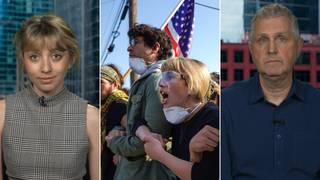
- Kat Abughazalehformer candidate for the U.S. House of Representatives and one of the “Broadview 6.”
- Michael RabbittDemocratic committeeperson in Chicago’s 45th Ward and one of the “Broadview 6.”
Watch Part 2 of our conversation with Kat Abughazaleh and Michael Rabbitt, two of the “Broadview 6” who were indicted for protesting last year outside the Broadview ICE jail during Trump’s so-called Operation Midway Blitz immigration crackdown.
During a recent court hearing, the U.S. Attorney’s Office admitted federal prosecutors committed misconduct during the grand jury proceedings and, in a stunning move, the U.S. Attorney’s Office dismissed the charges against the remaining four defendants. Charges had already been dropped against two others.
More from this Interview
- Part 1: “Appalling Misconduct”: Chicago Federal Prosecutors Under Fire; “Broadview 6” Charges Dropped
- Part 2: The Government Tried to Villainize Us: Broadview 6 Defendants Speak Out After Charges Dropped
- Part 3: “Broadview 6” Defendants Kat Abughazaleh & Michael Rabbitt on ICE Protest & Prosecutorial Misconduct
Transcript
AMY GOODMAN: This is Democracy Now!, democracynow.org, The War and Peace Report. I’m Amy Goodman, as we continue with Part 2 of our look at the Broadview 6 case in Chicago with two of the activists indicted: Kat Abughazaleh, who recently ran for the U.S. Congress, and Michael Rabbitt, Democratic [committeeperson] in Chicago’s 45th Ward. They were arrested, then indicted, for protesting last year outside the Broadview ICE jail during Trump’s so-called Operation Midway Blitz crackdown, when hundreds of masked men, federal immigration agents, flooded the streets of Chicago.
During a recent court hearing, the U.S. Attorney’s Office admitted federal prosecutors committed misconduct during the grand jury proceedings. And in a stunning move, the U.S. Attorney’s Office dismissed the charges against four of the Broadview 6. Two of them, the case had already been dropped.
I thank you so much for staying with us for a continuation of our discussion, Michael Rabbitt and Kat Abughazaleh. So, start off in this part by — Kat, describe the experience of the moment. You had been protesting for a while, and you had been tossed to the ground by immigration agents even before an ICE agent drove into the group of protesters, that led to these indictments — not against him, but against you.
KAT ABUGHAZALEH: Yeah, it was harrowing, the experience that day. And when I found out, I was in my campaign office. I was actually doing an interview with Kevin from Here’s Why Kevin, who’s reporting at Delaney Hall right now. And my phone kept blowing up. I turned it off. And then I turned it back on an hour later, and it was a bunch of calls from the FBI.
And over the past year, my co-defendants and I have had a truly harrowing experience. Even though we won, we are still saddled with hundreds of dollars — hundreds of thousands of dollars of legal debt. Andre’s and my fundraisers have been fully fulfilled, but Michael, as well as our co-defendant Brian Straw, still have more to go. And that’s —
AMY GOODMAN: And explain who Andre is.
KAT ABUGHAZALEH: — the thing with these cases, is even if you win, you are still — you still have a detriment to your life. And we’re still picking up the pieces of our lives.
AMY GOODMAN: And explain who Andre is.
KAT ABUGHAZALEH: Andre Martin is my field director on the campaign. He now helps run my mutual aid political advocacy organization, KAPOW. And he was my co-defendant. And, you know, I have to recommend to people, if you and a friend have to be indicted independently, I recommend you do it together, because it was kind of nice to have a buddy through this experience.
AMY GOODMAN: Well, that’s interesting, because you knew Andre, but what about the other four? You were called the Broadview 6, and you were charged with conspiracy. Explain what that means and whether you knew the other people.
KAT ABUGHAZALEH: So, I had actually spoken to Michael for about 45 minutes a couple months before the indictment, but a lot of us met in the courtroom for the first time, and we got to meet our alleged co-conspirators for the first time.
And the thing is, is that the federal government puts a lot of pressure on people to take a deal. They want you to separate from each other. We played out the prisoner’s dilemma in real time. And as Andre often says, it’s actually not that hard. But that’s just kind of a joke, because it is. You’re facing a lot in legal debt. We were facing up to a decade in jail.
And all of us, without being able to communicate with each other, without knowing each other, without knowing each other’s hearts, independently decided to see this case to the end and say we stand for our First Amendment rights, we stand with immigrants, we believe that we will win. And that was actually one of the phrases that the government cited as evidence against us that was going to be used in court, the chant that “I believe that we will win.”
AMY GOODMAN: Kat, explain how these indictments — these were felony indictments?
KAT ABUGHAZALEH: Yes, one was a felony, one was a misdemeanor.
AMY GOODMAN: Explain how the indictments affected your campaign for the U.S. Congress.
KAT ABUGHAZALEH: You know, I ran for Congress from March 24th of last year ’til Election Day on March 17th. We came second in a field of 15. But it absolutely had an impact. Every piece of communication that went out was run by a lawyer, which adds up very fast, and not to mention the psychological impact of not just the candidate, but one of her most senior staff members constantly going in and out of court and just dealing with this albatross hanging around both of our necks. I had a wonderful staff that supported us through this entire ordeal and was extremely supportive and helped pick up our slack, but it absolutely had an impact on the campaign.
AMY GOODMAN: Michael Rabbitt, we talked briefly in Part 1 of this discussion about what happened to you. Explain why you went out that day to the protest and what happened to you, from that moment on.
MICHAEL RABBITT: So, I think this story really winds back to January of 2025, when Trump was inaugurated. And Chicago has amazing organizers and activists who sprung into action. And actually, the planning — we knew Operation Midway Blitz was coming. We didn’t know exactly when. But a lot of the organizing work started in late January. And the community’s response was amazing. So, once Midway Blitz did hit in September, we were ready. Our plans to hold Know Your Rights trainings, those had already happened. They were great and widespread. Rapid response networks were forming. Deportation defense was in place. And then, when Operation Midway Blitz hit, we were ready.
But I don’t think anybody realized it would be as horrific as it was, seeing ICE terrorize our communities, seeing our neighbors kidnapped and disappeared, seeing the violence and aggressive tactics of ICE. So, that was the start of, you know, people taking action at protests. I was involved in a lot of that work. But I realized that Broadview needed to be in the mix. So, I hadn’t been actually to Broadview until September 26th, but I felt that I could not ignore not only what was happening with Midway Blitz, but I could not ignore the unjust and inhumane conditions at the Broadview ICE Processing Center. You know, human rights violations cannot be ignored, and so that’s why I showed up that day.
AMY GOODMAN: And what about your role as Democratic committeeperson in Chicago’s 45th Ward? What do you do in that position? And how did your action fit into that?
MICHAEL RABBITT: Yeah, so, I mean, the Democratic committeeperson is a part-time unpaid position. It has certain minimum responsibilities, such as, you know, we’re involved in the Cook County Democratic Party slating process. We’re involved in running elections on Election Day, increasing voter turnout. But for me, the part of the job that is most important is that I can use it as a platform to advocate for the issues that I’m passionate about, such as affordable housing, climate justice, police accountability, tax reform, you know, a number of progressive issues that I’ve tried to champion over the years.
And so, immigration rights was also part of that platform, and so, you know, I was proud to have built an organization and have a community of supporters that were ready to mobilize when Operation Midway Blitz hit. And it required us to step up. And I felt that as an elected official, you know, I had a responsibility to be there, be very visible and be very active.
AMY GOODMAN: And so, explain what happened that day. Where were you when the ICE agent drove his car, what it looks like, into the Jericho walkers?
MICHAEL RABBITT: Yes, so, we were doing the Jericho walk, which is a peaceful form of protest in which we chant, sing songs. It’s all about community and solidarity. So, as we were doing the Jericho walk, the vehicle drove through the crowd.
And what’s notable about it is that up to that point, the Broadview Police Department was present that day, and they were helping us and directing us to clear a path for other vehicles that needed to pass through. So, other vehicles passed through without incident.
What stood out was this ICE agent drove through our Jericho walk. And, you know, when I saw that, I thought, “This must be ICE, an ICE vehicle,” because we knew that ICE had a history of provoking protesters violently. And so, that’s what happened. He drove through the crowd. I happened to be just to the side of the vehicle as it was driving through the crowd of protesters. I was stunned and alarmed that he was doing that, you know, and my — I live by the motto of “do not stand idly by.” When you see injustice, when you witness injustice, when you see that people are at the risk of harm and in a dangerous situation, you have to step up and take action. So, my response was to approach the vehicle. My goal was for the driver to stop driving through the crowd. I put my hand on the vehicle, yelled “stop” twice. But, unfortunately, he continued driving through the protesters. Fortunately, no one was hurt, but it was a very scary situation.
AMY GOODMAN: So, then describe, Michael Rabbitt, how you found out you were indicted. In Part 1, you briefly said it. Give us more details, and how, then, this affected your life.
MICHAEL RABBITT: So, I was on vacation with my wife in Portugal. We were celebrating our 30-year wedding anniversary. Apparently, the FBI had been trying to reach me overnight. Due to the time difference, I didn’t get the message until I woke up that morning, and I looked at the messages on my phone, and I had two calls from the FBI. And the message said that “You are being investigated for an incident that happened at Broadview on September 26th, and an indictment has been secured against you. And you have to surrender yourself tomorrow. If you don’t do so by tomorrow, there will be a warrant for your arrest.”
So, needless to say, that was quite shocking. Didn’t even know if it was real. I thought it was a scam, had to look up the names to see if it was real. Once I saw that it was, I was worried that we were going to have to end our vacation early and get back to Chicago. Fortunately, you know, I was able to secure an attorney right away, and there were arrangements made for us to be processed at a later time. But it was a very stressful situation.
And that was just the start of it, you know, in terms of the personal toll. You know, our co-defendant, Brian Straw, Oak Park trustee, I think, summed it up really well. He said the process is the punishment. And that process was long and arduous for over seven months. You know, Kat mentioned the legal fees are astronomical. But in addition to that, it’s just so much stress for your families to go through. You know, we had to attend many court hearings. There were so many twists and turns in this case.
You know, one of the first reactions I had was: How did they get a conspiracy charge past a grand jury? So, immediately I was asking my attorney, “Is there some way we can get these grand jury transcripts?” And, of course, then our defense team, from the start, was repeatedly and was relentless in trying to get these transcripts. And it took a long while. Fortunately, they did come out, and, you know, we’re exposing the misconduct that happened in this case.
AMY GOODMAN: And then, explain that, Kat, these documents, how it was that the judge finally saw this, and their heavy redactions, some whole pages missing, to find out how it was you all faced the charges that you did.
KAT ABUGHAZALEH: Yeah. So, as Michael said, our defense team — we had a joint defense, because especially with the conspiracy charges — have been pushing for these grand jury transcripts, for the judge to look at them unredacted, since, essentially, the start of this case. And she, as many judges do, was operating under a presumption of regularity, the idea that our government serves us, that they are doing things by the book, that prosecutors are trying to pursue justice and not political punishment.
And finally, basically a week before our trial was supposed to start, Chris Parente, who was on your show earlier, said, “Judge, you don’t have to show them to us, but if you could just look at these unredacted transcripts?” because when she was about to look at them a couple weeks before, that’s when our felony charge got dropped. The conspiracy charge got dropped as soon as the government was forced to show these unredacted transcripts. So she did, and then called a hearing the next day for all prosecutors who had touched this case.
And what she reported was massive prosecutorial misconduct. Vouching, the concept of a prosecutor saying, “You know, you can trust me that this case — this case is good,” telling grand jurors who disagreed with this, especially grand jurors in Chicago during Midway Blitz — we saw what was happening — who were saying, “I don’t think that this is a crime that you should prosecute,” telling them to leave the process. And the entire situation, we have no idea how far this misconduct goes. There are implications, that was reported in Bloomberg Law yesterday, that there were messages going to Andrew Boutros as far as the White House, telling them to —
AMY GOODMAN: He’s the U.S. attorney in the case.
KAT ABUGHAZALEH: — prosecute more of these ICE-related cases. And in one as political as ours, it’s hard to believe that this just happened independently.
AMY GOODMAN: And just to be clear, Andrew Boutros is the U.S. attorney in charge of the office in this case. And you have two now senators who are calling for his resignation. You have Dick Durbin, and you have Tammy Duckworth of Illinois.
KAT ABUGHAZALEH: Yes, and I think one thing that I think is important to mention about Andrew Boutros is, after our charges were dismissed, in the exact same hearing — you can look at the transcript for yourself — he says that he still believed that there was probable cause to prosecute us, that he was ready to take this to trial, and then villainized us. He said that our conduct does not fit in a civilized society.
And frankly, I think that it’s extremely civilized to stand up for your neighbors. I think it’s very uncivilized to drive through a crowd of protesters. He said it was only by the grace of God that that ICE agent only drove two miles an hour through us, that he didn’t get out and shoot us with his firearm. And if that is how our law enforcement is supposed to act, that we are supposed to trust the grace of God to keep us from getting murdered in the street, then I think it’s about time that we reevaluate not just our law enforcement processes, but also our prosecutorial processes. And it’s absolutely a moral imperative for all politicians to be pushing for the abolition and prosecution of ICE.
AMY GOODMAN: Michael Rabbitt, you said, when you ran for 45th Ward Democratic committeeperson in Chicago, the position you occupy now, that immigration crackdown was one of the issues you cared a lot about. Can you explain to the global audience what is Broadview, and your concerns about what was happening there, for people to remember Operation Midway Blitz?
MICHAEL RABBITT: Yeah, so, Broadview was a local ICE processing center. That’s a misleading term, because you should — processing should be a very short-term action, but it actually was a detention center. People were being held there for days and days in horrific, inhumane conditions, where they were denied legal counsel, they were denied proper bedding, hygiene, overcrowded conditions. It was horrific, you know, inhumane human rights violations that were happening there. So, again, you had Operation Midway Blitz happening in the streets of Chicago, ICE terrorizing our neighbors, terrorizing our communities. And then you also had these human rights abuses that were happening at Broadview, which is a suburb of Chicago.
AMY GOODMAN: And finally, Kat, your final thoughts now, and also where you go from here with this case? OK, the charges have been dropped, but what your plans are?
KAT ABUGHAZALEH: This case isn’t over. Our lawyers have filed a motion under the Hyde Amendment to not just recoup our costs, but to find out more about why we were prosecuted in the first place. This is happening in cases across the country, if it’s happening to us. And we’re already seeing our case being cited, in instances like the SPLC case, as basically precedent to look at these grand jury transcripts and see why they were indicted in the first place and if there was prosecutorial misconduct.
But I think one of the most harrowing things that we can look at here is what happened in Spokane exactly a week after our charges were dropped. The Spokane 3, formerly the Spokane 9, were a group of activists that had almost an identical situation to us, from the charges to individual instances, such as an unidentified person spray-painted a bus, and that was used as evidence against them, despite that person not being indicted. In our indictment, someone allegedly scrolled “pig” on the side of this van. It never alleged that we did it, but it was still included in the indictment and caused a lot of flurry in the media. They were convicted. They are waiting for their sentencing. And I don’t know how we are free and they are not. And so, I think it’s really important to keep eyes on Spokane. I think it’s really important to keep eyes on Delaney Hall. All of this is tied together.
And the administration wants to make you fear speaking out. They want to make you fear the secret police, and the idea that if you disagree with them, that you could not just face prosecution, but a lot worse. But that’s the thing. There’s a lot more of us than there are of them. And this case has shown, in spectacular fashion, because we saw it to the end, how the government is not just being incompetent, but outright insidious in the prosecution of regular citizens.
AMY GOODMAN: I want to thank you both for being with us, Kat Abughazaleh, who recently ran for U.S. Congress, and Michael Rabbitt, Democratic committeeperson in Chicago’s 45th Ward, both members of the so-called Broadview 6. All charges have been dropped against them. We’ll continue to follow this story. And to see our coverage of what’s happened in Spokane, Washington, go to democracy now.org. For Part 1 of our discussion on Broadview. you can go to democracynow.org, as well. I’m Amy Goodman. Thanks so much for joining us.



 Top
Top
Media Options