




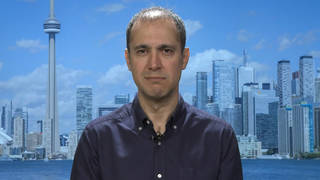








Watch Part 2 of conversation with Steven Thrasher, author of the new book The Overseer Class: A Manifesto. In the book, he explores how members of historically marginalized groups rise to positions of power within institutions. Thrasher says these figures often perpetuate, rather than challenge, systems of injustice.
Transcript
AMY GOODMAN: This is Democracy Now!, democracynow.org. I’m Amy Goodman, with Juan González.
We end today’s show with journalist, author, scholar Steven Thrasher, formerly the inaugural chair of social justice in reporting at the Medill School of Journalism at Northwestern University in Chicago. But in 2024, after students set up a Palestine solidarity encampment to protest the Gaza genocide, Thrasher linked arms with other faculty to stop police from violently evicting the students. He ended up brutalized himself. The university then filed criminal charges against Thrasher, which were later dismissed, but the next two years of Thrasher’s classes were canceled, and he was denied tenure. He told Democracy Now! at the time, “What they don’t like is that I am now applying the same social justice journalism principles that I’ve applied to race and that I’ve applied to LGBTQ people, to COVID and HIV, that I was now applying those to Palestine,” he said.
Steven Thrasher is the author of the award-winning book The Viral Underclass: The Human Toll When Inequality and Disease Collide. He’s now out with a new book titled The Overseer Class: A Manifesto, in which he explores, quote, “a phenomenon in which people from marginalized populations amass power not by uplifting people from the communities they come from, but by collectively cracking the skulls of their own.” Steven Thrasher is here in New York to present a film series he programmed, inspired by his book, called “Black Cops, Spies and Overseers.” The series will play at the BAM Rose Cinemas in Brooklyn, starting June 5th.
Steven Thrasher, welcome to Democracy Now! How does your own experience link to your new book?
STEVEN THRASHER: I have been reporting on police violence for many years. The first time I was on Democracy Now!, I was talking about the NYPD. And I saw, when I was reporting in Ferguson, a dynamic that I have seen many times, of a Black — of a white police officer either beating or killing a Black person.
And I noticed that as America grew more structurally critical of policing, that I was seeing a figure of Black cops over and over again, that Black cops were appearing in movies, that I was seeing them as talking heads on CNN and MSNBC, and, of course, running for many political offices, Joe Biden choosing two Black women prosecutors as his — on his final list before choosing Kamala Harris. And so, I started thinking about the ways that Black cops are kind of rehabilitating police departments, as are women cops and LGBTQ cops. As Americans were more critical of what policing did and how violent it inherently is, the more often these people were dispatched. And those are the people who I call overseers, the ones who rule between the ruling class and the working class.
JUAN GONZÁLEZ: But, Steve, isn’t this essentially a historical problem that has existed not just in the U.S., but in other — in other countries? I think of apartheid South Africa, when many of the troops of the South African minority-white regime were themselves Black and were put to repress their own people, or even in many parts of Nazi-occupied Germany, where the actual people delivering the repression in these various countries were from those countries, even though the Nazis were the occupiers.
STEVEN THRASHER: Well, that’s really an important point, Juan. And I got to travel through Africa, through South Africa and Uganda in the fall. And it was interesting hearing people say, “Why do you in America even think that there would be an alliance between Black cops and Black people? Because everybody here is Black,” and so they don’t — you know, they don’t think of a racial container of solidarity that we often think about here. In South Africa, when I was visiting Prison Four, which is where Mandela was briefly kept before going to Robben Island — Gandhi was also kept there — the tour guide did explain to me that the white guards would walk along the top of the — you know, the perimeter, but it would be Black guards who would be sent onto the yard to do the more intimate policing.
And you’re right to bring up the case of kapos in the concentration camps, who were people who collaborated with the Nazis.
And I’m thinking historically, too, on this. I’m thinking back to when overseers were literally the people who worked on plantations and made sure that enslaved workers worked as hard as they possibly could on behalf of the master. That person was usually white, but they were sometimes Black, and the white overseers often had Black drivers who worked with them. And those were the people that the master exploited the close kinship, the relationship, to try to get a more intimate level of surveillance and to try to get more work and more value out of what they were doing.
JUAN GONZÁLEZ: And you posted — during the Gaza campus protest at Columbia University, you said, “going to see Columbia University’s first Arab president work with New York City’s black cop mayor [Eric Adams] [and] with the nypd’s first Latino Chief [Edward Caban] to arrest as many diverse students as possible.” You talk about this first narrative and this individualistic view of how achievement occurs in America. Could you elaborate on that?
STEVEN THRASHER: Yeah. So, what I found in college campuses was that we diversified the disciplinarian apparatus and nothing else. So, I looked — I saw that at Columbia. When I was beaten up at Northwestern, it was the Black chief of police who manhandled me personally. And then I started thinking about how I’d seen Black cops, chief cops, at the University of Chicago, at Northwestern, at NYU, at Columbia. I looked at 22 schools I’d reported on. Nineteen had a Black chief of police. And just looking at those 19 schools, to create sort of a control for the variable, they had 100% Black cops at those 19 schools. They only had about 5% Black students, 6% Black faculty. So, what I saw was that often chiefs of police, deans, middle managers, people with positions of some power, they’re often diversified in this way, and those are the people dispatched as overseers. But they’re not there to help people like them; they’re really there to crack their skulls.
And I certainly saw that that’s an exploitation of identity. You know, it’s Gay Pride Month right now. I could have an affinity with someone like Karine Jean-Pierre, who hailed herself as the first LGBTQ press secretary. But she was also the face of the genocide of Gaza. And she’s been going out on kind of a press rehabilitation tour right now, you know, trying to get back in people’s good graces. Instead of — the overseer dynamic makes it so that we are supposed to feel an affinity with someone like her, because she’s the first to do this. But we could have a sense of affinity with LGBTQ people in Gaza, with LGBTQ people in Iran, with LGBTQ people in any of the countries that have been bombed by the United States. And people in those positions try to allay and obscure the horizontal connection we have to people we could feel solidarity with, and instead want us to feel it for this first person, who’s often suppressing the group that we’re from.
AMY GOODMAN: We just have a minute. Then we’re going to do a post-show, Steven Thrasher. But you, in fact, applied to be a New York police officer back in 2003. Can you talk about what led you to consider that, and your motivations to write this book?
STEVEN THRASHER: And I’m prepared to get canceled for that. But I also want to show people that you can change over time. The reason I applied was because I needed a job. You know, I’d gone to film school. I had a lot of student debt. I wasn’t getting media work. I’d also — I had previously applied to be a teaching fellow. I didn’t get that, and so I applied for this job. And I think when we are critical of the fact that a majority of ICE agents are Latino, we also have to wrestle with the fact that ICE is the major hiring program of the federal government right now. And so, we need to give people options for things they can do for a living, and not just rely on individual moral decisions for how to deal with these systemic problems.
AMY GOODMAN: And in the last 10 seconds, DEI, the Trump administration’s attack on it, and your thoughts on it?
STEVEN THRASHER: I make a critique of DEI that’s different from the Trump administration’s. I think DEI doesn’t go far enough. What the Trump administration is doing is racist.
AMY GOODMAN: We’re continuing our conversation with Steven Thrasher, author of the new book The Overseer Class: A Manifesto. Steven will be presenting “Black Cops, Spies and Overseers,” a film series he programmed, inspired by his book, at the BAM Rose Cinema in Brooklyn from June 5th to June 11th. He’s also the author of the award-winning book, The Viral Underclass, that, in a sense, really went viral, The Viral Underclass: The Human Toll When Inequality and Disease Collide.
Steven Thrasher was suspended from teaching in 2024 and denied tenure at the Medill School of Journalism at Northwestern University in Chicago, after standing in solidarity with his students who were protesting genocide in Gaza.
In Part 2 of this discussion — we ended Part 1, Steven Thrasher, talking about DEI, about President Trump’s attack on DEI, and the erasure of Black history. I mean, you have, for example, in Philadelphia, national park, the remembering George Washington and the fact that first White House was there and he had slaves there. The Trump administration just ripped it down. But talk about DEI, the erasure, and then your attitude toward DEI.
STEVEN THRASHER: I was really lucky. I’ve had two wonderful women who’ve shepherded my career in this book — Tanya McKinnon, my agent, and Abby West, my editor — who really pushed me on this point in particular, that the argument and the critique I wanted to make of DEI was a different — was a different argument than the one Trump was making. I’m writing about historically how DEI itself was a watered-down version of affirmative action. My friend Victor Ray’s book, I talk — On Critical Race Theory, he writes a lot about this history, that affirmative action had the weight of the federal government, in a specific way, to deal with — to deal with reparations, to deal with racial matters explicitly. And DEI is much more amorphous.
AMY GOODMAN: And just to be clear, for our global audience, ”DEI” stands for “diversity, equity and inclusion.”
STEVEN THRASHER: Correct, and I have a little bit of an international perspective on that. So, DEI was itself a watered-down version that often didn’t go far enough. And I write about how in corporations the goals are amorphous. Who it’s actually helping is — you know, you’re not always clear about it. The enforcement mechanisms aren’t clear. It is often usurped as a PR ploy of corporations. But at the same time, I write about how I’ve never met a person who works in DEI who wasn’t well-meaning. Often they have good intent. They’re often structurally set up for failure. And so, that’s a very different critique than what the Trump administration is doing, which is really bound by racism and transphobia, sexism.
And I got to see this both, you know, in the U.S. — I think we all probably, if we care at all about these issues, know people who have lost their jobs or companies that have gotten rid of things, from Target to various HR departments. When I was reporting from Uganda, where I talked to you briefly, I saw the effects of both the end of USAID, which I was reporting for Pulitzer and The Intercept, not just, in fact — not just about HIV and LGBT health, but explicitly around DEI. Everywhere in the world, people are saying, “We’re getting calls.” You know, I knew people who worked with the particle accelerator in Switzerland. They’re getting calls from the federal government. “Do you have DEI?” You know, people in Uganda are — “Do you have DEI? You must get rid of it.”
And it was particularly lethal in Uganda, where it is illegal. You were talking about another country that did this earlier in the show today, and it’s illegal to be LGBTQ in Uganda. You can face the death penalty. One of the things they’ve done to get around that with HIV work is to talk about minorities or to talk about diversity. Uganda is 99-upwards Black, so “diversity” and “minorities” were stand-in words for LGBTQ. Not only did Trump explicitly get rid of LGBTQ and USAID stuff, he also then got rid of this workaround they had. So, the concept — you know, I’m trying to make a very responsible argument by saying we can’t lump critiques of DEI not going far enough with the critiques that DEI, you know, should go out because of racism.
AMY GOODMAN: The dismantling of DEI also removes funding for environmental justice programs and other initiatives that have material impact on people, and particularly people of color. Your thoughts on this?
STEVEN THRASHER: That’s really at the heart of my — of this book, The Overseer Class, that there are material and structural things that happen. Often the face of that is somebody from a marginalized background. So, in Atlanta, where I got to go to Charis Books, you know, Atlanta is still a pretty Black city, but a relatively Black city. But I write about 10 cities across the U.S. that have had declining Black populations. Atlanta is one of them. But almost all of these cities have a Black mayor, and they have a Black chief of police. And so, I believe the mayor is Andre Dickens, who is the current mayor. He’s a Black man. And many activists talk about how, you know, he, Keisha Lance Bottoms, Fani Willis, the prosecutor, most famous for trying to prosecute Trump, these were all figures that have been involved in various ways as trying to suppress the Stop Cop City movement. Those are all Black — you know, those are all Black people, as well. They have a racial analysis that is also born into dealing with criminal justice, but also Stop Cop City took out lots of trees in a city where Black people have disparate rates of asthma.
And so, all of these things are connected. And it’s often somebody like a mayor or a police chief, that’s trying to be the face of a group, that’s going to be harmed by environmental problems that then is going to hurt that same group. And looking at the global climate movement, as people need to move around the globe as temperatures go up, I think that we’re going to see a lot of these overseers being dispatched to try to hold borders in hard ways and to try to keep people who are not white or not rich from accessing clean air, clean water and food.
AMY GOODMAN: Black people represent about 15% of the U.S. population, yet, statistically, the majority of people in prison, who experience homelessness, have the highest maternal mortality and highest unemployment rates. In your book, you talk about how firsts are used to create containers of race meant to benefit the careers of individuals. Talk about the difference between the narrative of individualistic achievement and the betterment of an entire race or group.
STEVEN THRASHER: Well, I think of it in two large ways in the book, about — you know, as you’re saying, there are these ways that we can see our relationship to broader groups, kind of across class or across different containers. As I was saying earlier, it’s LGBTQ Pride Month. And we could think about how LGBTQ people are disparately impacted by the police, you know, disparately poor, or have a lot of health problems that straight people don’t have and cis people don’t have. And we could think of our allegiance across those groups, or we could think about having an alliance with somebody like Pete Buttigieg, you know, who was a Cabinet secretary and was a mayor at some point.
In one part of my book, in a different corporate area, I’m talking about what are called employee resource groups, ERGs. And the history of those is very interesting. The first — these are groups where people come together within corporations around a shared identity to try to make their work situation go well. The first one was started in Rochester after a riot where the police were terrorizing the Black community, used a helicopter for one of the first times to try to suppress, at a police level. The helicopter crashed, killed five people, and that made the whole thing get even bigger. And at Kodak at the time, which was kind of like the Google of its time — it was the leading tech company in the country. It was in Rochester. The Black employees said, “We don’t feel safe. We want to make a group.” And they had this — this Republican, sort of liberal CEO said, “Yes, you should have your own group.” And they used that to develop their talents. And that has a very noble origin.
But ERGs have very much gotten sucked up into corporations and having them often try to bring groups together to stop them from unionizing. And I looked back at my own history at The Village Voice, where we had won the first contract, long before I was there. But in the early 1970s, we won the first contract ever for same-sex partner benefits of any private corporation in the country. That was done through a union, you know, not through an ERG. And sometimes, you know, these kinds of corporate efforts hail individuals. You know, they hail — you know, we have the first CEO, the first vice president of a company. But what if all the Black workers and all the LGBTQ workers and the women workers, you know, work together to say, “We need good pay, maternity leave, same-sex partner benefits, all these things together”? And the first narratives often are used to pull people away from that kind of solidarity, which doesn’t mean some of the people aren’t very well-meaning, but structurally that’s often what happens.
AMY GOODMAN: How would you fit the first African American president, Barack Obama, into your narrative?
STEVEN THRASHER: I think of him — I do think of him as an overseer, particularly where he ended up. I write about both him and Harris. And they actually — and they ended up both in the Oval Office in similar places. Many people that I reported on in Chicago are quite unhappy with the Obamas right now, because this new, almost billion-dollar center is opening up that was funded by — that was funded by the donors that gave to the Obama Center. Many of them are bankers who were let off easy after 2008. And the effect of having the center there has driven up rents in the area, is displacing people, creating gentrification. So, there’s a lot of kind of disappointment with him there.
I actually think he and Harris had different paths to power. She was a career prosecutor from the beginning. She was an assistant district attorney and eventually a district attorney in California. And he was a community organizer, so he had a very different kind of orientation.
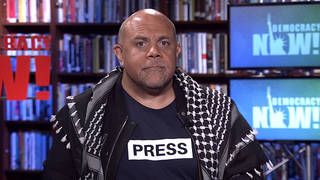
One of the — an example, though, that I think he really functions as an overseer right now is as a cultural overseer who oversees the boundaries of our imagination and our debate. So, for example, he’s continuously gotten heckled or interrupted about the genocide in Gaza. And he does this, “You know, no, no, no, we must be polite” kind of routine that is saying — is saying people shouldn’t be engaged politically, that they shouldn’t feel a real revulsion and anger, which we should, for the tens of thousands of people who were killed and almost 300 of our journalism colleagues, for whom I am wearing this shirt in their memory.
AMY GOODMAN: You’re wearing a shirt that says “press.”
STEVEN THRASHER: Yes, for the audio — for the audio listeners. And so, yeah, Obama does — I think he does function as an overseer, which doesn’t mean that maybe he had good intent at one point, and a lot of people had lots of hopes for what he could do structurally. But the effect of sometimes having the first Black president, as we’re told again and again, makes it harder to go after certain targets. So, I think the country has a much easier time mobilizing against the villainy of immigration enforcement under Trump than it did under Obama, even though Obama, at least the last time I checked, had more deportations than Trump did.
AMY GOODMAN: I wanted to go to what happened at CUNY’s graduation. CUNY’s Colin Powell College was disrupted, a graduation speech, by Linda Thomas-Greenfield, who served as U.N. ambassador under President Biden. The students highlighted her role in Gaza and her votes against multiple ceasefire resolutions there.
STUDENT PROTESTERS: [echoed by the People’s Mic] Linda Greenfield, you’re a liar! You set Palestine on fire! We are disrupting our own graduation because Linda Thomas-Greenfield is a war criminal! We demand that CUNY disclose and divest, boycott! Solidarity with colonized people!
AMY GOODMAN: So, just to be clear, what some of the students were chanting, “Linda Thomas-Greenfield, you’re a liar! You set Palestine on fire! We’re disrupting our own graduation because Linda Thomas-Greenfield is a war criminal! We demand that CUNY disclose and divest, boycott! Solidarity!” they said. Interestingly, we had on a student who was about to graduate that day, in the last week, from CUNY, and we were talking about what’s happening around the country, where a number of colleges and universities have just ended, like CUNY, the ability of students to speak at graduation, because of their concerns about what they would say. And then you have the admonishing of the professor at University of Michigan who dared to talk about students speaking up for Palestine.
STEVEN THRASHER: Yeah, I have a lot — I have a lot of thoughts on this. Many people sent me that video of Linda Thomas-Greenfield, because I actually begin my book writing about her. She’s the first major overseer that I write about. And I’m writing about the year 2023, which the first big news story I tuned into that year was about the killing of Tyre Nichols, where he was killed by five Black police officers, and then the year ends right before Christmas with ceasefire resolutions failing at the United Nations because of the sole vote of Linda Thomas-Greenfield. Sometimes her deputy, Robert Wood, stood in for her, but he was also a Black man. And so I felt a lot of shame and conflict seeing this single hand being a Black one that was continuing the genocide in Gaza.
And my friend Adam Johnson, who wrote a fantastic book called How to Sell a Genocide, we were in conversation together in Pilsen Books. He talked about how awful it is that we are expected to just bring these people back into polite society. They think they can go back onto the speaking tour and go to colleges and not face the consequences of their actions. And the CUNY students, as I’m sure you remember from 2024, were particularly brutalized, physically. I think there was more than a hundred arrests that happened at one point. There were several different actions that happened. And this is happening at the Colin Powell School, who himself should have been thought of as a war criminal both for his cover-up of the — helping cover up the My Lai massacre, as well as, of course, saying there were weapons of mass destruction, that led to the deaths of a million people.
AMY GOODMAN: Although, interestingly, afterwards, he would say about that address he gave right before the U.S. invaded Iraq, something he was actually not for, but, ultimately, because he was the one who gave the speech about weapons of mass destruction, it justified, and he said that that would always be a stain on his career.
STEVEN THRASHER: As it should be. And, you know, this is exactly what I’m talking about when I talk about these overseers, that they put someone like Colin Powell forward to make the case, and he could have said no. He could have refused to do it. People have often been asking me on my tour, “Well, you know, what if Linda Greenfield-Thomas had said no? They’d just get someone else.” And I said, “No, if she had said no, then the ceasefire would have gone into effect. You know, it would have happened. They wouldn’t have had a chance for a do-over.”
And I want to talk a little bit more about this point you bring about the college students, who are so smart, so moral, so ethical, and they are being silenced. You know, I saw it happen at Northwestern. I reported on seven or eight campuses myself. Almost all of them, the students were viciously attacked. And I write in the book about my own experience prior to Northwestern, when I was a student at NYU and I gave a graduation speech. I was punished for that.
AMY GOODMAN: Explain how you were punished.
STEVEN THRASHER: Well, I did — I was asked to give the graduation speech. I did not ask to give it. And between the time I was asked to give it and I gave it, all this stuff went down at NYU, largely around Palestine. In a foreshadowing of what was to come —
AMY GOODMAN: And what year was this?
STEVEN THRASHER: This was 2019. And in a foreshadowing of what was to come, the students had chosen — every year, there was an award called the President’s Award. Students would choose clubs they wanted to honor; president would present it to them. They chose JVP, Jewish Voices for Peace, and SJP, Students for Justice in Palestine. The students chose them. The president didn’t show up. Instead, he wrote an op-ed in The Wall Street Journal the next day denouncing them. And so, I knew that in some way I was going to address this, and I added a few sentences to my speech off the cuff of what I was going to say, partially to try to protect people, who then turned on me. But I saw — you know, I was punished, because my advisers never spoke — two of my advisers never spoke to me again. The president of the university denounced me. NYU denounced me. I thought maybe I wouldn’t even get to start my job at Northwestern. And so, that was one — just one example of a time that I’ve been punished. And I’ve been punished no way like, you know, our Palestinian colleagues have been punished.
But also at NYU, a year ago, I was really proud to see Logan Rozos, who was a Black trans student who was asked to give one of the graduation speeches, and gave this beautiful, tear-inducing moral argument about how they could not not use this moment to say what was in their heart. NYU denied Logan his diploma, has never — to my knowledge, has never given it to him. I was terrified that was going to happen to me. Like, the three months I was waiting for my diploma in 2019, that whole summer, I thought maybe I’m not going to get it. I was checking the mail every day. And I did finally get it, but I thought that could happen to me. But Logan, like, they’ve never done that. After selecting him as one of the best students in the university, they’ve denied him his diploma.
And so, and now, this last year — I wrote a piece about this in Lit Hub — NYU said, “No more live graduation speeches. We will only put them on video,” seat the student like they’re a hostage under a proof-of-life video, and, you know, march everyone to watch this video. The entire thing is absurd. And many universities are doing this. Or at USC a couple years ago, they just canceled graduation to keep the Palestinian student, who I think you had on Democracy Now! —
AMY GOODMAN: Yes.
STEVEN THRASHER: So, the students are just being silenced. And it is so against the concept of education to me that students don’t get to use what we impart with them. And you don’t get to — like, you don’t get to dictate what it is they do with it. I had an activity I love doing at Medill, where I would start my classes with a song or a video, and I would then hand a marker to a student and be like, “You go up and lead the class in a discussion of the song, so I can learn what you’re thinking about, and so you can practice learning not being just a one-way street.” And, like, we have to hand the mics — we have to hand the mic over to students. We have to hand the markers over to students. We have to let them go into the world.
And so, it’s no surprise that students, when they’re given a graduation speaker that is vulgar and repulsive to them, whether it’s about so-called AI or it’s about the genocide, that they express themselves. And they’re now expressing themselves in the only way that they’re allowed to, because they’re not allowed to have student speakers anymore.
AMY GOODMAN: So, you have Linda Greenfield-Thomas being the U.N. — the U.S. ambassador to the U.N., and the protest against her at CUNY, and at the same time, you have Wendy Sherman, a former top State Department official under President Biden, who essentially just recently said in an interview that what happened in Gaza was a genocide.
STEVEN THRASHER: I had not seen that, and I’m glad to hear that they’re admitting it. It’s too late, but I’m glad to hear they’re at least saying it.
AMY GOODMAN: Well, this is what Wendy Sherman said.
WENDY SHERMAN: I think that it is critical that Israel remain an ally of the United States and that we protect the right of a Jewish state. But I also believe that the prime minister has led us down a road, and we have been part of it, that has, in essence, created a genocide in Gaza.
AMY GOODMAN: That was Wendy Sherman, a Biden top State Department official, speaking with Mishal Husain of Bloomberg Podcasts. Your response?
STEVEN THRASHER: She’s reinforcing one of the central tenets of Zionism, that there has to be a state that is connected to religion, and not a state that’s connected to individuals having one person, one vote. So, what happens in Gaza is an outgrowth of that project, in the same way that settler colonialism always ends up with this kind of discrimination. So, I have caveats about the quote, but I’m glad to see some people are addressing it. And it’s really horrifying to see Linda Thomas-Greenfield or Tony Blinken — I think Tony Blinken just went to some job or onto the board at the Center for American Progress. These people are just kind of going back into society as if they were not part of one of the worst crimes of the 21st century.
AMY GOODMAN: We’re talking with Steven Thrasher. He’s the author of a new book. It’s called The Overseer Class: A Manifesto. He also is presenting a series called “Black Cops, Spies and Overseers.” It’s a film series that he programmed, inspired by his book, at the BAM Rose Cinema in Brooklyn for a week, from June 5th to June 11th. Among the films screening will be the 1967 film In the Heat of the Night, starring Sidney Poitier, directed by Norman Jewison, and Quentin Tarantino’s 2012 film Django Unchained. Another one of the films screening will be the 1973 film The Spook Who Sat by the Door, Ivan Dixon’s explosive adaptation of a novel by Sam Greenlee that follows the fictional first Black CIA agent. Here’s a clip from the trailer.
CARSTAIRS: [played by Jack Aaron] Raise your right hand and repeat after me: I do hereby declare…
NARRATOR: The Spook Who Sat by the Door. The controversial best-selling novel now becomes a shocking screen reality, the story of the first Black agent in the CIA.
WILLA: [played by Beverly Gill] Whoever they select will be the best-known spy since 007.
NARRATOR: Their first mistake was letting him in.
CARSTAIRS: Let me congratulate you on being the first Negro officer in the Central Intelligence Agency.
NARRATOR: Their worst mistake was letting him out.
DAN FREEMAN: [played by Lawrence Cook] You really want to mess with Whitey? I can show you how.
AMY GOODMAN: That’s a clip from The Spook Who Sat by the Door. So, talk overall about this film series inspired by your book, The Overseer Class, and specifically talk about that clip.
STEVEN THRASHER: I did something like this for my first book, too. I love working with BAM. And I hope you’re finding it with — you know, congratulations on your movie.
AMY GOODMAN: Not mine, but —
STEVEN THRASHER: Sorry, yes.
AMY GOODMAN: — a film about Democracy Now!, Steal This Story, Please!
STEVEN THRASHER: Steal This Story, yes. But, you know, with different mediums, there are different ways to explore things. And so, with film programming, it’s interesting to think visually about these images we’re getting. I have an entire chapter of The Overseer Class that’s just about the ways that we ingest overseers as part of our visual imagination. And I think throughout the book about how there’s a difference between, you know, just a Black police officer, even an Eric Adams when he’s a police officer, versus Eric Adams as the mayor. You know, I think Eric Adams, the mayor, is an overseer. The people who are just beat cops are drivers at most.
AMY GOODMAN: And Eric Adams, as police officer, sued the New York Police Department for racism.
STEVEN THRASHER: Yes, he did. So, he experienced those dynamics, as well. But I think in Hollywood, you know, police officers are overseers. They come into our homes, they come into our imaginations and make us think that this is inevitable. I think the fact that Michael B. Jordan, who was first known in cinema for playing Oscar Grant, somebody killed by police, and he now just signed on to Miami Vice ’85, so he’ll be playing a cop. So many Black actors end up as cops.
So, I wanted to use this series as a way to explore the different ways that we see Black overseers, literally as cops or in different positions of power, sometimes literally as overseers. That’s why we’re showing Django Unchained and showing Band of Angels. And also some queer people — we’re looking at Al Pacino in Cruising.
But I also wanted to show examples of anti-overseers. And we’re opening with The Spook Who Sat by the Door, which is a fantastic film. It’s a lot of fun. And it’s an unusual narrative to see come out of cinema in the United States. We see the first Black spy. He is chosen alone. There’s literally only one. And his name is Dan Freeman in the movie. And then they train him, they show him everything the CIA does, and they don’t let him do anything. They say, “Go run the copy machine for five years.” They trot out — they trot out government officials to say, “Look, we have one over there at the copy machine.” And then he leaves.
AMY GOODMAN: But they don’t copy him.
STEVEN THRASHER: They don’t — what? No, no, they don’t copy him. They just have one. When he leaves, he takes everything he learned from the copy machine, joins up with a Black Panther kind of group and overthrows the United States government. And so, like, he uses all the counterinsurgency techniques that the CIA uses against the U.S. itself. So, the film is a lot of fun and really interesting. But a question I get often from readers is, you know, “Do I have to throw out everything that I watch?” Because I’m hard on Law & Order, I’m hard on Cops, you know, these TV shows. But these figures are everywhere.
And In the Heat of the Night, which I watched for the first time writing this book, I’m embarrassed to say, is an excellent movie. Like, it is a — it is a first-rate drama. It won a bunch of Oscars. Poitier is great in it. But it is also copaganda. It is bringing our minds into thinking this is the limit of what Black people can do. And there’s a fantastic scene in In the Heat of the Night where he’s trying to solve a murder, Poitier, and — or, his character is Lieutenant Tibbs — and he has to go to a Black abortionist. And he goes, and he threatens her. You know, he gets the information he needs by threatening her. And this is a really good example of how Black cops function, because they know in the town the white cops could never go to — they could never go into that part of town. They could never source the Black abortionist. They couldn’t get close enough to her to threaten her and to threaten to take away abortion. I think abortion was illegal at the time when it came out. And so, like, that’s an example of how intimately policing happens.
So, the festival is showing a variety of movies, you know, comedies. We have The Naked Gun We have Beverly Hills Cop. I think a lot in the book about: Is it just a comedy, or is it something that’s making us laugh and bring our critical defenses down? We’re showing a bunch of dramas, In the Heat of the Night, Cleopatra Jones, and some literal movies about slavery, Django Unchained, which has Samuel L. Jackson as Stephen, who is maybe the greatest overseer of cinema of all time. He’s kind of like the Darth Vader of overseers, I think.
So, I think it’s going to be a lot of fun. We’re doing panels opening night with Craig Jenkins and Soraya McDonald, closing night with Alex Vitale, who I know has been on the show a bunch, and Julien Lucas from The New Yorker. And I’ll be introducing a bunch of the movies. And I really hope that it’s a time that people can think about these narratives and think about how to experience them in community and conversation with each other, so they can know when they’re seeing them, because they happen often, and they’re not always so obvious.
AMY GOODMAN: Steven Thrasher, as we wrap up, we have just entered Pride Month. You take on the issue of pinkwashing. Why don’t we end with that?
STEVEN THRASHER: Pinkwashing, for people who aren’t familiar with the concept, is when you — when institutions or nations will say, “We’re good for gay rights because we do X for gay people.” So, Israel will say, “Well, we’re better on gay rights than Palestine.” Doesn’t — isn’t necessarily even true, but it’s just something that’s put forward. And it’s often used to hide violence. So, when a Karine Jean-Pierre is the White House press secretary, she was spinning when Biden renormalized Saudi Arabian relations. He had said as a candidate that he wasn’t going to, but then he did. And he went to Saudi Arabia not long after five men had been beheaded, accused of homosexuality. And she fielded those questions. And so, pinkwashing is saying, “Oh, we have a — we have a lesbian White House spokesperson,” and then we’re unaware of thinking of the responsibility we might have to our LGBT people in other countries.
And something that comes up every year is whether or not cops should march in Pride. And Pride began as a riot against police violence, you know, not far from here, in the Stonewall Inn. And now NYPD cops are often part of the main Pride, so that’s created the Reclaim Pride March without cops.
But pinkwashing is something that happens often in films. And I will end by saying we end our series with Cruising, and it’s the one that people think doesn’t have a racial dimension. It has a very disturbing one, but only in one scene. But in that movie, Al Pacino is playing a cop who goes undercover as — allegedly as a gay cop. And pinkwashing will help us to slow our imaginations to not think of all the liberation that was possible at Stonewall or all the liberation that we’ve thought is possible through what trans people show us, and then say, “We have to make it smaller. We need to think about policing on our national borders and make enemies out of people who don’t quite fit in our group.” Pinkwashing is the opposite of what I think queer liberation can provide.
AMY GOODMAN: Steven Thrasher, he’s author of the new book, The Overseer Class: A Manifesto. He will also be presenting the film series “Black Cops, Spies and Overseers” — he programmed this, inspired by his book — at the BAM Rose Cinema in Brooklyn from June 5th to June 11th. He’s also author of the award-winning book that went viral called The Viral Underclass: The Human Toll When Inequality and Disease Collide. He was suspended from teaching in 2024, denied tenure at the Medill School of Journalism at Northwestern University, after standing in solidarity with his students who were protesting genocide in Gaza.



 Top
Top
Media Options