











 Watch Full Show

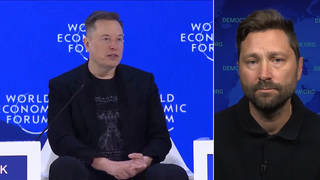
Elon Musk’s rocket company SpaceX is set to go public this week targeting a $1.8 trillion valuation, potentially making it the largest initial public offering in history. It is also projected to make Elon Musk, already the world’s richest man, the world’s first trillionaire.
The nonprofit newsroom More Perfect Union has released a new report from business reporter Eric Gardner called “We Uncovered a Hidden Wealth Transfer in the SpaceX IPO. You’re Holding the Bag.” It details how Musk convinced Nasdaq to forgo the usual waiting period to include SpaceX in its index fund, potentially exposing retirement savers to what many professional investors believe will be an overinflated stock price. While Musk and early investors are positioned to see their wealth skyrocket, the SpaceX IPO could hurt these regular investors, says Gardner. “He has essentially financially engineered the IPO as a massive wealth transfer from everyday investors to insiders,” Gardner says of Musk.
Related Story
 StoryJun 09, 2026“Tech-Driven Prosperity & Right-Wing Racist Politics”: Quinn Slobodian on Elon Musk and SpaceX IPO
Transcript
AMY GOODMAN: This is Democracy Now!, democracynow.org. I’m Amy Goodman, with Juan González.
Elon Musk’s rocket company SpaceX is set to go public this week targeting a $1.8 trillion valuation — that’s “trillion” with a “T.” It’s expected to be the largest IPO in history. It’s also projected to make Elon Musk, already the world’s richest man, the world’s first trillionaire. SpaceX is parent company to several Musk ventures. These include Starlink, the satellite internet company, which is profitable and growing, and xAI, which operates at a significant loss. The SpaceX valuation is based largely on Musk’s promise to launch and operate data centers in space to power AI technology that’s not yet been proven.
While Musk and other investors are positioned to see their own wealth skyrocket, what will the SpaceX IPO mean for regular Americans? The nonprofit newsroom More Perfect Union has released a new report from business journalist Eric Gardner. It’s called “Rigged: We Uncovered a Hidden Wealth Transfer in the SpaceX IPO. You’re Holding the Bag.” This is a part of that report.
GEORGE PEARKES: I’m a guy that’s into space. I hope we go to Mars and all that stuff. To see that get turned into a way to transfer wealth from ordinary people who are just trying to save for retirement to people like Elon Musk is just depressing.
ERIC GARDNER: SpaceX is going public this month. It could be the biggest IPO in history.
GRADY TRIMBLE: It could also make Elon Musk the world’s first trillionaire.
ERIC GARDNER: Millions of Americans, like you and me, are about to become SpaceX shareholders. We won’t buy a single share.
ROBIN WIGGLESWORTH: The reason why I described it as a bag-holder situation is because it feels like it’s getting engineered to be one.
ERIC GARDNER: Bag holders, IPO valuations — sounds complicated. It’s supposed to. But you don’t need a finance degree to understand it. You need 10 minutes. The whole scheme hinges on something you’ve probably heard of: index funds. A good chunk of American retirement savings are tied to them. You pick a fund; it picks an index, which picks the stocks. You don’t think about it. That’s the point. Index funds are supposed to be safe, passive. The rules are the rules — except, if you look closely, the rules seem like they’re being rewritten to make people like Elon Musk fabulously wealthy at everyone else’s expense.
GEORGE PEARKES: Every piece of evidence we have is that the IPO is being engineered to rise very rapidly after it prices, and then fall very dramatically after that. That is a recipe for retail investors, especially, to take large losses.
ERIC GARDNER: $1.75 trillion. That’s the value Elon Musk has floated for SpaceX when it goes public this month, more than Walmart. Is it worth that?
ROBIN WIGGLESWORTH: SpaceX is a real company. It shoots satellites up in the sky. It provides things like Starlink. It’s a very impressive engineering company.
ERIC GARDNER: That’s Robin Wigglesworth, editor at the Financial Times.
GEORGE PEARKES: There is definitely real business to be done there and real asset value there. The question is whether it is as large as Musk claims it is.
ERIC GARDNER: George Pearkes advises investors where to put their money. Last year, SpaceX made about $19 billion, most of it from Starlink and government contracts. But a company’s market value is partially a bet on what that company will earn in the future. That bet is called a revenue multiple. Facebook went public at roughly 10 times its projected revenue. SpaceX is asking for over 50 times.
GEORGE PEARKES: The combination of sheer size and this extreme multiple is completely unprecedented.
ERIC GARDNER: This valuation seems too good to be true. Some investors may need it to be. In 2022, Elon Musk raised $44 billion and bought Twitter. His backers? Andreessen Horowitz, a Saudi prince, the co-founder of Palantir and Jack Dorsey, the guy who founded Twitter in the first place. Musk renamed it X, and within a year, it’s worth less than half he paid. That’s a problem. There was also a solution. AI was hot. Musk owned an AI company, so he merged X into xAI. No cash changed hands. X investors received xAI stock. But that solution raised another problem.
ROBIN WIGGLESWORTH: xAI is essentially a money furnace.
ERIC GARDNER: The solution? Musk has a rocketship company. He uses it to buy xAI. Again, no cash exchanged. Three companies, two mergers, $0 actually paid. Everyone who helped take Twitter private now holds SpaceX shares. Now, SpaceX isn’t just a rocket company that sells internet. According to Musk, it’s the future. Data centers in space.
ELON MUSK: Assuming my predictions come true, SpaceX will launch more AI than the cumulative amount on Earth combined — of everything else combined.
GEORGE PEARKES: I see no evidence that it’s a viable business opportunity. There are far too many physical challenges with doing this.
ERIC GARDNER: But the value has to hold, because so far no one has been paid. Investor shares are only worth something on paper. To turn paper into cash, SpaceX has to go public. When a company goes public, it opens its doors. Early investors cash out, get paid for the risk they took. Everyone else gets a chance to own a piece of something that used to be off-limits. It’s called an initial public offering, or IPO, for short.
GEORGE PEARKES: It is a very normal part of a company’s evolution and life cycle.
ERIC GARDNER: There isn’t just Twitter investors here. SpaceX’s original investors took a big risk — Peter Thiel, Palantir’s other co-founder, Google and Andreessen Horowitz. But SpaceX’s IPO is anything but normal. In a typical IPO, 90% of shares go to institutional investors, pension funds, banks, insurance companies. Regular people get 10%. SpaceX says they’re changing that. Thirty percent to ordinary people, Main Street, not Wall Street.
ROBIN WIGGLESWORTH: When you see an IPO give a far larger allocation to ordinary investors, it’s usually a sign that they can’t get professional investors to buy it at that price. The price is nuts. And if you can’t sell it to professional investors, well, you sell it to unprofessional investors who don’t know any better.
ERIC GARDNER: If people want to invest in SpaceX’s IPO, that’s their right. The problem is Musk found a way to make people invest in SpaceX, whether they want to or not. How? Index funds.
ROBIN WIGGLESWORTH: The index fund is one of the rare examples of the finance industry coming up with something that lines the pockets of ordinary people and not Wall Street itself.
ERIC GARDNER: An index is a list. Someone decides which companies go on it. A fund is a basket. Someone builds it to mirror the list. When a company gets added to the index, every fund mirroring it has to buy shares, not because they think it’s a good investment, but because the rules require it.
ROBIN WIGGLESWORTH: Index funds have both outperformed the vast majority of active managers in every market, in every country, over any timeframe in the long run.
ERIC GARDNER: Thousands of indexes exist. Nearly a third of American stock is tied to one of them. One of the most popular tracks, the Nasdaq-100, the 100 biggest nonfinancial stocks on the Nasdaq exchange. Under Nasdaq’s index rules, SpaceX isn’t eligible to be included in the Nasdaq-100. New companies have to wait up to a year. It’s called seasoning.
GEORGE PEARKES: Seasoning a stock is just the process of having it trade publicly for a while. Public markets tend to be unsure of how to handle certain kinds of investments, novel sorts of companies, really quickly.
ERIC GARDNER: Like a rocket company that makes most of its money providing satellite internet and wants to build AI infrastructure in space. If Musk could change that rule, he could trigger mandatory buying of SpaceX stock by every fund that tracks the index. This spring, Nasdaq changed their rules.
BENJAMIN SCHIFFRIN: Nasdaq is both an index provider and an exchange.
ERIC GARDNER: Ben Schiffrin spent 18 years at the Securities and Exchange Commission, which oversees the stock market.
BENJAMIN SCHIFFRIN: You know, it kind of used to be the case that the exchange wasn’t really supposed to be this for-profit, money-making entity, but now it is.
ERIC GARDNER: Two stock exchanges compete for every major listing: New York and Nasdaq.
ROBIN WIGGLESWORTH: For the Nasdaq Stock Exchange, having SpaceX is a big win. You want big, prestigious tech companies to go public there, and the New York Stock Exchange wants them to go public on the New York Stock Exchange.
ERIC GARDNER: SpaceX was the prize. Musk knew it. According to Reuters, Musk conditioned where SpaceX would list on one thing: fast-track SpaceX into their major index.
ROBIN WIGGLESWORTH: It’s all gravy for Nasdaq.
ERIC GARDNER: SpaceX pays Nasdaq to list their stock. The real money is somewhere else.
ROBIN WIGGLESWORTH: All the data and trading fees that they then sell over time, year after year, to other trading firms, to asset managers.
ERIC GARDNER: Nasdaq changed a rule that shapes trillions of dollars in retirement savings. No regulator approved it.
BENJAMIN SCHIFFRIN: If an index wants to change how it’s going to include certain stocks in that particular index, that is not something that has to be approved by the Securities and Exchange Commission.
ERIC GARDNER: Upwards of $30 trillion is being directed by a process that’s effectively self-regulated.
ROBIN WIGGLESWORTH: I think at some point we are going to have to say that these are incredibly influential investment advisers in practice, and they should be regulated and supervised accordingly.
ERIC GARDNER: When I asked Nasdaq if the change was made because SpaceX demanded it, and if there’s a conflict of interest in being both an exchange and an index provider, Nasdaq never answered the conflict-of-interest question, but did say that the rule change reflects how markets have evolved. The consultation, they said, followed industry standards.
AMY GOODMAN: That’s an excerpt of business journalist Eric Gardner’s report for More Perfect Union. We’re joined right now by Eric Gardner himself.
Thanks so much. It’s a fascinating report. So, if you can talk more about the guardrails that were put in, in fact, after Enron and the dot-com bubble burst? What’s the worst-case scenario of SpaceX prematurely getting added to the indexes and 401(k)s? And remember, you’re talking to a world mainly of non-economists.
ERIC GARDNER: Yeah. Thank you. Thank you for having me.
Well, I think the worst-case scenario is what, frankly, seems like it’s going to play out over the next couple weeks, in that SpaceX is going to go public, it’s going to go public at a price that is essentially double what independent analysts think that it should be, and regular savers are going to be paying that price, while early investors, the Musk random companies, will be able to cash out at that high price.
As I mentioned in the piece there that you saw, a good way to kind of think about a value of a company is through what’s called a revenue multiple. So, if you have a restaurant, and you do $3 million of sales a year, and you sell it for $9 million, you have a revenue multiple of three. That’s a standard kind of workable revenue multiple that’s normal. Musk is asking right now for 94 times revenue multiple. It’s a complete bonkers evaluation — or, it’s a complete bonkers valuation. And unfortunately, he has essentially financially engineered this IPO as a massive wealth transfer from everyday investors to insiders.
JUAN GONZÁLEZ: And, Eric, the long-term goal of SpaceX is not simply to data centers in space, which itself is not yet proven to be able to be feasible, but they actually are talking about colonizing Mars and creating a self-sustaining city of a million people in Mars. I mean, who on Earth wants that, and — given all the problems we still have on this planet?
ERIC GARDNER: Yeah, so, when a company goes public, they file what’s called an S-1 with the Securities and Exchange Commission, and it basically outlines the company. And this S-1 that SpaceX filed is, effectively, bonkers, if you look into it, right? Like, AI is viewed as, you know, kind of the saving grace of this company. It’s referenced more time — I saw some — I saw some analysis around this. AI is referenced more time in this S-1 than Jesus Christ is in the Bible, right? Like, it’s a complete bonkers thing. As much as they talk about colonizing space and colonizing Mars, if you think about that, that costs a lot of money in kind of capital investments, in building spaceships, in building space stations. That’s a huge investment. If you were to trace their actual investments, what they’re making, more than half of it is into AI. And so, it doesn’t really compute.
Throwing out a kind of a few more, kind of a bigger pictures for folks, one of the problems with this IPO is that SpaceX is basically three companies. There’s SpaceX, the rocketship company. There’s Twitter. And then there’s xAI. SpaceX, the rocketship company, is a real company. 2024, the last year before they all merged together, it did about $15 billion of revenue and generated about $800 million in profit. That’s kind of a low end of an industrial, but that’s a viable company. Last year, Elon Musk merged them all together in kind of a sleight of hand as he was running into troubles with the others, and now revenue is up to about $19 billion, but profit has cratered to under a loss of $4 billion. And what’s driving that, it’s fundamentally AI. They’ve invested a serious amount of money in what looks like a business line that has no clear — or, no clear path for profitability, and the way out of it is through the public markets. So, another way to think about this is that this looks like the first steps towards, essentially, socializing the loss of a huge investment into a product that doesn’t seem to have a profitable path.
AMY GOODMAN: Eric Gardner, we want to thank you so much for being with us. We’ll link to your report for the nonprofit newsroom More Perfect Union, headlined “Rigged: We Uncovered a Hidden Wealth Transfer in the SpaceX IPO. You’re Holding the Bag.”




 Top
Top
Media Options